Question
Consider a solid sphere of radius r and mass m that has a charge q distributed uniformly over its volume. The sphere is rotated about its diameter with an angular speed $\omega.$ Show that the magnetic moment $\mu$ and the angular momentum l of the sphere are related as $\mu=\frac{\text{q}}{2\text{m}}\text{l}.$

Answer


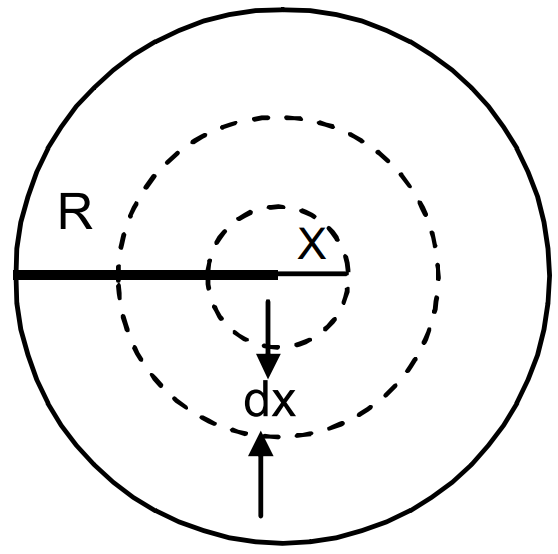
Considering a strip of width dx at a distance x from centre,

$\text{di}\frac{\text{dp}}{\text{dt}}=\frac{\text{q}4\pi\text{x}^2\text{dx}}{\Big(\frac{4}{3}\Big)\pi\text{R}^3\text{}}4\pi\text{x}^2\text{dx}$

$\text{di}=\frac{\text{dq}}{\text{dt}}=\frac{\text{q}4\pi\text{x}^2\text{dx}}{\Big(\frac{4}{3}\Big)\pi\text{R}^3\text{t}}=\frac{3\text{q}\text{x}^2\text{dx}\omega}{\text{R}^32\pi}$

$\text{d}\mu=\text{di}\times\text{A}=\frac{3\text{q}\text{x}^2\text{d}\text{x}\omega}{\text{R}^32\pi}\times4\pi\text{x}^{2\ =\ \frac{6\text{q}\omega}{\text{R}^3}\text{x}^4\text{dx}}$

$\mu=\int\limits_0^{\mu}\text{d}\mu\int\limits_0^{\text{R}}\frac{6\text{q}\omega}{\text{R}^3}\text{x}^4\text{dx}=\frac{6\text{q}\omega}{\text{R}^3}\Big[\frac{\text{x}^5}{5}\Big]_0$

$\text{R}=\frac{\text{6}\text{q}\omega\text{R}^5}{\text{R}^3}\frac{\text{R}^5}{5}=\frac{6}{5}\text{q}\omega\text{R}^2$
Need a full question paper?

Generate a complete, print-ready paper with questions like this in minutes — across 16+ boards, with answer keys.

Start Generating Free

Similar questions

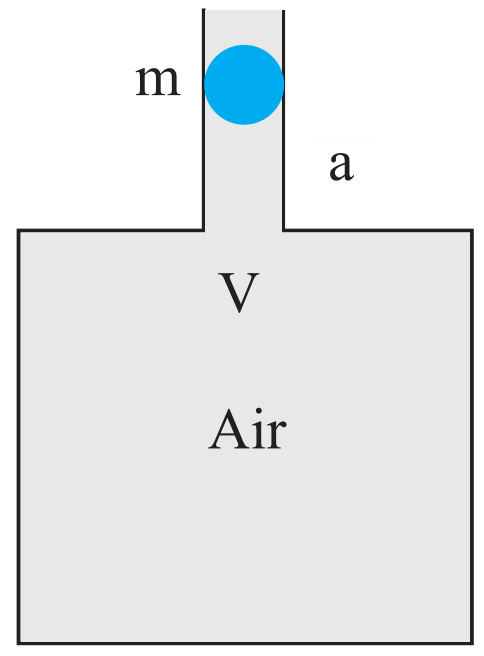
An air chamber of volume V has a neck area of cross section a into which a ball of mass m just fits and can move up and down without any friction (Fig.). Show that when the ball is pressed down a little and released , it executes SHM. Obtain an expression for the time period of oscillations assuming pressure-volume variations of air to be isothermal [see Fig.].

Write Newton's formula for the speed of sound in air. What was wrong with this formula? What correction was made by Laplace in this formula?
What is mean free path? Explain and obtain its expression and prove that $\lambda \propto T$ and $\lambda \propto \lambda_{ P }.$
  1. An electron moves along a circle of radius 1m in a perpendicular magnetic field of strength 0.50T. What would be its speed? Is it reasonable?
  2. If a proton moves along a circle of the same radius in the same magnetic field, what would be its speed?
A cylindrical piece of cork of density of base area A and height h floats in a liquid of density $\rho_1.$ The cork is depressed slightly and then released. Show that the cork oscillates up and down simple harmonically with a period $\text{T}=2\pi\sqrt{\frac{\text{h}\rho}{\rho_1\text{g}}}$ where $\rho$ is the density of cork. (Ignore damping due to viscosity of the liquid).
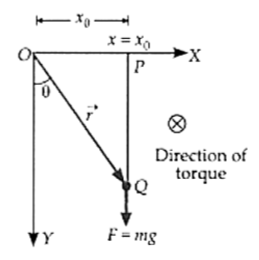
A particle of mass $m$ is released from point P at $x = x _0$ on the X -axis from origin O and falls vertically along the Y-axis, as shown in Fig.
Image

i. Find the torque $t$ acting on the particle at a time $t$ when it is at point Q with respect to O .
ii. Find the angular momentum L of the particle about O at this time t .
iii. Show that $\tau=\frac{d L}{d t}$ in this example.
Explain the motion of a boat floating in water. Find the expression of its period.
One end of a long string of linear mass density 8.0 × 10⁻³kg m–1 is connected to an electrically driven tuning fork of frequency 256Hz. The other end passes over a pulley and is tied to a pan containing a mass of 90kg. The pulley end absorbs all the incoming energy so that reflected waves at this end have negligible amplitude. At t = 0, the left end (fork end) of the string x = 0 has zero transverse displacement (y = 0) and is moving along positive y-direction. The amplitude of the wave is 5.0cm. Write down the transverse displacement y as function of x and t that describes the wave on the string.
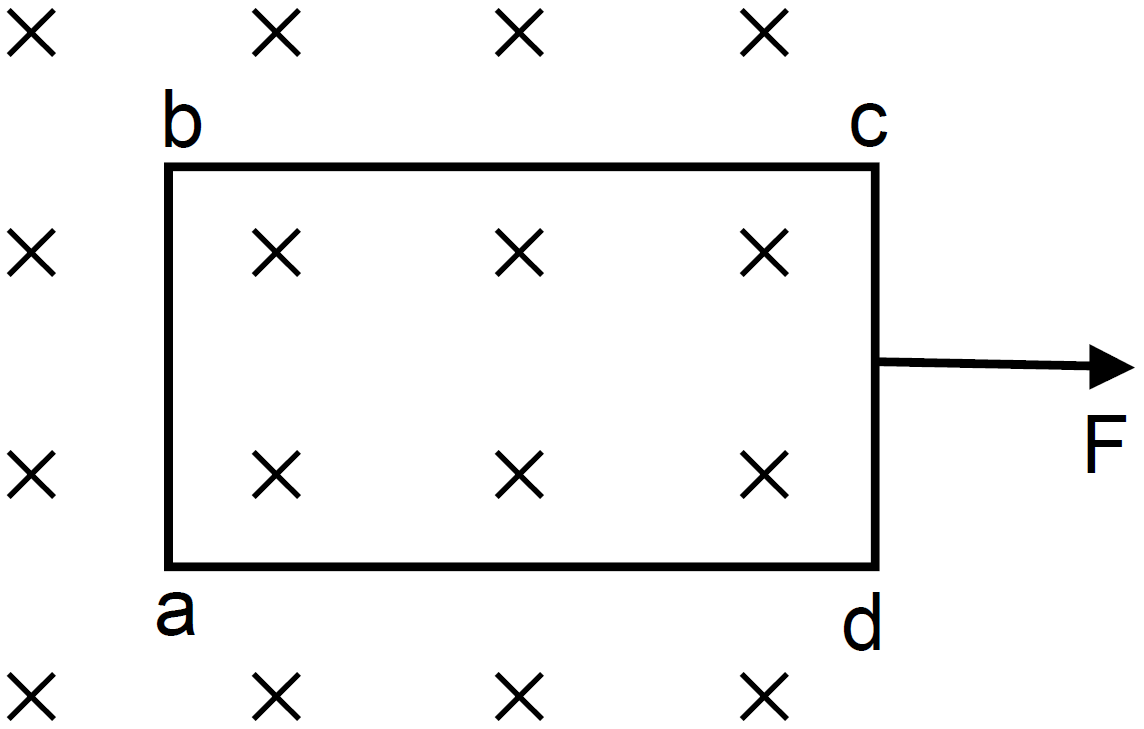
A rectangular frame of wire abcd has dimensions 32cm × 8.0cm and a total resistance of $2.0\Omega.$ It is pulled out of a magnetic field B = 0.020T by applying a force of 3.2 × 10⁻⁵N (figure). It is found that the frame moves with constant speed. Find
  1. This constant speed.
  2. The emf induced in the loop.
  3. The potential difference between the points a and b.
  4. The potential difference between the points c and d.

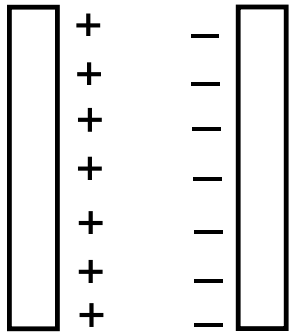
Two large conducting plates are placed parallel to each other and they carry equal and opposite charges with surface density $\sigma$ as shown in figure. Find the electric field:
  1. At the left of the plates.
  2. In between the plates.
  3. At the right of the plates.