Questions

2 Marks Questions

Take a timed test

6 questions · self-marked practice — reveal the answer and mark yourself.

Question 12 Marks
The mass of planet Jupiter is $1.9 \times 10^{27} kg$ and that of the sun is $1.99 \times 10^{30} kg$. The mean distance of Jupiter from the Sun is $7.8 \times 10^{11} m$. Calculate gravitational force which sun exerts on Jupiter, and the speed of Jupiter.
Answer
The mass of planet Jupiter is $\left( m _2\right)=1.9 \times 10^{27} kg$ 
The mass of sun is $1.99 \times 10^{30} kg$.
The mean distance of Jupiter from the Sun is $( r )=7.8 \times 10^{11} m$
$
\begin{aligned}
& F=\frac{G M m_2}{r^2} \\
& =\frac{6.67 \times 10^{-11} \times 1.99 \times 10^{30} \times 1.9 \times 10^{27}}{\left(7.8 \times 10^{11}\right)^2} \\
& F=4.1 \times 10^{23} N \\
& \therefore F=\frac{m v^2}{r} \Rightarrow v=\sqrt{\frac{F r}{m}}=\sqrt{\frac{G M m}{r^2} \times \frac{r}{m}} \\
& v=1.3 \times 10^4 ms^{-1}
\end{aligned}
$
View full question & answer
Question 22 Marks
How much below the surface of the earth does the acceleration due to gravity become $70 \%$ of its value at the surface of the earth? Radius of the earth is 6400 km .
Answer
Here, it is given that the acceleration due to gravity becomes $70 \%$ of the value on surface of the Earth at a depth d .
So, $70 \%$ value of g means $\frac{70}{100} g=0.7 g$
Hence, it is clear that g at depth d becomes $g ( d )=0.7 g$
Now, we know the formula for $g$ at depth as
$
g(d)=g\left(1-\frac{d}{R_E}\right)
$
Here, $R _{ E }$ is the radius of the Earth and g is the acceleration due to gravity on the surface of the Earth.
So, we get
$
\begin{aligned}
& 0.7 g=g\left(1-\frac{d}{R_E}\right) \\
& 0.7=1-\frac{d}{R_E} \\
& \frac{d}{R_E}=1-0.7=0.3 \\
& \therefore d=0.3 R_{E}=0.3 \times 6400=1920 km
\end{aligned}
$
Hence, we can see that at a depth of 1920 km from the surface of the Earth, the value of $g$ becomes $70 \%$ as that on surface.
View full question & answer
Question 32 Marks
What do you mean by inertia of motion? Give an example to illustrate it.
Answer
Inertia of motion is the tendency of a body to maintain its state of uniform motion. As an illustration, we observe that a person jumping out of a running train or bus falls with his head in forward direction due to the inertia of motion. Similarly, passengers experience a forward push when the driver of a bus running at high speed suddenly applies brakes.
View full question & answer
Question 42 Marks
The displacement of a progressive wave is represented by $y = A \sin (\omega t - kx )$, where x is distance and t is time. Write the dimensional formula of
i. $\omega$ and
ii. k .
Answer
Dimensional formula in L.H.S. and R.H.S. by principal of homogeneity are equal.
$\therefore$ Dimension of $y =$ dimensions of $A \sin (\omega t - kx )$
$[ L ]=[ L ] \times$ dimensions of $(\omega t - kx )$
as $(\omega t - kx )$ are angle of $\sin$ (Trigonmetrical ratio)
So $(\omega t - kx )=$ No dimension or dimensions of $\omega t =$ dimensions of kx
$
\frac{2 \pi}{T}=Kx \Rightarrow\left[M^0 L^0 T^0\right]=k[L]
$
Hence, Dimension of $k =\frac{\left[M^0 L^0 T^9\right]}{|L|}=\left[ M ^0 L^{-1} T^0\right]$, Dimension of $\omega=$ No dimension
View full question & answer
Question 52 Marks
Find the value of 60 W on a system having 100 g, 20 cm and 1 min as the fundamental units.
Answer
Given, $n _1=60 W$, power, P is $\left[ M ^1 L^2 T^{-3}\right]$
In first system, $M _1=1 kg=1000 g, L _1=1 m=100 cm$, and $T _1=1 s$
In second system, $M _2=100 g, L _2=20 cm$ and $T _2=1 min=60 s$
In a given physical quantity, the product of its magnitude and unit is always constant.
$
\begin{aligned}
& n_1 u_1=n_2 u_2 \\
& n_2=n_1\left[\frac{M_1}{M_2}\right]^1\left[\frac{L_1}{L_2}\right]^2\left[\frac{T_1}{T_2}\right]^{-3} \\
& =60\left[\frac{1000 g}{100 g}\right]\left[\frac{100 cm}{20 cm}\right]^2\left[\frac{1 s}{60 s}\right]^{-3} \\
& =60 \times \frac{1000}{100} \times \frac{100}{20} \times \frac{100}{20} \times 60 \times 60 \times 60 \\
& =3.24 \times 10^9 \text { units }
\end{aligned}
$
View full question & answer
Question 62 Marks
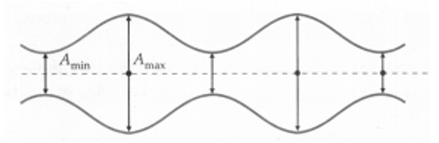
If two waves of the same frequency but of different amplitudes travelling in opposite directions through a medium superpose upon each other, will they form stationary wave? Is energy transferred? Are there any nodes?
Answer
Yes, the given waves superpose to form stationary waves of the form shown in Fig. No energy is transferred. There are no nodes but there are positions of minimum amplitude.
Image
View full question & answer