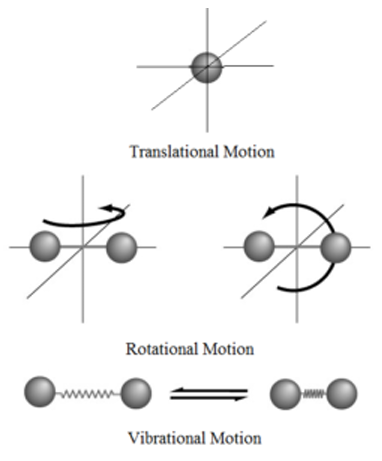
Question 14 MarksThe number of independent ways by which a dynamic system can move, without violating any constraint imposed on it, is called the number of degrees of freedom. According to the law of equipartition of energy, for any dynamic system in thermal equilibrium, the total energy for the system is equally divided among the degree of freedom.1. If gas has n degree of freedom, the ratio of specific heat is:(a) $-2 n$ (b) $2 n$ (c) $1+2 / n$ (d) $1-2 / n$2. The kinetic energy, due to translational motion, of most of the molecules of an ideal gas at absolute temperature T, is:(a) $kT ^3$ (b) $kT ^2$ (c) kT (d) $k / T$3. The mean free path is the:(a) length of the container that contains the gas(b) mean of the square of the average distance between two successive collisions(c) the average distance covered by a molecule between two successive collisions(d) height of the container that contains the gas4. The law of equipartition of energy is applicable to the system whose constituents are:(a) in non random motion (b) in random motion (c) in orderly motion (d) in restORThermochemical calorie is equal to(a) 41.48 joule (b) 4.148 joule (c) 4148 joule (d) 414.8 jouleAnswer1. (c) $1+2 / n$Explanation: $1+2 / n$2. (c) kTExplanation: kT3. (c) the average distance covered by a molecule between two successive collisionsExplanation: the average distance covered by a molecule between two successive collisions4. (b) in random motionExplanation: in random motionOR(b) 4.148 jouleExplanation: 4.148 jouleView full question & answer→
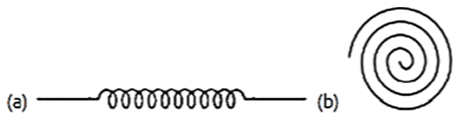
Question 24 MarksThere are many types of spring. Important among these are helical and spiral springs as shown in the figure.Usually, we assume that the springs are massless. Therefore, work done is stored in the spring in the form of the elastic potential energy of the spring. Thus, the potential energy of a spring is the energy associated with the state of compression or expansion of an elastic spring.1. The potential energy of a spring increases in which of the following cases?(a) If work is done against conservative force (b) If work is done by non-conservative force force(c) If work is done by conservative force (d) If work is done against nonconservative force2. The potential energy, i.e. $U(x)$ can be assumed zero when(a) gravitational force is constant(b) $x=0$(c) infinite distance from the gravitational source(d) All of these3. The ratio of spring constants of two springs is $2: 3$. What is the ratio of their potential energy, if they are stretched by the same force?(a) $3: 2$ (b) $9: 4$ (c) $2: 3$ (d) $4: 9$ORThe potential energy of a spring when stretched through a distance x is 10 J . What is the amount of work done on the same spring to stretch it through an additional distance $x$ ?(a) 40 J (b) 10 J (c) 30 J (d) 20 J4. The potential energy of a spring increases by 15 J when stretched by 3 cm . If it is stretched by 4 cm , the increase in potential energy is(a) 36 J (b) 30 J (c) 27 J (d) 33 JAnswer1. (a) If work is done against conservative forceExplanation: If work is done against conservative force2. (d) All of theseExplanation: All of these3. (a) $3: 2$Explanation: $3: 2$OR(c) 30 JExplanation: 30 J4. (c) 27 JExplanation: 27 JView full question & answer→