Questions

5 Marks Questions

🎯

Test yourself on this topic

6 questions · timed · auto-graded

Question 15 Marks
a. Find the moment of inertia of a sphere about a tangent to the sphere, given the moment of inertia of the sphere about any of its diameters to be $\frac{2 M R^2}{5}$, where $M$ is the mass of the sphere and $R$ is the radius of the sphere.
b. Given the moment of inertia of a disc of mass M and radius R about any of its diameters to be $\frac{M R^2}{4}$, find its moment of inertia about an axis normal to the disc and passing through a point on its edge.
Answer
a. The moment of inertia (M.I.) of a sphere about its diameter is given by $=\frac{2}{5} M R^2$
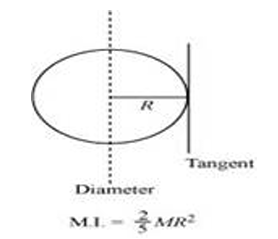
Image

Given,
Moment of inertia of the sphere about its diameter is given by $=\left(\frac{2}{5}\right) mR ^2$ Use, parallel axis theorem ,
Moment of inertia of the sphere about tangent is given by $= I + mR ^2$
$
\begin{aligned}
& =\left(\frac{2}{5}\right) mR^2+mR^2 \\
& =(7 / 5) mR^2
\end{aligned}
$
b. Moment of inertia of disc of mass m and radius R about any of its diameter is $= mR ^2 / 4$ Moment of inertia about diameter is given by $= I _{ x }= I _{ y }=\left(\frac{1}{4}\right) mR ^2$
Using, perpendicular axis theorem,
$
I_{z}=I_{x}+I_{y}
$
Where $I_{ z }$ is moment of inertia about perpendicular axis of plane of disc. Hence,
$
\begin{aligned}
& I_{Z}=\left(\frac{1}{4}\right) mR^2+\left(\frac{1}{4}\right) mR^2 \\
& =\left(\frac{1}{2}\right) mR^2
\end{aligned}
$
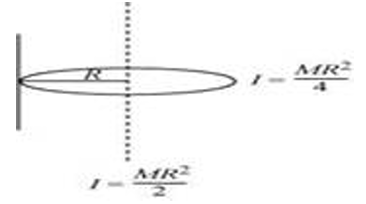
Image

Moment of inertia of disc about passing through a point of its edge is given by; Use, parallel axis theorem, we get
$
\begin{aligned}
& I=I_{Z}+mR^2 \\
& =\left(\frac{1}{2}\right) mR^2+mR^2 \\
& =\left(\frac{3}{2}\right) mR^2
\end{aligned}
$
View full question & answer
Question 25 Marks
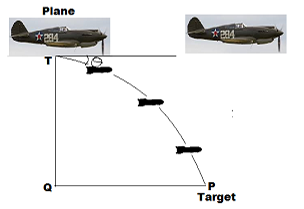
A fighter plane is flying horizontally at an altitude of 1.5 km with a speed of $720 km / h$. At what angle of sight (w.r.t horizontal) when the target is seen, should the pilot drop the bomb in order to attack the target?
Main concept used: $u =720 km / h =720 \times \frac{5}{18} m / s =200 m / s$
Answer

Image
Let the pilot drops the bomb in $t$ second before the point $Q$, vertically up the target $T$.
The horizontal velocity of the bomb will be equal to the velocity of the fighter plane, but the vertical component of it is zero.
So, in time $t$ bomb must cover the vertical distance $T Q$ as free fall with the initial velocity zero.
Given that : $u=0, H=1.5 km=1500 m, g=+10 m / s ^2$
By Using the equation, $H=u t+\frac{1}{2} g t^2$, we get
$
\begin{aligned}
& 1500=0+\frac{1}{2} 10 t^2 \\
& t=\sqrt{\frac{1500}{5}}=\sqrt{300}=10 \sqrt{3} s
\end{aligned}
$
$\therefore$ Distance covered by plane or bomb in this time $t$, is given by $PQ = ut$
$
\begin{aligned}
& P Q=200 \times 10 \sqrt{3}=2000 \sqrt{3} m \\
& \tan \theta=\frac{T Q}{P Q}=\frac{1500}{2000 \sqrt{3}} \cdot \frac{\sqrt{3}}{\sqrt{3}}=\frac{15 \sqrt{3}}{20 \times 3}=\frac{\sqrt{3}}{4} \\
& \tan \theta=\frac{1.732}{4}=0.433=\tan ^{-1} 23^{\circ} 42^{\prime} \\
& \Rightarrow \theta=23^{\circ} 42^{\prime}
\end{aligned}
$
Thus the bomb should be thrown at an angle $23^{\circ} 42^{\prime}$
View full question & answer
Question 35 Marks
Given $\vec{a}+\vec{b}+\vec{c}+\vec{d}=0$, which of the following statements are correct:
i. $\vec{a}, \vec{b}, \vec{c}$, and $\vec{d}$ must each be a null vector.
ii. The magnitude of $(\vec{a}+\vec{c})$ equals the magnitude of $(\vec{b}+\vec{d})$.
iii. The magnitude of ' $\vec{a}$ ' can never be greater than the sum of the magnitudes of $\vec{b}, \vec{c}$, and $\vec{d}$.
iv. $\vec{b}+\vec{c}$ must lie in the plane of $\vec{a}$ and $\vec{d}$ if $\vec{a}$ and $\vec{d}$ are not collinear, and in the line of $\vec{a}$ and $\vec{d}$, if they are collinear?
Answer
i. Incorrect
In order to make $\vec{a}+\vec{b}+\vec{c}+\vec{d}=0$, it is not necessary to have all the four given vectors to be null vectors. There are many other combinations that can give the sum zero.
ii. Correct
$
\begin{aligned}
& \vec{a}+\vec{b}+\vec{c}+\vec{d}=0 \\
& \vec{a}+\vec{c}=-(\vec{b}+\vec{d})
\end{aligned}
$
Taking modulus on both the sides, we get:
$
|\vec{a}+\vec{c}|=|-(\vec{b}+\vec{d})|=|\vec{b}+\vec{d}|
$
Hence, the magnitude of $(\vec{a}+\vec{c})$ is the same as the magnitude of $(\vec{b}+\vec{d})$.
iii. Correct
$
\begin{aligned}
& \vec{a}+\vec{b}+\vec{c}+\vec{d}=0 \\
& \vec{a}=(\vec{b}+\vec{c}+\vec{d})
\end{aligned}
$
Taking modulus both sides, we get:
$
\begin{aligned}
& |\vec{a}|=|\vec{b}+\vec{c}+\vec{d}| \\
& |\vec{a}| \leq|\vec{a}|+|\vec{b}|+|\vec{c}| \ldots(i)
\end{aligned}
$
Equation (i) shows that the magnitude of a is equal to or less than the sum of the magnitudes of $\vec{b}, \vec{c}$, and $\vec{d}$.
Hence, the magnitude of a vector can never be greater than the sum of the magnitudes of $b, c$, and $d$.
iv. Correct
$
\begin{aligned}
& \text { For } \vec{a}+\vec{b}+\vec{c}+\vec{d}=0 \\
& \vec{a}+(\vec{b}+\vec{c})+\vec{d}=0
\end{aligned}
$
The resultant sum of the three vectors $\vec{a},(\vec{b}+\vec{c})$, and d can be zero only if $(\vec{b}+\vec{c})$ lie in a plane containing a and d, assuming that these three vectors are represented by the three sides of a triangle.
If a and d are collinear, then it implies that the vector $(\vec{b}+\vec{c})$ is in the line of a and d . This implication holds only then the vector sum of all the vectors will be zero.
View full question & answer
Question 45 Marks
A particle executes simple harmonic motion of amplitude A.
i. At what distance from the mean position is its kinetic energy equal to its potential energy?
ii. At what points is its speed half the maximum speed?
Answer
The potential energy and kinetic energy of a particle at a displacement y are given
$
\begin{aligned}
& E_{p}=\frac{1}{2} k y^2 \\
& \text { and } E_{k}=\frac{1}{2} k\left(A^2-y^2\right)
\end{aligned}
$
where A is the amplitude and k is the force constant.
$
\begin{aligned}
& \text { i. As } E_{k}=E_{p} \\
& \therefore \frac{1}{2} k\left(A^2-y^2\right)=\frac{1}{2} k y^2 \text { or } 2 y^2=A^2 \\
& \text { or } y= \pm \frac{A}{\sqrt{2}}= \pm 0.71 A
\end{aligned}
$
$
=0.71 \text { times the amplitude on either side of the mean position. }
$
ii. Here, $v =\frac{1}{2} v_{\max }$
In general, kinetic energy
$
\begin{aligned}
& =\frac{1}{2} m v^2=\frac{1}{2} m\left(\frac{1}{2} v_{\max }\right)^2=\frac{1}{4} \cdot \frac{1}{2} m v_{\max }^2 \\
& =\frac{1}{4} \times \text { Maximum kinetic energy } \\
& \text { or } E_{k}=\frac{1}{4} \times\left(E_k\right)_{\max } \ldots \text { (ii) }
\end{aligned}
$
From equation (i),
$
\begin{aligned}
& E_{k}=\frac{1}{2} k\left(A^2-y^2\right) \\
& \therefore\left(E_{k}\right)_{\max }=\frac{1}{2} k A^2[\text { Put } y=0]
\end{aligned}
$
Putting these values in equation (ii), we get
$
\frac{1}{2} k\left(A^2-y^2\right)=\frac{1}{4} \times \frac{1}{2} k A^2
$
or $4 y ^2=3 A^2$
or $y = \pm \frac{\sqrt{3}}{2} A= \pm 0.86 A$
$=0.86$ times the amplitude on either side of the mean position.
View full question & answer
Question 55 Marks
What is Simple pendulum? Find an expression for the time period and frequency of a simple pendulum?
Image
Answer
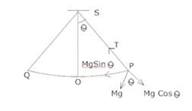
A simple pendulum is the most common example of the body executing S.H.M, it consists of heavy point mass body suspended by a weightless inextensible and perfectly flexible string from rigid support, which is free to oscillate. When a pendulum is displaced sideways from its resting, equilibrium position, it is subject to a restoring force due to gravity that will accelerate it back toward the equilibrium position. When released, the restoring force acting on the pendulum's mass causes it to oscillate about the equilibrium position, swinging back and forth. The time for one complete cycle, a left swing and a right swing, is called the period.
Let $m=$ mass of bob
l = length of a pendulum
Let O is the equilibrium position, $OP = X$
Let $\theta=$ small angle through which the bob is displaced.
The forces acting on the bob are:-
i. The weight $= Mg$ acting vertically downwards.
ii. The tension $= T$ in string acting along Ps.
Resolving Mg into 2 components as $Mg \operatorname{Cos} \theta$ and $Mg \operatorname{Sin} \theta$,
Now, $T = Mg \operatorname{Cos} \theta$
Restoring force $F =- Mg \operatorname{Sin} \theta$
$-$ ve sign shows force is directed towards mean position.
Let $\theta=\operatorname{Small}$, so $\operatorname{Sin} \theta \approx \theta=\frac{\operatorname{Arc}( op )}{1}=\frac{ x }{1}$
Hence $F =- mg \theta$
$
\left.\Rightarrow F=-mg \frac{x}{l} \rightarrow 3\right)
$
Now, In S.H.M, F = k x $\rightarrow$ )
where, $k =$ Spring constant
Equating equation 3) \& 4) for $F$
$
\Rightarrow-kx=-mg \frac{x}{l}
$
$
\Rightarrow \text { Spring factor }=k=\frac{m g}{l}
$
Inertia factor $=$ Mass of bob $= m$
Now, Time period $= T$
$
\begin{aligned}
& =2 \pi \sqrt{\frac{\text { Inertia factor }}{\text { Spring factor }}} \\
& \Rightarrow T=2 \pi \sqrt{\frac{l}{g}}
\end{aligned}
$
View full question & answer
Question 65 Marks
Determine the position of the centre of mass of a hemisphere of radius R.
Answer
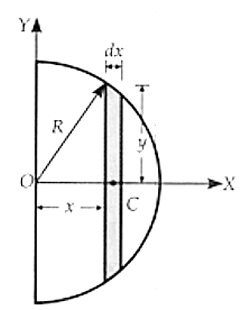
Let $\rho$ be the density of the material of the hemisphere. Take its centre O as the origin. The hemisphere can be assumed to be made of up a large number of co-axial discs. Consider one such elementary disc of radius y and thickness dx at a distance x from the origin.
Image
Mass of the elementary disc $=$ Volume $\times$ density
$
d m=\pi y^2 d x \times \rho=\pi\left(R^2-x^2\right) d x \cdot \rho
$
The coordinates of the centre of mass of the hemisphere can be determined as follows:
$
\begin{aligned}
& x_{CM}=\frac{1}{M} \int x d m=\frac{1}{M} \int_0^R x \pi\left(R^2-x^2\right) \rho d x \\
& =\frac{\pi \rho}{M} \int_0^R\left(R^2 x-x^3\right) d x=\frac{\pi \rho}{M}\left[R^2 \frac{x^2}{2}-\frac{x^4}{4}\right]_0^R \\
& =\frac{\pi \rho}{M}\left[\frac{R^4}{2}-\frac{R^4}{4}\right]=\frac{\pi \rho}{M}\left[\frac{R^4}{4}\right] \\
& =\frac{\pi \rho}{\frac{2}{3} \pi R^3 \rho}\left(\frac{R^4}{4}\right)=\frac{3}{8} R \quad\left[\because M=\frac{2}{3} \pi R^3 \times \rho\right]
\end{aligned}
$
Similarly, $y _{ CM }=\int y d m=0$ and $z_{C M}=\int z d m=0$
Hence the coordinates of the centre of mass of the hemisphere are $\left(\frac{3}{8} R, 0,0\right)$
View full question & answer
5 Marks Questions - Physics STD 11 Science Questions - Vidyadip