Questions

3 Marks Question

Take a timed test

8 questions · self-marked practice — reveal the answer and mark yourself.

Question 13 Marks
Show that the Reynold's number represents the ratio of the inertial force per unit area to the viscous force per unit area.
Answer
The physical significance of Reynold's number. Consider a narrow tube having a cross-sectional area A Suppose a fluid flows through it with a velocity v for a time interval $\Delta t$.
Length of the fluid $=$ Velocity $\times$ time $=v \Delta t$
The volume of the fluid flowing through the tube in time $\Delta t=A v \Delta t$
Mass of the fluid,
$
\Delta m=\text { Volume } \times \text { density }=Av \Delta t \times \rho
$
The inertial force acting per unit area of the fluid
$
\begin{aligned}
& =\frac{F}{A}=\frac{\text { Rate of change of momentum }}{A} \\
& =\frac{\Delta m \times v}{\Delta t \times A}=\frac{A v \Delta t \rho \times v}{\Delta t \times A}=\rho v^2
\end{aligned}
$
Viscous force per unit area of the fluid
$=\eta \times$ velocity gradient $=\eta \frac{v}{D}$
$
\frac{\text { Inertial force per unit area }}{\text { Viscous force per unit area }}=\frac{\rho v^2}{\eta v / D}=\frac{\rho v D}{\eta}=R_{e}
$
Thus Reynold's number represents the ratio of the inertial force per unit area to the viscous force per unit area.
View full question & answer
Question 23 Marks
Calculate the radius of new bubble formed when two bubbles of radius $r_1$ and $r_2$ coalesce?
Answer
Consider two soap bubbles of radii $r_1$ and $r_2$ and volumes as $V_1$ and $V_2$. Thus $V_1=\frac{4 \pi r_1^3}{3}$ and $V_2=\frac{4 \pi r_2^3}{3}$. Let S be the surface tension of the soap solution. If $P _1$ and $P _2$ are excess pressure inside the two soap bubbles then $P_1=\frac{4 S}{r_1} ; P_2=\frac{4 S}{r_2}$. Let r be the radius of the new soap bubble formed when the two soap bubble coalesces under isothermal conditions. If V and P are volume and excess of pressure inside the new soap bubble then $V=\frac{4}{3} \pi r^3 P=\frac{4 S}{r}$. As the new bubble is formed under isothermal condition, so Boyle's law holds good and hence
$
\begin{aligned}
& P_1 V_1+P_2 V_2=PV \\
& \left(\frac{4 S}{r_1} \times \frac{4}{3} \pi r_1^3\right)+\left(\frac{4 S}{r_2} \times \frac{4}{3} \pi r_2^3\right)=\frac{4 S}{r} \times \frac{4}{3} \pi r^3 \\
& \left(16 \times S \times \pi \times r_1^2\right)+\left(16 \times S \times \pi \times r_2^2\right)=16 S_{\pi r}^2 \\
& r=\sqrt{r_1^2+r_2^2}
\end{aligned}
$
View full question & answer
Question 33 Marks
The flow rate of water is $0.58 L / mm$ from a tap of diameter of 1.30 cm . After some time, the flow rate is increased to $4 L / min$. Determine the nature of the flow for both the flow rates. The coefficient of viscosity of water is $10^{-3} Pa- s$ and the density of water is $10^3 kg / m ^3$.
View full question & answer
Question 43 Marks
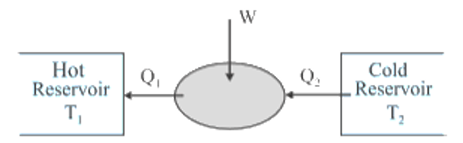
What is a refrigerator? Draw a schematic representation of a refrigerator.
Answer
A refrigerator or a heat pump is a heat engine working in reverse direction.
In the refrigerator, we have 2 bodies, lower temperature (cold) body which is freezer and higher temperature (hot) body which is surroundings. It takes heat from the cold reservoir and then some work is done on the refrigerator and then the amount of heat is transferred to the hot reservoir. Let $Q _2$ be the heat takes from the cold reservoir, W is the work done on the system and then releases $Q _1$ amount of heat to the hot reservoir.
Mathematically, $Q _2+ W = Q _1$
The schematic representation of a refrigerator has been shown in the following Figure. Here the refrigerator extracts heat $Q _2$ from a cold reservoir at temperature $T_2$, work $W$ is done on it and finally, it rejects $Q_1\left(=Q_2+W\right)$ heat to surroundings (hot reservoir) maintained at a higher temperature $T _1$.
Image
The efficiency of the refrigerator can be calculated from the coefficient of performance of the refrigerator, $\alpha=\frac{Q_2}{Q_1-Q_2}$
View full question & answer
Question 53 Marks
A monkey of mass 40 kg climbs on a rope which can stand a maximum tension 600 N . In which of the following cases will the rope break?
The monkey
a. climbs up with an acceleration of $6 m / s ^2$
b. climbs down with an acceleration of $4 m / s ^2$
c. climbs up with a uniform speed of $5 m / s$
d. falls down the rope freely under gravity. Take $g=10 m / s ^2$ and ignore the mass of the rope.
Answer
mass of the monkey, $m =40 kg$,
Tensile strength of the rope, $T =600 N$ (max tension rope can hold without breaking)
Here, the rope will break if reaction (R) exceeds the tension (T) applied, i.e. $R > T$
a. $a =6 m / s ^2$
For upward accelerated motion the net acceleration is $(g+a)$ instead of $g$, hence $R=m(g+a)=40(10+6)=640 N$. Therefore the rope will break, as $R > T$
b. $a =4 m / s ^2$
For downward accelerated motion the net acceleration is $(g-a)$ instead of $g$, hence $R=m(g-a)=40(10-6)=240 N$. Therefore the rope will not break as $R < T$
c. $v =5 m / s$ (constant) a $=0$
$R = mg =40 \times 10=400 N$. Therefore the rope will not break as $R < T$
d. For freefall, net acceleration on the body is zero, $a=g ; R=m(g-a)=m(g-g)$. Therefore $R=$ zero (Rope will not break)
View full question & answer
Question 63 Marks
A railway car of mass 20 tonnes moves with an initial speed of $54 km / hr$. On applying brakes, a constant negative acceleration of $0.3 m / s ^2$ is produced.
i. What is the breaking force acting on the car?
ii. In what time it will stop?
iii. What distance will be covered by the car before it finally stops?
Answer
Mass of the railway car,m $=20$ tonnes $=20 \times 1000 kg=20 \times 10^4 kg$, Initial speed, $u =54 km / hr =54 \times \frac{5}{18}=15 m / s$
Negative acceleration, $a=-0.3 m / s ^2$
a. Breaking force acting on the car, $F =- ma$
$
\begin{aligned}
& F=-\left(2 \times 10^4 kg\right) \times\left(-0.3 ms^{-2}\right) \\
& F=6000 N
\end{aligned}
$
b. When the railway car stops, its final velocity is zero.
i.e. $v=0$
Using the relation: $v-u=a t$
$
\begin{aligned}
& \Rightarrow 0=15+(-0.3) t \\
& \Rightarrow t=50 s
\end{aligned}
$
c. Using the relation : $v^2-u^2=2 a s$
$
\begin{aligned}
& \Rightarrow 0-(15)^2=2(-0.3) s \\
& \Rightarrow s=375 m
\end{aligned}
$
View full question & answer
Question 73 Marks
On a foggy day two drivers spot each other when they are just 80 metres apart. They are travelling at $72 km h ^{-1}$ and $60 km h ^{-1}$, respectively. Both of them applied brakes retarding their cars at the rate of $5 ms^{-2}$. Determine whether they avert collision or not.
Answer
For the first car :
$
u=72 kmh^{-1}=20 ms^{-1}, v=0, a=-5 ms^{-2}
$
As $v^2-u^2=2$ as
$
\therefore 0^2-20^2=2(-5) s_1
$
Distance covered by first car, $s _1=40 m$
For the second car :
$
\begin{aligned}
& u=60 kmh^{-1}=\frac{60 \times 5}{18} \\
& =\frac{50}{3} ms^{-1}, v=0, a=-5 ms^{-2}
\end{aligned}
$
As $v ^2- u ^2=2$ as
$
\therefore 0^2-\left(\frac{50}{3}\right)^2=2(-5) s_2
$
Distance covered by second car,
$
s_2=\frac{2500}{9 \times 10}=27.78 m
$
Total distance covered by the two cars
$
=s_1+s_2=40+27.78=67.78 m
$
As this distance is less than the initial distance $(=80 m)$ between the two cars, so the collision will be averted.
View full question & answer
Question 83 Marks
Two vessels A and B of different materials but having identical shape, size and wall thickness are filled with ice and kept at the same place. Ice melts at the rate of $100 g min ^{-1}$ and $150 g min ^{-1}$ in $A$ and $B$, respectively. Assuming that heat enters the vessels through the walls only, calculate the ratio of thermal conductivities of their materials.
Answer
Suppose $m_1$ and $m_2$ be the masses of ice melted at the same time $(t=1 min)$ in vessels $A$ and $B$, respectively.
The amounts of heat flowed into the two vessels will be
$
\begin{aligned}
& Q_1=\frac{K_1 A\left(T_1-T_2\right) t}{x}=m_1 L \\
& Q_2=\frac{K_2 A\left(T_1-T_2\right) t}{x}=m_2 L
\end{aligned}
$
where $L$ is latent heat of ice.
Dividing Equation (i) by Equation (ii)
$
\Rightarrow \frac{K_1}{K_2}=\frac{m_1}{m_2}=\frac{100 g}{150 g}=\frac{2}{3}=2: 3
$
View full question & answer
3 Marks Question - Physics STD 11 Science Questions - Vidyadip