Question types

Model Paper 2 question types

38 questions across 6 question groups — pick any mix to generate a Physics paper with step-by-step answer keys.

38
Questions
6
Question groups
5
Question types
Sample Questions

Model Paper 2 questions

One sample from each question group in this chapter. Select any group above to see the full set with answer keys.

Average distance of the earth frorn the sun is $L _1$. If one year of the earth $= D$ days, one year of another planet whose average distance from the sun is $L _2$ will be:
  • A
    $D\left(\frac{L_2}{L_1}\right)^{\frac{1}{2}}$ days
  • B
    $D\left(\frac{L_2}{L_1}\right)^{\frac{2}{3}}$
  • C
    $D\left(\frac{L_2}{L_1}\right)^{\frac{3}{2}}$ days
  • D
    $D\left(\frac{L_2}{L_1}\right)$
View full solution
A solid sphere of volume V and density $\rho$ floats at the interface of two immiscible liquids of densities $\rho_1$ and $\rho_2$ respectively. If $\rho_1<\rho<\rho_2$, then the ratio of the volume of the parts of the sphere in upper and lower liquids is
  • A
    $\frac{\rho+\rho_2}{\rho+\rho_1}$
  • B
    $\frac{\rho-\rho_1}{\rho_2-\rho}$
  • C
    $\frac{\rho_2-\rho}{\rho-\rho_1}$
  • D
    $\frac{\rho+\rho_1}{\rho+\rho_2}$
View full solution
When 1 m, 1 kg and 1 min are taken as the fundamental units, the magnitude of the force is 36 units. What will be the value of this force in CGS system?
  • A
    $10^4$ dyne
  • B
    $10^8$ dyne
  • C
    $10^3$ dyne
  • D
    $10^5$ dyne
View full solution
A body A of mass 0.5 kg and specific heat 0.85 is at a temperature of $60^{\circ} C$. Another body B of mass 0.3 kg and specific heat 0.9 is at a temperature of $90^{\circ} C$. When they are connected to a conducting rod, heat will flow from
  • A
    B to A
  • B
    A to B
  • C
    first A to B then B to A
  • D
    heat can't flow
View full solution
The time period of a satellite is related to the density of earth $(\rho)$ as:
  • A
    $\rho$
  • B
    $\rho^{\frac{1}{2}}$
  • C
    $\rho^{\frac{-1}{2}}$
  • D
    $\rho^{\frac{-3}{2}}$
View full solution
Assuming the earth to be a uniform sphere of radius 6400 km and density $5.5 gcm ^{-3}$, find the value of g on its surface. Given G $=6.66 \times 10^{-11} Nm ^2 kg^{-2}$.
View full solution
Q 133 Marks Question3 Marks
The flow rate of water is $0.58 L / mm$ from a tap of diameter of 1.30 cm . After some time, the flow rate is increased to $4 L / min$. Determine the nature of the flow for both the flow rates. The coefficient of viscosity of water is $10^{-3} Pa- s$ and the density of water is $10^3 kg / m ^3$.
View full solution
Q 153 Marks Question3 Marks
A monkey of mass 40 kg climbs on a rope which can stand a maximum tension 600 N . In which of the following cases will the rope break?
The monkey
a. climbs up with an acceleration of $6 m / s ^2$
b. climbs down with an acceleration of $4 m / s ^2$
c. climbs up with a uniform speed of $5 m / s$
d. falls down the rope freely under gravity. Take $g=10 m / s ^2$ and ignore the mass of the rope.
View full solution
Q 164 Marks Question4 Marks
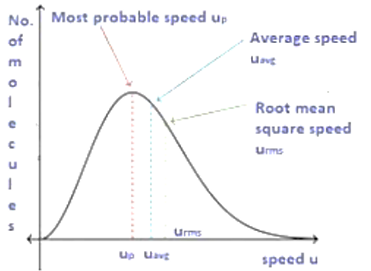
Root mean square velocity (RMS value)is the square root of the mean of squares of the velocity of individual gas molecules and the Average velocity is the arithmetic mean of the velocities of different molecules of a gas at a given temperature.
Image
1. Moon has no atmosphere because:
(a) the escape velocity of the moon’s surface is more than the r.m.s velocity of all molecules
(b) it is far away from the surface of the earth
(c) the r.m.s. velocity of all the gas molecules is more than the escape velocity of the moon’s surface
(d) its surface temperature is $10^{\circ} C$
2. For an ideal gas, $\frac{C_P}{C_V}$ is
(a) $\leq 1$    (b) none of these    (c) $>1$    (d) $<1$
3. The root means square velocity of hydrogen is $\sqrt{5}$ times that of nitrogen. If $T$ is the temperature of the gas then:
(a) $T\left(H_2\right)=T\left(N_2\right)$    (b) $T \left( H _2\right)< T \left( N _2\right)$
(c) $T \left( H _2\right) \neq T \left( N _2\right)$    (d) $T \left( H _2\right)> T \left( N _2\right)$
4. Suppose the temperature of the gas is tripled and $N _2$ molecules dissociate into an atom. Then what will be the rms speed of atom:
(a) $v_0 \sqrt{2}$    (b) $v_0 \sqrt{6}$    (c) $v_0 \sqrt{3}$    (d) $v_0$
OR
The velocities of the molecules are $v , 2 v , 3 v , 4 v \& 5 v$. The RMS speed will be:
(a) 11 v    (b) $v (12)^{11}$   (c) v    (d) $v (11)^{12}$
View full solution
Q 174 Marks Question4 Marks
View full solution
Derive an expression for the moment of inertia of a thin uniform rod about an axis passing through its one end and perpendicular to its length. Also determine the radius of gyration about the same axis.
View full solution
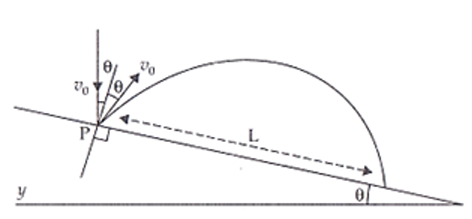
A particle falling vertically from a height hits a plane surface inclined to horizontal at an angle with speed $v_0$ and rebounds elastically as shown in the figure. Find the distance along the plane where it will hit the second time.
Image
Hint:
i. After rebound, particle still has speed $V_0$ to start.
ii. Work out angle particle speed has with horizontal after it rebounds.
iii. Rest is similar to if particle is projected up the incline.]
View full solution
A projectile is projected horizontally with a velocity u. Show that its trajectory is parabolic. And obtain expressions for:
i. Time of flight
ii. Horizontal range
iii. Velocity at any instant $t$.
View full solution
From a uniform disk of radius R , a circular hole of radius $\frac{R}{2}$ is cut out. The centre of the hole is at $\frac{R}{2}$ from the centre of the original disc. Locate the centre of gravity of the resulting flat body.
View full solution
Assertion (A): A planet moves faster, when it is closer to the sun in its orbit and vice versa.
Reason (R): Orbital velocity in orbital of planet is constant.
  • A
    Both A and R are true and R is the correct explanation of A.
  • B
    Both A and R are true but R is not the correct explanation of A.
  • C
    A is true but R is false.
  • D
    A is false but R is true.
View full solution
Assertion: When percentage errors in the measurement of mass and velocity are $1 \%$ and $2 \%$ respectively, the percentage error in KE is $5 \%$.
Reason: $\frac{\Delta E}{E}=\frac{\Delta m}{m}+\frac{2 \Delta v}{v}$
  • A
    Assertion and reason both are correct statements and reason is correct explanation for assertion.
  • B
    Assertion and reason both are correct statements but reason is not correct explanation for assertion.
  • C
    Assertion is correct statement but reason is wrong statement.
  • D
    Assertion is wrong statement but reason is correct statement.
View full solution
Assertion (A): If $\vec{A} \cdot \vec{B}=\vec{B} \cdot \vec{C}$, then $\vec{A}$ may not always be equal to $\vec{C}$.
Reason (R): The dot product of two vectors involves cosine of the angle between the two vectors.
  • A
    Both A and R are true and R is the correct explanation of A.
  • B
    Both A and R are true but R is not the correct explanation of A.
  • C
    A is true but R is false.
  • D
    A is false but R is true.
View full solution
Assertion (A): State variables are required to specify the equilibrium state of the system.
Reason (R): Pressure is an intensive state variable.
  • A
    Both A and R are true and R is the correct explanation of A.
  • B
    Both A and R are true but R is not the correct explanation of A.
  • C
    A is true but R is false.
  • D
    A is false but R is true.
View full solution

Generate a Model Paper 2 paper free

Pick question groups from the list above, set marks and difficulty, and export a branded PDF with step-by-step answer keys. First 3 chapters free — no signup.

Download App