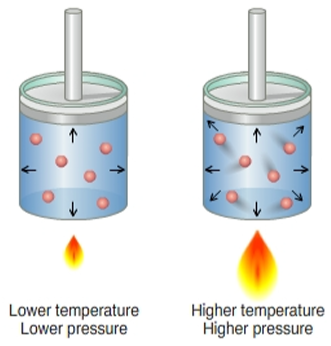
Question 14 MarksIn a gas the particles are always in a state of random motion, all the particles move at different speed constantly colliding and changing their speed and direction, as speed increases it will result in an increase in its kinetic energy.1.If the temperature of the gas increases from 300 K to 600 K then the average kinetic energy becomes:(a) same (b) becomes double (c) becomes half (d) become triple2.What is the average velocity of the molecules of an ideal gas?(a) Infinite (b) Same (c) Increase (d) Zero3.Cooking gas containers are kept in a lorry moving with uniform speed. The temperature of the gas molecules inside will $\qquad$(a) decrease (b) Rises (c) increase (d) remains same4.Find the ratio of average kinetic energy per molecule of Oxygen and Hydrogen:(a) $1: 1$ (b) $4: 1$ (c) $1: 2$ (d) $1: 4$ORThe velocities of the three molecules are $3 v , 4 v$, and 5 v . calculate their root mean square velocity?(a) 4.0 v (b) 4.02 v (c) 4.08 v (d) 4.04 vAnswer1. (b) becomes doubleExplanation: becomes double2. (d) ZeroExplanation: Zero3. (d) remains sameExplanation: remains same4. (a) $1: 1$Explanation: 1:1OR(c) 4.08 vExplanation: 4.08 vView full question & answer→
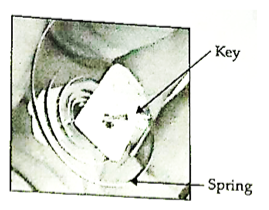
Question 24 MarksClockwork refers to the inner workings of mechanical clock or watch (where it is known as "movement") and different types of toys which work using a series of gears driven by a spring. Clockwork device is completely mechanical and its essential parts are:- A key (or crown) which you wind to add energy- A spiral spring in which the energy is stored- A set of gears through which the spring's energy is released. The gears control how quickly (or slowly) a clockwork machine can do things. Such as in mechanical clock/watch the mechanism is the set of hands that sweep around the dial to tell the time. In a clockwork car toy, the gears drive the wheels.Winding the clockwork with the key means tightening a sturdy metal spring, called the mainspring. It is the process of storing potential energy. Clockwork springs are usually twists of thick steel, so tightening them (forcing the spring to occupy a much smaller space) is actually quite hard work. With each turn of the key, fingers do work and potential energy is stored in the spring. The amount of energy stored depends on the size and tension of the spring. Harder a spring is to turn and longer it is wound, the more energy it stores.While the spring uncoils, the potential energy is converted into kinetic energy through gears, cams, cranks and shafts which allow wheels to move faster or slower. In an ancient clock, gears transform the speed of a rotating shaft so that it drives the second hand at one speed, the minute hand at $\frac{1}{60}$ of that speed, and the hour hand at $\frac{1}{3600}$ of that speed. Clockwork toy cars often use gears to make themselves race along at surprising speed.1. What is the meaning of movement of old age mechanical clocks?(a) The pendulum of the clock(b) The gears which move the hands of the clock(c) A spring and combination of gears which move the hands of the clock(d) The hands of the clock2. What type of energy is stored in the spring while winding it?(a) Potential (b) Heat (c) Both kinetic and potential (d) Kinetic3. When the spring of a clockwork uncoils(a) Kinetic energy is converted into potential energy(b) Potential energy is converted into kinetic(c) Potential energy is converted into heat, light and sound energy(d) Kinetic energy is converted into heat, light and sound energyORIn clockwork devices, ________ transform the speed of a rotating ________ to drive wheels slower or faster.(a) Shaft, spring (b) shaft, gear (c) Gear, Shaft (d) Spring, gear4. More energy is stored in a spring if the(a) Spring is larger, harder and wound fur a longer time(b) Spring is smaller, harder and wound for a shorter time(c) Spring is larger, harder and wound for aAnswer1. (c) A spring and combination of gears which move the hands of the clockExplanation: Movement refers to the inner workings of mechanical clock using a series of gears driven by a spring.2. (a) PotentialExplanation: Winding the spring means tightening a sturdy metal spring. It is the process of storing potential energy (forcing the spring to occupy a much smaller space) is actually quite hard work. With each turn of the key, fingers do work and potential energy is stored in the spring.3. (b) Potential energy is converted into kineticExplanation: When the spring uncoils, the potential energy is converted into kinetic energy through gears, cams, cranks and shafts which allow wheels to move faster or slower.OR(c) Gear, ShaftExplanation: In an ancient clock, gears transform the speed of a rotating shaft so that it drives the second hand at one speed, the minute hand at $\frac{1}{60}$ of that speed, and the hour hand at $\frac{1}{3600}$ of that speed. Clockwork toy cars often use gears to make themselves race along at surprising speed.4. (a) Spring is larger, harder and wound fur a longer timeExplanation: With each turn of the key, fingers do work and potential energy is stored in the spring. The amount of energy stored depends on the size and tension of the spring. Harder a spring is to turn and longer it is wound, the more energy it stores.View full question & answer→