Question types

Model Paper 4 question types

38 questions across 6 question groups — pick any mix to generate a Physics paper with step-by-step answer keys.

38
Questions
6
Question groups
5
Question types
Sample Questions

Model Paper 4 questions

One sample from each question group in this chapter. Select any group above to see the full set with answer keys.

In a streamline flow,
i. the speed of a particle always remains same
ii. the velocity of a particle always remains same
iii. the kinetic energies of all the particles arriving at a given point are the same iv. the potential energies of all the particles arriving at a given point are the same
  • A
    Statement (iv) is correct.
  • B
    Statement (ii) is correct.
  • C
    Statement (i) is correct.
  • D
    Statement (iii) is correct.
View full solution
If the length of a closed organ pipe is 1 m and velocity of sound is $330 m / s$, then the frequency for the second note is
  • A
    $3 \times \frac{330}{4} Hz$
  • B
    $2 \times \frac{4}{330} Hz$
  • C
    $4 \times \frac{330}{4} Hz$
  • D
    $2 \times \frac{330}{4} Hz$
View full solution
A body of mass 2.0 kg and radius of gyration 0.5 m is rotating about an axis. If its angular speed is $2.0 rad / s$, the angular momentum of the body (in $kg - m ^2 / s$ ) is:
  • A
    $2.0$
  • B
    $0.5$
  • C
    $1.5$
  • D
    $1.0$
View full solution
A small object of uniform density rolls up a curved surface with an initial velocity v'. If reaches up to a maximum height of $\frac{3 v^2}{4 g}$ with respect to the initial position. The object is
  • A
    solid sphere
  • B
    ring
  • C
    disc
  • D
    hollow sphere
View full solution
There are two bodies of masses 1 kg and 100 kg separated by a distance 1 m. At what distance from the smaller body, the intensity of gravitational field will be zero?
  • A
    $\frac{10}{11} m$
  • B
    $\frac{1}{9} m$
  • C
    $\frac{1}{11} m$
  • D
    $\frac{1}{10} m$
View full solution
If the mass of the sun is $2 \times 10^{30} kg$, the distance of the earth from the sun is $1.5 \times 10^{11} m$ and period of revolution of the earth around the sun is one year ( $=365.3$ days), calculate the value of gravitational constant.
View full solution
Calculate the energy required to move an earth satellite of mass $10^3 kg$ from a circular orbit of radius 2 R to that of radius 3R. Given mass of the earth, $M=5.98 \times 10^{24} kg$ and radius of the earth, $R=6.37 \times 10^6 m$.
View full solution
A rocket with a lift-off mass $20,000 kg$ is blasted upwards with an initial acceleration of $5.0 ms^{-2}$. Calculate the initial thrust (force) of the blast.
View full solution
Q 113 Marks Question3 Marks
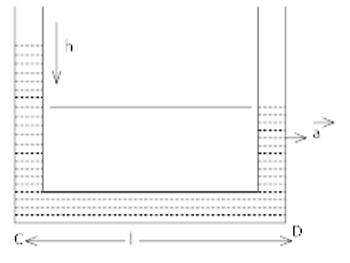
A liquid stands at the same level in the $U$ - tube when at rest. If $A$ is the area of cross section of tube and $g$ is the acceleration due to gravity, what will be the difference in height of the liquid in the two limbs when the system is given acceleration 'a'?
Image
View full solution
Q 123 Marks Question3 Marks
The efficiency of a Carnot engine is $1 / 2$. If the sink tem perature is reduced by $100^{\circ} C$, then engine efficiency becomes $2 / 3$. Find
i. sink temperature
ii. source temperature
iii. Explain, why a Carnot engine cannot have $100 \%$ efficiency?
View full solution
Q 133 Marks Question3 Marks
What is the pressure inside the drop of mercury of radius 3.00 mm at room temperature? Surface tension of mercury at that temperature $\left(20^{\circ} C \right)$ is $4.65 \times 10^{-1} Nm ^{-1}$. The atmospheric pressure is $1.01 \times 10^5 Pa$. Also give the excess pressure inside the drop.
View full solution
Q 143 Marks Question3 Marks
If a number of little droplets of water, each of radius $r$, coalesce to form a single drop of radius $R$, show that the rise in temperature will be given by $\Delta \theta=\frac{3 \sigma}{J}\left(\frac{1}{r}-\frac{1}{R}\right)$ where $\sigma$ is the surface tension of water and J is the mechanical equivalent of heat.
View full solution
Q 164 Marks Question4 Marks
View full solution
Q 174 Marks Question4 Marks
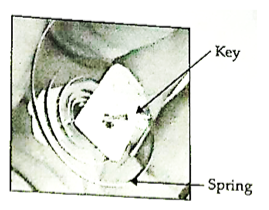
Clockwork refers to the inner workings of mechanical clock or watch (where it is known as "movement") and different types of toys which work using a series of gears driven by a spring. Clockwork device is completely mechanical and its essential parts are:
- A key (or crown) which you wind to add energy
- A spiral spring in which the energy is stored
- A set of gears through which the spring's energy is released. The gears control how quickly (or slowly) a clockwork machine can do things. Such as in mechanical clock/watch the mechanism is the set of hands that sweep around the dial to tell the time. In a clockwork car toy, the gears drive the wheels.
Winding the clockwork with the key means tightening a sturdy metal spring, called the mainspring. It is the process of storing potential energy. Clockwork springs are usually twists of thick steel, so tightening them (forcing the spring to occupy a much smaller space) is actually quite hard work. With each turn of the key, fingers do work and potential energy is stored in the spring. The amount of energy stored depends on the size and tension of the spring. Harder a spring is to turn and longer it is wound, the more energy it stores.
Image
While the spring uncoils, the potential energy is converted into kinetic energy through gears, cams, cranks and shafts which allow wheels to move faster or slower. In an ancient clock, gears transform the speed of a rotating shaft so that it drives the second hand at one speed, the minute hand at $\frac{1}{60}$ of that speed, and the hour hand at $\frac{1}{3600}$ of that speed. Clockwork toy cars often use gears to make themselves race along at surprising speed.

1. What is the meaning of movement of old age mechanical clocks?
(a) The pendulum of the clock
(b) The gears which move the hands of the clock
(c) A spring and combination of gears which move the hands of the clock
(d) The hands of the clock
2. What type of energy is stored in the spring while winding it?
(a) Potential  (b) Heat  (c) Both kinetic and potential  (d) Kinetic
3. When the spring of a clockwork uncoils
(a) Kinetic energy is converted into potential energy
(b) Potential energy is converted into kinetic
(c) Potential energy is converted into heat, light and sound energy
(d) Kinetic energy is converted into heat, light and sound energy
OR
In clockwork devices, ________ transform the speed of a rotating ________ to drive wheels slower or faster.
(a) Shaft, spring  (b) shaft, gear  (c) Gear, Shaft  (d) Spring, gear
4. More energy is stored in a spring if the
(a) Spring is larger, harder and wound fur a longer time
(b) Spring is smaller, harder and wound for a shorter time
(c) Spring is larger, harder and wound for a

View full solution
A projectile is fired horizontally with a velocity of $98 ms^{-1}$ from the hill 490 m high. Find
i. time taken to reach the ground
ii. the distance of the target from the hill and
iii. the velocity with which the projectile strikes the ground.
View full solution
You are riding in an automobile of mass 3000 kg . Assuming that you are examining the oscillation characteristics of its suspension system. The suspension sags 15 cm when the entire automobile is placed on it. Also, the amplitude of oscillation decreases by $50 \%$ during one complete oscillation. Estimate the values of
a. the spring constant $k$ and
b. the damping constant b for the spring and shock absorber system of one wheel, assuming that each wheel supports 750 kg .
View full solution
Two particles each of mass m and speed v travel in opposite direction along parallel lines, separated by a distance d. Show that vector angular momentum of the two particles system is same whatever be the point about which angular momentum is taken.
View full solution
Obtain an expression for the linear acceleration of a cylinder rolling down an inclined plane and hence find the condition for the cylinder to roll down without slipping.
View full solution
A projectile is projected horizontally with a velocity $u$. Show that its trajectory is parabolic. And obtain expressions for:
i. Time of flight
ii. Horizontal range
iii. Velocity at any instant $t$.
View full solution
Assertion: An artificial satellite is moving in a circular orbit of the earth. If the gravitational pull suddenly disappears, then it moves with the same speed tangential to the original orbit.
Reason: The orbital speed of a satellite decreases with the increase in radius of the orbit.
  • A
    Assertion and reason both are correct statements and reason is correct explanation for assertion.
  • B
    Assertion and reason both are correct statements but reason is not correct explanation for assertion.
  • C
    Assertion is correct statement but reason is wrong statement.
  • D
    Assertion is wrong statement but reason is correct statement.
View full solution
Assertion (A): Two particle of different mass, projected with same velocit, the maximum height attained by both the particle will be same.
Reason (R): The maximum height of projectile is independent of patricle mass. is equal to maximum height attained by projectile.
  • A
    Both A and R are true and R is the correct explanation of A.
  • B
    Both A and R are true but R is not the correct explanation of A.
  • C
    A is true but R is false.
  • D
    A is false but R is true.
View full solution
Assertion (A): Work done over a closed path is always zero.
Reason (R): No force is required in a closed path.
  • A
    Both A and R are true and R is the correct explanation of A.
  • B
    Both A and R are true but R is not the correct explanation of A.
  • C
    A is true but R is false.
  • D
    A is false but R is true.
View full solution
Assertion (A): A gas has a unique value of specific heat.
Reason (R): Specific heat is defined as the amount of heat required to raise the temperature of unit mass of the substance through unit degree.
  • A
    Both A and R are true and R is the correct explanation of A.
  • B
    Both A and R are true but R is not the correct explanation of A.
  • C
    A is true but R is false.
  • D
    A is false but R is true.
View full solution

Generate a Model Paper 4 paper free

Pick question groups from the list above, set marks and difficulty, and export a branded PDF with step-by-step answer keys. First 3 chapters free — no signup.

Download App