Questions

2 Marks Questions

🎯

Test yourself on this topic

6 questions · timed · auto-graded

Question 12 Marks
Two waves of equal frequencies have their amplitudes in the ratio of $3: 5$. They are superimposed on each other. Calculate the ratio of $I _{\text {max }} / I _{\text {min }}$.
Answer

$\begin{aligned} & \text { Ratio of amplitudes(given) }=\frac{A_1}{A_2}=\frac{3}{5} \Rightarrow \sqrt{\frac{I_1}{I_2}}=\frac{3}{5}[\text { as } A \propto \sqrt{I}] \\ & \text { Now, } \frac{I_{\max }}{I_{\min }}=\left(\frac{\sqrt{I_1}+\sqrt{I_2}}{\sqrt{I_1}-\sqrt{I_2}}\right)^2=\left(\frac{\sqrt{I_1 / I_2}+1}{\sqrt{I_1 / I_2}-1}\right)^2 \\ & =\left(\frac{3 / 5+1}{3 / 5-1}\right)^2 \\ & =\frac{64}{4}=\frac{16}{1}=16: 1\end{aligned}$
View full question & answer
Question 22 Marks
Calculate the energy required to move a body of mass $m$ from an orbit of radius $2 R$ to $3 R$.
Answer
Gravitational PE of mass m in orbit of radius $R=U=-\frac{G M m}{R}$
$
\begin{aligned}
& \therefore U_i=\frac{G M m}{2 R} \\
& U_f=-\frac{G M m}{3 R}
\end{aligned}
$
Energy required = Potential energy of the Earth(mass system when mass is at distance 3R) - Potential energy of the Earth (mass system when mass is at distance 2R)
$
\begin{aligned}
& \Delta U=U_f-U_i=G M m\left[\frac{1}{3}-\frac{1}{2}\right] \\
& =\frac{G M m}{6 R}
\end{aligned}
$
View full question & answer
Question 32 Marks
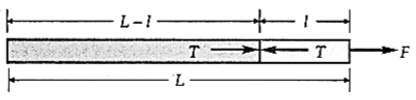
A uniform rope of length $L$, resting on a frictionless horizontal surface is pulled at one end by a force $F$. What is the tension in the rope at a distance 1 from the end where the force is applied?
Answer
Let $M$ be the mass of uniform rope of length $L$. 
Then Mass per unit length of rope $=\frac{M}{L}$ 
Acceleration in the rope $=\frac{F}{M}$
Image
Let T be the tension in the rope at a distance l from the end where the force F is applied.
Mass of length $( L - l )$ of the rope is
$
M^{\prime}=\frac{M}{L}(L-l)
$
As tension T is the only force on the length ( $L - l$ ) of the rope, so
$
T=M^{\prime} \times \frac{F}{M}=\frac{M}{L}(L-l) \times \frac{F}{M}=\left(1-\frac{l}{L}\right) F
$
View full question & answer
Question 42 Marks
Subtract $2.5 \times 10^{-6}$ from $4.0 \times 10^{-4}$ with due regard to significant figures.
Answer
Let $x =2.5 \times 10^{-6}=0.0000025(2$ significant figures $)$
$y=4.0 \times 10^{-4}=0.00040$ ( 2 significant figures)
$\therefore y - x =0.00040-0.0000025=0.0003975$
$=3.975 \times 10^{-4}=4.0 \times 10^{-4}$ [Rounded off upto 2 significant figures]
View full question & answer
Question 52 Marks
The orbital velocity $\nu$ of a satellite may depend on its mass $m$, distance $r$ from the centre of earth and acceleration due to gravity g. Obtain an expression for orbital velocity.
View full question & answer
Question 62 Marks
The acceleration due to gravity at the moon's surface is $1.67 ms^{-2}$. If the radius of the moon is $1.74 \times 10^6 m$, then calculate the mass of the moon.
Answer
$
g=\frac{G M}{R^2} \text { or } M=\frac{g R^2}{G}
$
This relation is true not only to the earth but for any heavenly body which is assumed to be spherical.
Now, $g=1.67 ms^{-2}, R=1.74 \times 10^6 m$
$
G=6.67 \times 10^{-11} Nm^{-2} kg^{-2}
$
$\therefore$ Mass of the moon, $M =\frac{1.67 \times\left(1.74 \times 10^6\right)^2}{6.67 \times 10^{-11}} kg$
$
=7.58 \times 10^{22} kg
$
View full question & answer
2 Marks Questions - Physics STD 11 Science Questions - Vidyadip