Questions

3 Marks Question

Take a timed test

8 questions · self-marked practice — reveal the answer and mark yourself.

Question 13 Marks
Specific heat of Argon at constant Pressure is $0.125 cal / g / K$ and at constant volume is $0.075 cal / g / K$. Calculate the density of Argon at N.T.P. Given that $J =4.2$ Joule/cal?
Answer
Specific heat of argon at constant pressure, $C _{ P }=0.125 cal / g / K$
$
\begin{aligned}
& \left.C_{P}=0.125 \times 4.2 \times 1000 J / Kg / K \text { (using } 1 cal=4.2 J\right) \\
& C_{P}=525 J / Kg / K \ldots(i)
\end{aligned}
$
Specific heat of argon at constant volume, $C _{ V }=0.075 cal / g / K$
$
C_V=0.075 \times 4.2 \times 1000=315 J / Kg / K
$
The gas constant, r for 1 kg of gas is given by:-
$
r=C_P-C_V=525-315=210 J / Kg / K
$
$
\begin{aligned}
& \text { Normal pressure }=P=h P g=0.76 \times 13600 \times 9.8=101292.8 N / m^2 \\
& \text { Normal Temperature }=T=273 K .
\end{aligned}
$
$
\begin{aligned}
& \text { Suppose } V=\text { Volume of argon gas at } N \text {. T. P. } \\
& PV=nrT \\
& \text { for } n=1 mole \\
& \frac{P V}{T}=r
\end{aligned}
$
$
\begin{aligned}
& V=\frac{r T}{P}=\frac{210 \times 273}{101292.8}=0.566 m^3 \\
& \rho=\frac{\text { Mass }}{\text { Volume }}=\frac{1}{0.566}=1.8 Kg / m^3
\end{aligned}
$
Hence the density of argon is $1.8 Kg / m ^3$.
View full question & answer
Question 23 Marks
A metallic sphere of radius $1.0 \times 10^{-3} m$ and density $1.0 \times 10^4 kg m ^{-3}$ enters a tank of water, after a free fall through a distance of $h$ in the earth's gravitational field. If its velocity remains unchanged after entering water, determine the value of $h$. Given coefficient of viscosity of water $=1.0 \times 10^{-3} Nsm ^{-2}, g=10 ms^{-2}$ and density of water $=1.0 \times 10^3 kgm ^{-3}$.
Answer
The velocity attained by the sphere after falling freely from height $h$ is $v =\sqrt{2 g h} \ldots$ (i)
After entering water, the velocity of the sphere does not change. So v is also the terminal velocity of the sphere. Hence $v =\frac{2}{9} \frac{r^2}{\eta}\left(\rho-\rho^{\prime}\right) g$
But $\rho=10^4 kgm ^{-3}, \rho^{\prime}=10^3 kgm ^{-3}, r =10^{-3} m, g =10 ms^{-2}, \eta=10^{-3} Nsm ^{-2}$
$
\therefore v=\frac{2}{9} \times \frac{\left(10^{-3}\right)^2 \times\left(10^4-10^3\right) \times 10}{10^{-3}}=20 ms^{-1}
$
From (i), h $=\frac{v^2}{2 g}=\frac{20 \times 20}{2 \times 10}=20 m$
View full question & answer
Question 33 Marks
A sphere is dropped under gravity through a fluid of viscosity $\eta$. Taking the average acceleration as half of the initial acceleration, show that the time taken to attain the terminal velocity is independent of the fluid density.
Answer
Suppose a sphere of radius r and density $\rho$ falls in a fluid of density $\rho^{\prime} p ^{\prime}$ and viscosity $\eta$. When the sphere just enters the fluid, the net downward force on it is
$F =$ Weight of the sphere - Weight of the fluid displaced
$
=\frac{4}{3} \pi r^3 \rho g-\frac{4}{3} \pi r^3 \rho^{\prime} g=\frac{4}{3} \pi r^3\left(\rho-\rho^{\prime}\right) g
$
It is Given that, average acceleration as half of the initial acceleration.
$\therefore$ Initial acceleration,
$
a=\frac{F}{m}=\frac{\frac{4}{3} \pi r^3\left(\rho-\rho^{\prime}\right) g}{\frac{4}{3} \pi r^3 \rho}=\left(\frac{\rho-\rho^{\prime}}{\rho}\right) g
$
When the sphere attains terminal velocity, its acceleration becomes zero.
$\therefore$ Average acceleration $=\frac{a+0}{2}=\left(\frac{\rho-\rho^{\prime}}{2 \rho}\right) g$
Let the sphere take time $t$ to attain the terminal velocity,
$
v=\frac{2}{9} \frac{r^2}{\eta}\left(\rho-\rho^{\prime}\right) g
$
Initial velocity, $u =0$
Hence by using first equation of motion
$
\begin{aligned}
& v=u+at \\
& \frac{2}{9} \frac{r^2}{\eta}\left(\rho-\rho^{\prime}\right) g=0+\left(\frac{\rho-\rho^{\prime}}{2 \rho}\right) g t \\
& \text { or } t=\frac{4}{9} \cdot \frac{r^2 \rho}{\eta}
\end{aligned}
$
View full question & answer
Question 43 Marks
Show that a liquid at rest exerts a force perpendicular to the surface of the container at every point.
Answer
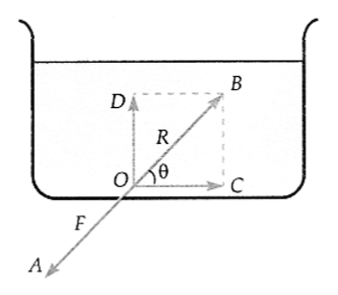
Consider a liquid contained in a vessel in the equilibrium state of rest. As shown in Fig., suppose the liquid exerts a force F on the bottom surface in an inclined direction OA. The surface exerts an equal reaction R to water along OB.
Image
The reaction R along OB has two rectangular components:
i. Tangential component, $OC = R \cos \theta$
ii. Normal component, $OD = R \sin \theta$
Since a liquid cannot resist any tangential force, the liquid near O should begin to flow along OC . But the liquid is at rest, the force along OC must be zero.
$
\therefore R \cos \theta=0
$
As $R \neq 0$, so $\cos \theta=0$ or $\theta=90^{\circ}$
Hence a liquid always exerts a force perpendicular to the surface of the container at every point.
View full question & answer
Question 53 Marks
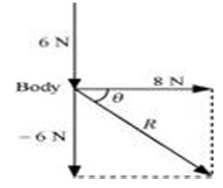
A body of mass 5 kg is acted upon by two perpendicular forces 8 N and 6 N . Give the magnitude and direction of the acceleration of the body.
View full question & answer
Question 63 Marks
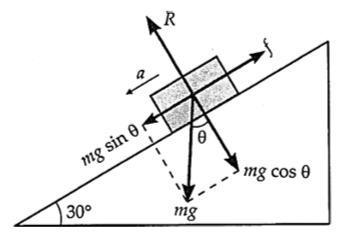
A block of metal of mass 50 g when placed over an inclined plane at an angle of $15^{\circ}$ slides down without acceleration. If the inclination is increased by $15^{\circ}$, what would be the acceleration of the block?
Answer
Here $m =50 g=0.05 kg$
Angle of repose,
$
\begin{aligned}
& \alpha=15^{\circ} \\
& \therefore \mu=\tan \mu=\tan 15^{\circ}=0.2679
\end{aligned}
$
New angle of inclination $=15+15=30^{\circ}$
Let a be the downward acceleration produced in the block.
Image
Net downward force on the block is
$
F=mg \sin \theta-f
$
$\begin{aligned} & ma = mg \sin \theta- u mg \cos \theta[\because f=\mu R=\mu m g \cos \theta] \\ & \therefore \quad a=g(\sin \theta-\mu \cos \theta) \\ & =9.8\left(\sin 30^{\circ}-0.2679 \cos 30^{\circ}\right) \\ & =9.8(0.5-0.2679 \times 0.866) \\ & =9.8 \times 0.2680=2.6 ms^{-2}\end{aligned}$
View full question & answer
Question 73 Marks
A 10 kW drilling machine is used to drill a bore in a small aluminium block of mass 8.0 kg . How much is the rise in temperature of the block in 2.5 minutes, assuming $50 \%$ of power is used up in heating the machine itself or lost to the surroundings. Specific heat of aluminium $=0.91 J g ^{-1} K^{-1}$.
View full question & answer
Question 83 Marks
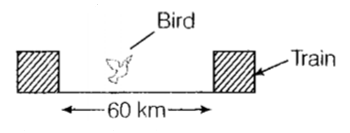
Two trains, each having a speed of $30 km / h$, are headed towards each other on the same track. A bird that can fly $60 km / h$ flies off the front of one train when they were 60 km apart and heads directly to the other train. On reaching the train, the bird flies back to the first train. What is the total distance the bird travels before the trains collide?
Answer

Image
Here, it is given that, $v_1=30 km / h , v_2=60 km / h$ and $d =60 km$
Therefore, $v_1=30 km / h =30 \times \frac{5}{18}=8.33 m / s$
and $v_2=60 km / h =60 \times \frac{5}{18}=16.67 m / s$
Also, $d =60 km=60000 m$ (because $1 km=1000 m$ )
Since the trains will collide in the middle, we have
$
\Delta x=30 km
$
When trains collide, $v=\frac{\Delta x}{\Delta t} \Rightarrow \Delta t=\frac{\Delta x}{v}$
$
\therefore \quad \Delta t=\frac{30000}{8.33}=3601
$
Now, $v=\frac{\Delta x}{\Delta t} \Rightarrow \Delta x=v \Delta t$
$
\begin{aligned}
& \therefore \Delta x=(16.67 m / s)(3601) \\
& \approx 60028.67 m \approx 60 km
\end{aligned}
$
View full question & answer
3 Marks Question - Physics STD 11 Science Questions - Vidyadip