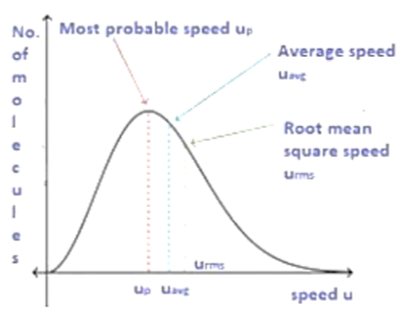
Question 14 MarksRoot mean square velocity (RMS value)is the square root of the mean of squares of the velocity of individual gas molecules and the Average velocity is the arithmetic mean of the velocities of different molecules of a gas at a given temperature.1. Moon has no atmosphere because:(a) the escape velocity of the moon’s surface is more than the r.m.s velocity of all molecules(b) it is far away from the surface of the earth(c) the r.m.s. velocity of all the gas molecules is more than the escape velocity of the moon’s surface(d) its surface temperature is $10^{\circ} C$2. For an ideal gas, $\frac{C_P}{C_V}$ is(a) $\leq 1$ (b) none of these (c) $>1$ (d) $<1$3. The root means square velocity of hydrogen is $\sqrt{5}$ times that of nitrogen. If T is the temperature of the gas then:(a) $T \left( H _2\right)= T \left( N _2\right)$ (b) $T \left( H _2\right)< T \left( N _2\right)$(c) $T \left( H _2\right) \neq T \left( N _2\right)$ (d) $T\left(H_2\right)>T\left(N_2\right)$4.Suppose the temperature of the gas is tripled and $N _2$ molecules dissociate into an atom. Then what will be the rms speed of atom:(a) $v_0 \sqrt{2}$ (b) $v_0 \sqrt{6}$ (c) $v_0 \sqrt{3}$ (d) $v_0$ORThe velocities of the molecules are $v , 2 v , 3 v , 4 v \& 5 v$. The RMS speed will be:(a) 11 v (b) $v (12)^{11}$ (c) v (d) $v(11)^{12}$AnswerRoot mean square velocity (RMS value)is the square root of the mean of squares of the velocity of individual gas molecules and the Average velocity is the arithmetic mean of the velocities of different molecules of a gas at a given temperature.1. (c) the r.m.s. velocity of all the gas molecules is more than the escape velocity of the moon's surfaceExplanation: The r.m.s. velocity of all the gas molecules is more than the escape velocity of the moon's surface.2. (c) $>1$Explanation: $>1$3. (b) $T \left( H _2\right)< T \left( N _2\right)$Explanation: $T \left( H _2\right)< T \left( N _2\right)$4. (b) $v_0 \sqrt{6}$Explanation: $v_0 \sqrt{6}$OR(d) $v (11)^{12}$Explanation: v(11) ${ }^{12}$View full question & answer→
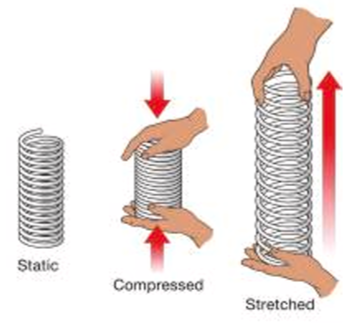
Question 24 MarksElastic potential energy is Potential energy stored as a result of the deformation of an elastic object, such as the stretching of a spring. It is equal to the work done to stretch the spring, which depends upon the spring constant k as well as the distance stretched1. If stretch in spring of force constant k is doubled, then the ratio of final to initial forces is:(a) $4: 1$ (b) $1: 4$ (c) $2: 1$ (d) $1: 2$2. A light body and a heavy body have the same kinetic energy. which one has greater linear momentum?(a) light body (b) both heavy and light body (c) Low body (d) heavy body3. A spring is cut into two equal halves. How is the spring constant of each half affected?(a) becomes double (b) becomes triple (c) becomes $1 / 4$ th (d) becomes halfORWhen spring is compressed, its potential energy:(a) fall (b) decrease (c) first increase then decrease (d) increase4. What type of energy is stored in the spring of a watch?(a) potential energy (b) Electrical energy (c) mechanical energy (d) kinetic energyAnswerElastic potential energy is Potential energy stored as a result of the deformation of an elastic object, such as the stretching of a spring. It is equal to the work done to stretch the spring, which depends upon the spring constant k as well as the distance stretched1. (c) $2: 1$Explanation: 2:12. (d) heavy bodyExplanation: heavy body3. (a) becomes doubleExplanation: becomes doubleOR(d) increaseExplanation: increase4. (a) potential energyExplanation: potential energyView full question & answer→