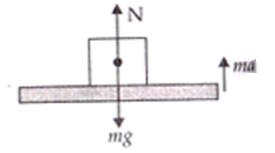
A person normally weighing 50 kg stands on a mass less platform which oscillates up and down harmonically at a frequency of $2.0 s^{-1}$ and an amplitude 5.0 cm . A weighing machine on the platform gives the persons weight against time. i. Will there be any change in weight of the body, during the oscillation? Figure In extensible string. ii. If answer to part (a) is yes, what will be the maximum and minimum reading in the machine and at which position?
Answer
a. Weight in weight machine will be due to the normal reaction $( N )$ by platform. Consider the top position of platform, two forces acting on it are due to weight of person and oscillator. They both act downward. ( $mg =$ weight of the person with the oscillator is acting downwards, $ma =$ force due to oscillation is acting upwards, $N =$ normal reaction force acting upwards) Now for the downward motion of the system with an acceleration a, $ ma=mg-N\ldots(i) $ When platform lifts form its lowest position to upward $ ma=N-mg\ldots(ii) $ $a=\omega^2 A$ is value of acceleration of oscillator $\therefore$ From equation (i) we get, $ N=m g-m \omega^2 A $ Where A is amplitude, $\omega$ angular frequency and m mass of oscillator. $ \omega=2 \pi \nu $ $ \therefore \omega=2 \pi \times 2=4 \pi rad / sec $ Again using $A=5 cm=5 \times 10^{-2} m$ we get $ \begin{aligned} & N=50 \times 9.8-50 \times 4 \pi \times 4 \pi \times 5 \times 10^{-2} \\ & =50\left[9.8-16 \pi^2 \times 5 \times 10^{-2}\right] N \\ & =50\left[9.8-80 \times 3.14 \times 3.14 \times 10^{-2}\right] N \\ & \Rightarrow N=50[9.8-7.89]=50 \times 1.91=95.50 N \end{aligned} $ So minimum weight is 95.50 N (for downward motion of the platform) From equation (ii), $N - mg = ma$ For upward motion from the lowest to the highest point of oscillator, $ \begin{aligned} & N=m g+m a \\ & =m\left[9.81+\omega^2 A\right] \quad \because a=\omega^2 A \\ & =50\left[9.81+16 \pi^2 \times 5 \times 10^{-2}\right] \\ & =50[9.81+7.89]=50 \times 17.70 N=885 N \end{aligned} $ Hence, there is a change in weight of the body during oscillation. b. The maximum weight is 885 N , when platform moves from lowest to upward direction. And the minimum weight is 95.5 N , when platform moves from the highest point to downward direction.
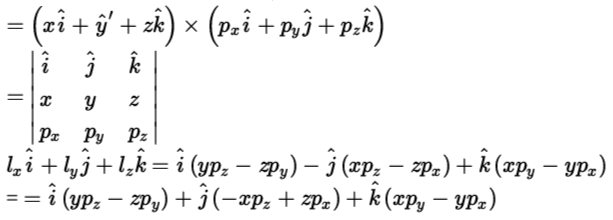
Find the components along the $x , y , z$ axes of the angular momentum l of a particle, whose position vector is r with components $x , y , z$ and momentum is p with components $p _{ x }, p _{ y }$ and $p _{ z }$. Show that if the particle moves only in the x y plane the angular momentum has only a z-component.
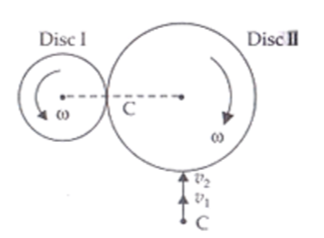
Two cylindrical hollow drums of radii $R$ and $2 R$, and of a common height $h$, are rotating with angular velocities $\omega_1$ (anti-clockwise) and $\omega_2$ (clockwise), respectively. Their axes, fixed are parallel and in a horizontal plane separated by $(3 R+\delta)$. They are now brought in contact $(\delta \rightarrow 0)$. i. Show the frictional forces just after contact. ii. Identify forces and torques external to the system just after contact. iii. What would be the ratio of final angular velocities when friction ceases?
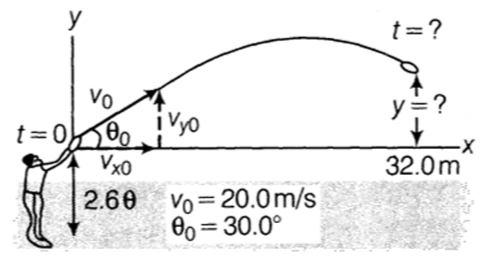
A quarterback, standing on his opponents 35-yard line, throws a football directly down field, releasing the ball at a height of 2.00 m above the ground with an initial velocity of $20.0 m / s$, directed $30.0^{\circ}$ above the horizontal. i. How long does it take for the ball to cross the goal line, 32.0 m from the point of release? ii. The ball is thrown too hard and so passes over the head of the intended receiver at the goal line. What is the ball's height above the ground as it crosses the goal line?
Answer
To better visualise the solution described here, we first sketch the trajectory as shown in figure.
i. The problem here is to find t when $x =32.0 m$. We can use $\left( x =v_{x_0} t\right.$ ), if we first find $v_{x_0}$. From figure, we see that $v_{x_0}= v _0$ $ \begin{aligned} & \cos \theta_0=(20.0 m / s)\left(\cos 30.0^{\circ}\right) \\ & =17.3 m / s \end{aligned} $ Using the relation and solve for t . $ \begin{aligned} & x=v_{x_0} t \\ & t=\frac{x}{v_{x 0}}=\frac{32.0 m}{17.3 m / s}=1.85 s \end{aligned} $ ii. We want to find $y$ when $x=32.0 m$, or since we have already found the time in part (a), we can state this, find $y$ when $t=1.85$ s. Using the relation, $ \begin{aligned} & y=v_{y_0} t-\frac{1}{2} gt^2 \\ & \text { where } v_{y_0}=v_0 \sin \theta_0=(20.0 m / s)\left(\sin 30.0^{\circ}\right) \\ & =10.0 m / s \end{aligned} $ Thus, $y =(10.0 m / s )(1.85 s)-\frac{1}{2}\left(9.80 m / s ^2\right)(1.85 s)^2=1.73 m$ Since, $y =0$ is 2.00 m above the ground, this means the ball is 3.73 m above the ground as it crosses the goal line too much high to be caught at that point.
Show that simple harmonic motion may be regarded as the projection of uniform circular motion along the diameter of the circle. Hence derive an expression for the displacement of a particle in S.H.M.
Answer
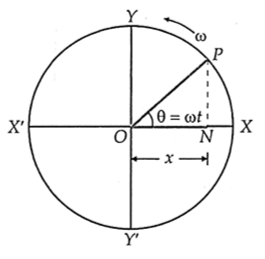
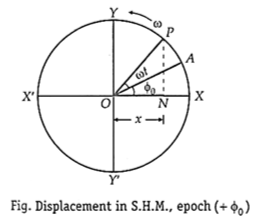
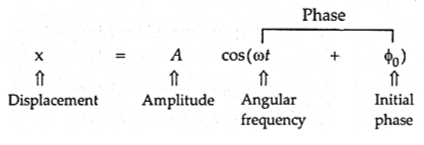
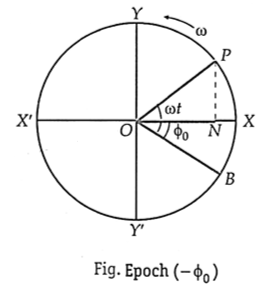
Relation between S.H.M. and uniform circular motion. As shown in figure, consider a particle P moving along a circle of radius A with uniform angular velocity $\omega$. Let N be the foot of the perpendicular drawn from the point P to the diameter XX '. Then N is called the projection of P on the diameter $XX ^{\prime}$. As P moves along the circle from X to $Y , Y$ to $X ^{\prime}, X ^{\prime}$ to $Y ^{\prime}$ and $Y ^{\prime}$ to $X ; N$ moves from X to $O , O$ to $X ^{\prime}, X ^{\prime}$ to O and O to X . Thus, as P revolves along the circumference of the circle, N moves to and fro about the point O along the diameter XX '. The motion of N about O is said to be simple harmonic. Hence simple harmonic motion may be defined as the projection of uniform circular motion upon a diameter of a circle. The particle P is called the reference particle or generating particle and the circle along which the particle $P$ revolves is called the circle of reference. Displacement in simple harmonic motion. As shown in Figure, consider a particle moving in the anticlockwise direction with uniform angular velocity $\omega$ along a circle of radius A and centre $O$. Suppose at time $t=0$, the reference particle is at point $A$ such that $\angle X O A=\phi_0$. At any time t , suppose the particle reaches the point P such that $\angle A O P=\omega t$. Draw $PN \perp XX$ '. Clearly, displacement of projection N from centre O at any instant t is $x = O N$. In right-angled $\triangle O N P$, $ \begin{aligned} & \angle P O N=\omega t+\phi_0 \\ & \therefore \frac{O N}{O P}=\cos \left(\omega t+\phi_0\right) \\ & \text { or } \frac{x}{A}=\cos \left(\omega t+\phi_0\right) \\ & \text { or } x=A \cos \left(\omega t+\phi_0\right) \end{aligned} $ This equation gives the displacement of a particle in S.H.M. at any instant $t$. The quantity $\omega t+\phi_0$ is called the phase of the particle and $\phi_0$ is called the initial phase or phase constant or epoch of the particle. The quantity A is called the amplitude of the motion. It is a positive constant whose value depends on how the motion is initially started. Thus As shown in Figure, if the reference particle starts motion from the point P such that $\angle B O X=\phi_0$ and $\angle B O P=\omega t$, then $ \begin{aligned} & \angle P O N=\omega t-\phi_0 \\ & \therefore x=A \cos \left(\omega t-\phi_0\right) \end{aligned} $ Here $-\phi_0$ is the initial phase of the S.H.M.