Questions

3 Marks Question

Take a timed test

8 questions · self-marked practice — reveal the answer and mark yourself.

Question 13 Marks
Describe the cleansing action of detergents.
Answer
Cleansing action of detergents: Oil stains and grease on dirty clothes cannot be removed by simply washing the clothes with water because water does not wet them. By adding detergent or soap to water, the greasy dirt can be easily removed. The cleansing action of detergents can be explained as follows:
i. Soap or detergent molecules have the shape of a hairpin.
ii. When detergent is dissolved in water, the heads of its hairpin shape molecules get attracted to water surface.
iii. When clothes with greasy stains are dipped in water containing detergent, the pointed ends of detergent molecules get attached to the molecules of grease. So a water-grease interface is formed. Thus surface tension is greatly reduced. The greasy dirt is held suspended.
iv. When the clothes are rinsed in water, the greasy dirt is washed away by running water.
So when detergent is added to water, the surface tension of water is reduced, its area of contact with grease is increased and hence its cleansing ability is increased.
View full question & answer
Question 23 Marks
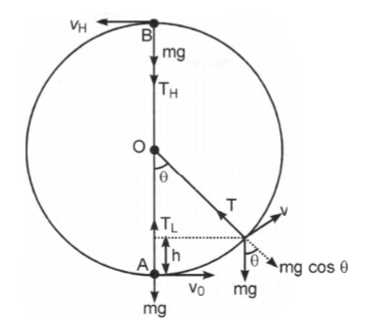
A small body tied to one end of the string is whirled in a vertical circle. Represent the forces on a diagram when the string makes an angle $\theta$ with initial position below the fixed point. Find an expression for the tension in the string. Also, find the tension and velocity at the lowest and highest points respectively.
Answer
Consider a small body of mass $m$ attached to one end of a string (of length $l$ ) and whirled in a vertical circle of radius ' $r$ '. Let body starts motion from its initial position A , just below the fixed point O , with a speed $v _0$.
Image

The forces acting on the body, when the string makes an angle $\theta$ with the initial position are shown in the figure. Here, mg is the weight of body and T the tension in the string. If v be the instantaneous velocity at this point, then a centripetal force $F=\frac{m v^2}{l}$ is required radially inward. From figure, it is clear that in equilibrium the centripetal force is provided by resultant of two forces i.e., $T-m g \cos \theta=\frac{m v^2}{l}$ 
or $T=m g \cos \theta+\frac{m v^2}{l}$$\ldots(i)$
If the body has covered a vertical distance $h$, then from law of conservation of mechanical energy, we have
$
\begin{aligned}
& \frac{1}{2} m v_0^2=\frac{1}{2} m v^2+m g h \\
& \Rightarrow v^2=v_0^2-2 g h\ldots(i)
\end{aligned}
$
which is the required expression for the velocity of a particle at any point.
At the lowest point $\theta=0^{\circ}$ and $h =0$, hence we have
$
\left.v_L=v=v_0 \ldots . \text { [from (i) putting } h=0\right]
$
Thus,
$
T_L=m g \cos 0^{\circ}+\frac{m}{l} v_L^2=m g+\frac{m v_0^2}{l}
$
and at the highest point $\theta=180^{\circ}$ and $h =2 l$. 
Hence, $v_H^2=v^2=v_0^2-4 g l$ [from (i) putting $\left.h =2 l\right]$
$
\begin{aligned}
& \text { or } v_H=\sqrt{v_0^2-4 g l} \\
& \text { and } T_H=m g \cos 180^{\circ}+\frac{m v_H^2}{l}=m g(-1)+\frac{m}{l}\left(v_0^2-4 g l\right)=\frac{m v_0^2}{l}-5 m g
\end{aligned}
$
which is the required expression for the Tension.
View full question & answer
Question 33 Marks
State and prove the principle of law of conservation of linear momentum.
Answer
The principle of conservation of linear momentum states that,"If no external forces act on the system of two colliding objects, then the vector sum of the linear momentum of each body remains constant and is not affected by their mutual interaction." i.e. if $\bar{F}$ ext $=0$ then $\bar{P}=$ constant . To prove this principle, we consider a collision between two spheres $A$ and $B$ having masses of $m _{ 1 }$ and $m _{ 2 }$ respectively.Let $u _{ 1 }$ and $u _{ 2 }$ be the velocities of the spheres before collision such that $u _{ 1 }> u _{ 2 }$ and moving on the same straight line . After collision, let their velocities be $v _{ 1 }$ and $v _{ 2 }$ on the same line. If they collide with each other for a short time interval $t$, each sphere exerts a force on the other sphere and so, the force experienced by $A$ is given as
$
F_2=\frac{\text { change in momentum }}{\text { time }}=\frac{m_1 v_1-m_1 u_1}{t}
$
Similarly, force experienced by $B$ is $F_1=\frac{\text { change in momentum }}{\text { time }}=\frac{m_2 v_2-m_2 u_2}{t}$
According to Newton's third law of motion, the force experienced by $A$ and $B$ are equal and opposite, $\overrightarrow{F_2}=-\overrightarrow{F_1}$
$
\begin{aligned}
& \Rightarrow m_2 v_2-m_2 u_2=-\left(m_1 v_1-m_1 u_1\right) \\
& \Rightarrow m_2 v_2+m_1 v_1=m_1 u_1+m_2 u_2 \\
& \Rightarrow P_f=P_i
\end{aligned}
$
That is, total momentum before collision is equal to total momentum after collision if no external forces act on them which proves the principle of conservation of linear momentum.
View full question & answer
Question 43 Marks
A U-tube is made up of capillaries of bore 1 mm and 2 mm respectively. The tube is held vertically and partially filled with a liquid of surface tension 49 dyne $cm ^{-1}$ and zero contact angle. Calculate the density of the liquid, if the difference in the levels of the meniscus is 1.25 cm . Take $g =980 cms ^{-2}$.
Answer

$\begin{aligned} & \text { Here } h _1=\frac{2 \sigma \cos \theta}{r_1 \rho g} \text { and } h _2=\frac{2 \sigma \cos \theta}{r_2 \rho g} \\ & \therefore h_1- h _2=\frac{2 \sigma \cos \theta}{\rho g}\left[\frac{1}{r_1}-\frac{1}{r_2}\right] \\ & \rho=\frac{2 \sigma \cos \theta}{\left(h_1-h_2\right) g}\left[\frac{1}{r_1}-\frac{1}{r_2}\right] \\ & \text { Now } r _1=\frac{1}{2} mm=0.05 cm \\ & r _2=\frac{2}{2} mm=0.1 cm \\ & \sigma=49 dyne cm ^{-1} \\ & h_1- h _2=1.125 cm^2 \theta=0^0, g=980 cm s ^{-2} \\ & \therefore \rho=\frac{2 \times 49 \times \cos 0^{\circ}}{1.25 \times 980}\left[\frac{1}{0.05}-\frac{1}{0.1}\right] \\ & =\frac{2 \times 49 \times 1}{1.25 \times 980} \times 10=0.8 g cm ^{-3}\end{aligned}$
View full question & answer
Question 53 Marks
In giving a patient a blood transfusion, the bottle is set up so that the level of blood is 1.3 m above needle, which has an internal diameter of 0.36 mm and is 3 cm in length. If $4.5 cm^3$ of blood passes through the needle in one minute, calculate the viscosity of blood. The density of blood is $1020 kgm ^{-3}$.
Answer
Length of the needle, $1=3 cm$
Radius of the needle, $r=\frac{0.36}{2} mm=0.018 cm$
Volume of blood flowing out per second,
$
Q=\frac{\text { Total Volume }}{\text { Time }}=\frac{4.5}{60}=0.075 cm^3 s^{-1}
$
Density of blood,
$
\rho=1020 kg m^{-3}=1020 \times 10^{-3} g cm^{-3}=1.02 g cm^{-3} \text { (Given) }
$
The bottle is set up so that the level of blood is 1.3 m above needle, pressure difference,
$
\begin{aligned}
& p=1.3 m \text { column of blood } \\
& =1.3 \times 100 \times 1.02 \times 980 \text { dyne cm}^{-2} \\
& \eta=\frac{\pi p r^4}{8 Q l}=\frac{3.142 \times 1.3 \times 100 \times 1.02 \times 980 \times(0.018)^4}{8 \times 0.075 \times 3} \\
& =0.238 \text { poise }
\end{aligned}
$
View full question & answer
Question 63 Marks
Answer
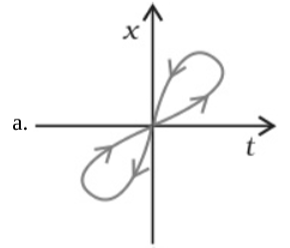
a. The given x-t graph, shown in (a), does not represent one-dimensional motion of the particle. This is because a particle cannot have two positions at the same instant of time.
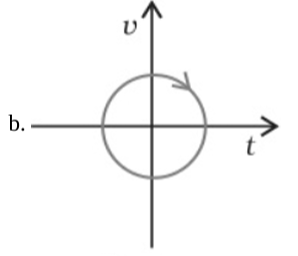
b. The given v-t graph, shown in (b), does not represent one-dimensional motion of the particle. This is because a particle can never have two values of velocity at the same instant of time.
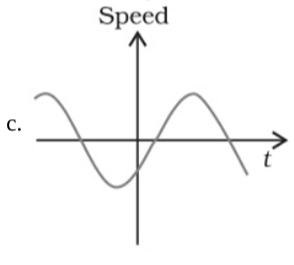
c. The given v-t graph, shown in (c), does not represent one-dimensional motion of the particle. This is because speed being a scalar quantity cannot be negative.
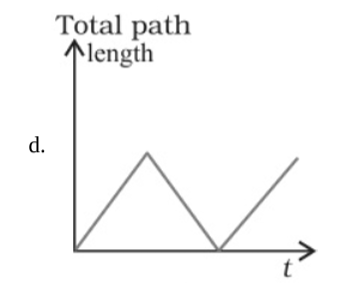
d. The given v-t graph, shown in (d), does not represent one-dimensional motion of the particle. This is because the total path length travelled by the particle cannot decrease with time.
View full question & answer
Question 73 Marks
Show that $C_P-C_V=R$ where $C_P=$ specific heat at constant pressure; $C_V=$ specific heat at constant volume and $R =$ Universal Gas constant for an ideal gas.
Answer
Let us first heat the gas at constant volume till the temperature increases by $\Delta T$ if $\Delta Q$ is the amount of heat required to raise the temperature of 1 mole of gas to increase the temperature by $\triangle T$
So, $\Delta Q=C_V \Delta T \ldots$ (i)
Here $C_V$ is the specific heat at constant volume. Since volume remains the same, hence no work is heating the gas then according to law of conservation of energy, the entire heat supplied goes into raising the internal energy and hence the temperature of the gas.
Now, $C_V \Delta T=\Delta U$ $\ldots(ii)$
$\therefore \Delta U=$ increase in the internal energy of the gas
Let us heat the gas at constant pressure till the temperature of the gas increases by $\Delta T$. In this case external work is done to expand the gas hence by using first law of thermodynamics.
$
\Delta Q^1=\Delta U+\Delta W
$
$
C_{p} \Delta T=C_{V} \Delta T+\Delta W \text { (by equation (ii)) }
$
Here $C_P$ is the specific heat at constant pressure.
$
\begin{aligned}
& \text { But } \Delta W=P \Delta V \text {, so } \\
& C_P \Delta T=C_V \Delta T+P \Delta V \ldots \text { (iii) }
\end{aligned}
$
Now, form ideal gas equation : $PV = RT$....(iv)
$
\text { or } P(V+\Delta V)=R(T+\Delta T) \ldots \text { (v) }
$
Subtracting equation (iv) from equation (v)
$
P \Delta V=R \Delta T
$
Put $P \Delta V=R \Delta T$ in equation (iii)
$
\begin{aligned}
& C_P \Delta T=C_V \Delta T+P \Delta V \\
& C_P \Delta T=C_V \Delta T+R \Delta T\ldots(vi)
\end{aligned}
$
Divide eq (vi) by $\triangle T$
$
\begin{aligned}
& C_P=C_V+R \\
& \text { or } C_P-C_V=R
\end{aligned}
$
View full question & answer
Question 83 Marks
An ice cube of mass 0.1 kg at $0^{\circ} C$ is placed in an isolated container which is at $227^{\circ} C$. The specific heat S of the container varies with temperature T according to the empirical relation $S = A + BT$, where $A =100 cal / kg - K$ and $B=2 \times 10^{-2} cal / kg - K ^2$. If the final temperature of the container is $27^{\circ} C$, determine the mass of the container. (Latent heat of fusion of water $=8 \times 10^4$ call kg. Specific heat of water $=10^3 cal / kg - K$ ).
Answer
Let M be the mass of container.
Heat released by container is absorbed by ice untl thermal equilibrium is achieved.
For container, $T _1=227^{\circ} C =(227+273) K =500 K$
Final temperature, $T _2-27^{\circ} C =(27+273) K =300 K$
$
\begin{aligned}
& \text { So, } T_1-T_2=200 K \\
& \int_{T_2}^{T_1} M s \cdot d T=m L+m s_{\text {water }}\left(T_2-273\right) \\
& M \cdot \int_{T_2}^{T_1}(A+B T) d T=\left(0.1 \times 8 \times 10^4\right)+0.1 \times 10^3 \times(300-273) \\
& M \cdot\left[[A T]_{T_2}^{T_1}+B\left[\frac{T^2}{2}\right]_{T_2}^{T_1}\right]=8000+2700 \\
& M \cdot\left\{A\left(T_1-T_2\right)+\frac{B}{2}\left(T_1^2-T_2^2\right)\right\}=10700 \\
& M\left\{100 \times(200)+\frac{2 \times 10^{-2}}{2}\left(-9 \times 10^4+25 \times 10^4\right)\right\}=10700 \\
& M \times 21600=10700 \\
& M=\frac{10700}{21600}=0.495 Kg
\end{aligned}
$
View full question & answer
3 Marks Question - Physics STD 11 Science Questions - Vidyadip