Question types

Model Paper 6 question types

38 questions across 6 question groups — pick any mix to generate a Physics paper with step-by-step answer keys.

38
Questions
6
Question groups
5
Question types
Sample Questions

Model Paper 6 questions

One sample from each question group in this chapter. Select any group above to see the full set with answer keys.

A truck on a straight road starts from rest, accelerating at $2.00 m / s ^2$ until it reaches a speed of $20.0 m / s$. Then the truck travels for 20.0 s at a constant speed until the brakes are applied, stopping the truck in a uniform manner in an additional 5.00 s . What is the average velocity in $m / s$ of the truck for the motion described?
  • A
    $15.7$
  • B
    $16.2$
  • C
  • D
    $17.5$
View full solution
The value of coefficient of volume expansion of glycerin is $5 \times 10^{-4} K^{-1}$. The fractional change in the density of glycerin for a rise of $40^{\circ} C$ in its temperature, is
  • A
    $0.020$
  • B
    $0.010$
  • C
    $0.025$
  • D
    $0.015$
View full solution
A body is projected from earth's surface to become its satellite. Its time period of revolution will not depend upon:
  • A
    mass of earth
  • B
    its own mass
  • C
    gravitational constant
  • D
    radius of earth
View full solution
An astronaut inside a small space ship orbiting around the earth cannot detect gravity. If the space station orbiting around the earth has a large size, can he hope to detect gravity?
View full solution
The mass of a bicycle rider along with the bicycle is 100 kg . He wants to cross over a circular turn of radius 100 m with a speed of $10 ms^{-1}$. If the coefficient of friction between the tyres and the road is 0.6 , will the rider be able to cross the turn? Take $g =10 ms^{-2}$.
View full solution
A small spherical ball of radius r falls with velocity v through a liquid having coefficient of viscosity $\eta$. Find the viscous drag F on the ball assuming it depends on $\eta, r$ and v . Take $K =6 \pi$.
View full solution
In CGS system, the value of Stefan's constant is $\sigma=5.67 \times 10^{-5} erg s ^{-1} cm^{-2} K^{-4}$. Find its value in SI units. Given $1 J=10^7 erg$.
View full solution
If earth has a mass 9 times and radius twice that of a planet Mars, calculate the minimum velocity required by a rocket to pull out of the gravitational force of Mars. Take the escape velocity on the surface of earth to be 11.2 $kms ^{-1}$.
View full solution
Q 123 Marks Question3 Marks
A small body tied to one end of the string is whirled in a vertical circle. Represent the forces on a diagram when the string makes an angle $\theta$ with initial position below the fixed point. Find an expression for the tension in the string. Also, find the tension and velocity at the lowest and highest points respectively.
View full solution
Q 143 Marks Question3 Marks
A U-tube is made up of capillaries of bore 1 mm and 2 mm respectively. The tube is held vertically and partially filled with a liquid of surface tension 49 dyne $cm ^{-1}$ and zero contact angle. Calculate the density of the liquid, if the difference in the levels of the meniscus is 1.25 cm . Take $g =980 cms ^{-2}$.
View full solution
Q 153 Marks Question3 Marks
In giving a patient a blood transfusion, the bottle is set up so that the level of blood is 1.3 m above needle, which has an internal diameter of 0.36 mm and is 3 cm in length. If $4.5 cm^3$ of blood passes through the needle in one minute, calculate the viscosity of blood. The density of blood is $1020 kgm ^{-3}$.
View full solution
Q 164 Marks Question4 Marks
View full solution
Q 174 Marks Question4 Marks
Certain collisions are referred to as elastic collisions. Elastic collisions are collisions in which both momentum and kinetic energy are conserved. The total system kinetic energy before the collision equals the total system kinetic energy after the collision. If total kinetic energy is not conserved, then the collision is referred to as an inelastic collision.
The coefficient of restitution, denoted by (e), is the measure of degree elasticity of collision. It is defined as the ratio of the final to inital relative speed between two objects after they collide. It normally ranges from 0 to 1 where 1 would be a perfectly elastic collision. A perfectly inelastic collision has a coefficient of 0 . In real life most of the collisions are neither perfectly elastic nor perfectly inealstic and $0< e <1$.

1. The following are the data of a collision between a truck and a car.
Mass of the car $=1000 kg$
Mass of the truck $=3000 kg$
Mass of the truck Before collision:
Speed of the car $=20 m / s$
Momentum of the car $=20000 kg m / s$
Speed of the truck $=20 m / s$
Momentum of the truck $=60000 kg m / s$
After collision:
Speed of the car $=40 m / s$ in the opposite direction
Momentum of the car $=40000 kg m / s$ in the opposite direction
Speed of the truck $=0$
Momentum of the truck $=0$
The collision is
(a) Both elastic since kinetic energy and momentum is conserved
(b) Elastic since momentum is conserved
(c) Inelastic since kinetic energy is conserved
(d) Elastic since kinetic energy is conserved
2. The coefficient of restitution is the measure of
(a) Malleability of a substance    (b) Conductivity of a substance
(c) degree of elasticity of collision    (d) Elasticity of a substance
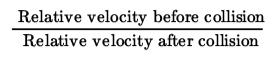
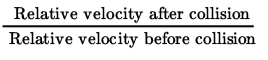
3. Coefficient of restitution is defined as
(a) 
Image
(b) Relative velocity after collision x relative velocity before collision
(c) Relative velocity after collision + relative velocity before collision
(d) 
Image
OR
In real life most of the collisions are
(a) Range of coefficient of restitution is 0 < e < 1
(b) both neither perfectly nor perfectly inelastic and range of coefficient of restitution is 0 < e < 1.
(c) neither perfectly elastic nor perfectly inelastic
(d) perfectly inelastic
4. For perfectly elastic and perfectly inelastic collision, the value of coefficient of restitution are respectively
(a) $+1,-1$    (b) 0,1    (c) $0,-1$    (d) 1,0
View full solution
i. What is projectile motion?
ii. The maximum range of projectile is $\frac{2}{\sqrt{3}}$ times actual range. What is the angle of projection for the actual range?
iii. Two balls are thrown with the same initial velocity at angles $\alpha$ and $\left(90^{\circ}-\alpha\right)$ with the horizontal. What will be the ratio of the maximum heights attained by them? When will this ratio be equal to 1 ?
View full solution
Plot the corresponding reference circle for each of the following simple harmonic motions. Indicate the initial $(t=0)$ position of the particle, the radius of the circle, and the angular speed of the rotating particle. For simplicity, the sense of rotation may be fixed to be anticlockwise in every case: ( $x$ is in cm and t is in s ).
a. $x=-2 \sin \left(3 t+\frac{\pi}{3}\right)$
b. $x=\cos \left(\frac{\pi}{6}-t\right)$
c. $x=3 \sin \left(2 \pi t+\frac{\pi}{4}\right)$
d. $x=2 \cos \pi t$
View full solution
Using the correspondence of S.H.M. and uniform circular motion, find displacement, velocity, amplitude, time period and frequency of a particle executing S.H.M?
View full solution
Calculate the moment of inertia of uniform circular disc of mass 500 g , radius 10 cm about
i. diameter of the disc
ii. the axis tangent to the disc and parallel to its diameter and
iii. the axis through the centre of the disc and perpendicular to its plane.
View full solution
A tube of length $L$ is filled completely with an incompressible liquid of mass $M$ and closed at both the ends. The tube is then rotated in a horizontal plane about one of its ends with a uniform angular velocity $\omega$. Determine the force exerted by the liquid at the other end.
View full solution
Assertion: It is not possible for a system, unaided by an external agency to transfer heat from a body at lower temperature to another body at a higher temperature.
Reason: According to Clausius statement “No process is possible whose sole result is the transfer of heat from a cooled object to a hotter object.”
  • A
    Assertion and reason both are correct statements and reason is correct explanation for assertion.
  • B
    Assertion and reason both are correct statements but reason is not correct explanation for assertion.
  • C
    Assertion is correct statement but reason is wrong statement.
  • D
    Assertion is wrong statement but reason is correct statement.
View full solution
Assertion (A): Mass and energy are not conserved separately, but are conserved as a single entity called mass energy. 
Reason (R): Mass and energy conservation can be obtained by Einstein equation for energy.
  • A
    Both A and R are true and R is the correct explanation of A.
  • B
    Both A and R are true but R is not the correct explanation of A.
  • C
    A is true but R is false.
  • D
    A is false but R is true.
View full solution
Assertion (A): There is no effect of rotation of the earth on acceleration due to gravity at poles.
Reason (R): The rotation of the earth is about the polar axis.
  • A
    Both A and R are true and R is the correct explanation of A.
  • B
    Both A and R are true but R is not the correct explanation of A.
  • C
    A is true but R is false.
  • D
    A is false but R is true.
View full solution

Generate a Model Paper 6 paper free

Pick question groups from the list above, set marks and difficulty, and export a branded PDF with step-by-step answer keys. First 3 chapters free — no signup.

Download App