Questions

2 Marks Questions

Take a timed test

6 questions · self-marked practice — reveal the answer and mark yourself.

Question 12 Marks
Consider a simple pendulum, having a bob attached to a string, that oscillates under the action of the force of gravity. Suppose that the period of oscillation of the simple pendulum depends on its length (l), mass of the bob (m) and acceleration due to gravity (g). Derive the expression for its time period using method of dimensions.
Answer
Let us assume that $T \propto m^a l^b g^c$
$
\text { or, } T=km^{a} l^{b} g^{c}\ldots(i)
$
where, k is a dimensionless constant.
The dimensions of various quantities are
$
\begin{aligned}
& {[T]=T,[m]=M,} \\
& {[l]=L, \text { and }[g]=LT^{-2}}
\end{aligned}
$
Substitute these values in Eq.(i), we obtain
$
\begin{aligned}
& T=[M]^{a}[L]^{b}\left[LT^{-2}\right]^{c} \\
& \text { or, } M^0 L^0 T^1=M^{a} L^{b+c} T^{-2 c}
\end{aligned}
$
Now equate the powers of $M , L$ and T on both sides, we obtain
$
a=0, b+c=0,-2 c=1
$
On solving, $a =0, b=\frac{1}{2}, \quad c=-\frac{1}{2}$
$
\therefore T=k m^0 l^{1 / 2} g^{-1 / 2}=k \sqrt{\frac{l}{g}}
$
From experiments, $k =2 \pi$
Therefore, $T =2 \pi \sqrt{\frac{l}{g}}$, which is the required expression.
View full question & answer
Question 22 Marks
A spherical planet has mass $M _{ P }$ and diameter $D _{ P }$. A particle of mass $m$ falling freely near the surface of this planet will experience acceleration due to gravity, equal to whom?
Answer
Force experience by the body is given by
$
\begin{aligned}
& F=\frac{G M_e m}{R^2}=\frac{G M_p m}{\left(D_p / 2\right)^2}=\frac{4 G M_p m}{D_p^2} \\
& \frac{F}{m}=\frac{4 G M_p}{D_p^2}
\end{aligned}
$
View full question & answer
Question 42 Marks
Answer
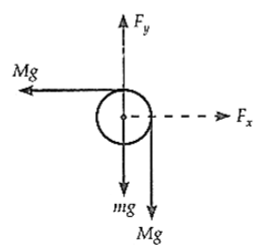
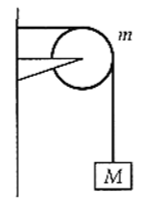
The free body diagram for the pulley is shown in Figure. 
Image
For the equilibrium of the pulley,
$F _{ X }=$ Horizontal component of the force by the clamp on the pulley $= Mg$
$F_y=$ Vertical component of the force by the clamp on the pulley $=(M+m) g$
The net force exerted on the pulley by the clamp,
$
F=\sqrt{F_x^2+F_y^2}=g \sqrt{(M+m)^2+M^2}
$
View full question & answer
Question 52 Marks
State the rules for finding the number of significant figures in a measurement.
Answer
Following rules are to be followed for finding the number of significant figures in a measurement:
i. All the non-zero digits are significant.
ii. All the zeros between two non-zero digits are significant, no matter where the decimal point is, if at all.
iii. If the number is less than 1 , the zeros on the right side of decimal point but to the left of the first non-zero digit are not significant. For example, in $\underline{0} . \underline{00}456$, the underlined zeros are not significant.
iv. The trailing zero(s) in a number without a decimal point are not significant. For example, 14500 have three significant figures as trailing zeros being not significant.
v. The trailing zero(s) in a number with a decimal point are significant. For example, 1.6500 have five significant figures.
vi. If a measurement is expressed in terms of powers of ten, then these powers are not significant.
View full question & answer
Question 62 Marks
Two monoatomic ideal gases 1 and 2 of molecular masses $m_1$ and $m_2$ respectively are enclosed in separate containers kept at the same temperature. What is the ratio of the speed of sound in gas 1 to that in gas 2 ?
Answer
The speed of sound in a gas of molecular mass $M$ is
$
\begin{aligned}
& v=\sqrt{\frac{\gamma R T}{M}} \text { i.e., } v \propto \frac{1}{\sqrt{M}} \\
& \therefore \quad \frac{v_1}{v_2}=\sqrt{\frac{m_2}{m_1}}
\end{aligned}
$
View full question & answer
2 Marks Questions - Physics STD 11 Science Questions - Vidyadip