Question types

Model Paper 8 question types

38 questions across 6 question groups — pick any mix to generate a Physics paper with step-by-step answer keys.

38
Questions
6
Question groups
5
Question types
Sample Questions

Model Paper 8 questions

One sample from each question group in this chapter. Select any group above to see the full set with answer keys.

A tank with a square base of area $2.0 m^2$ is divided into two compartments by a vertical partition in the middle. There is a small hinged door of face area $20 cm^2$ at the bottom of the partition. Water is filled in one compartment and acid, of relative density 1.7 , in the other, both to a height of 4 m . If $g =10 ms^{-2}$ the force necessary to keep the door closed is:
  • A
    80.88 N
  • B
    20.92 N
  • C
    40.52 N
  • D
    54.88 N
View full solution
Measurement of a physical quantity is essentially the
  • A
    process of comparing with a standard using an instrument
  • B
    process of observing the physical quantity
  • C
    process of taking readings on an instrument
  • D
    process of subdividing the physical quantity
View full solution
A liquid boils when its vapour pressure is equal to
  • A
    atmospheric pressure
  • B
    double of atmospheric pressure
  • C
    6.0 cm of Hg column
  • D
    1000 pa or more
View full solution
The instantaneous angular position of a point on a rotating wheel is given by the equation $\theta(t)=2 t^3-6 t^2$. The torque on the wheel becomes zero at
  • A
    $t =0.25 s$
  • B
    $t =0.5 s$
  • C
    $t=2 s$
  • D
    $t=1 s$
View full solution
A closed organ pipe (closed at one end) is excited so as to support the third overtone. It is then found that there are in the pipe:
  • A
    three nodes and four antinodes
  • B
    four nodes and three antinodes
  • C
    four nodes and four antinodes
  • D
    three nodes and three antinodes
View full solution
Consider a simple pendulum, having a bob attached to a string, that oscillates under the action of the force of gravity. Suppose that the period of oscillation of the simple pendulum depends on its length (l), mass of the bob (m) and acceleration due to gravity (g). Derive the expression for its time period using method of dimensions.
View full solution
A spherical planet has mass $M _{ P }$ and diameter $D _{ P }$. A particle of mass $m$ falling freely near the surface of this planet will experience acceleration due to gravity, equal to whom?
View full solution
Two bodies of masses $M$ and $m(M>m)$ are allowed to fall freely from the same height. If air resistance for each body is same, which one will reach the ground first.
View full solution
Q 113 Marks Question3 Marks
A moving neutron with speed $10^6 m / s$ collides with a deuteron at rest and sticks to it. Find the speed of the combination if masses of the neutron and deuteron are $1.67 \times 10^{-27} kg$ and $3.34 \times 10^{-27} kg$, respectively.
View full solution
Q 123 Marks Question3 Marks
State three basic laws of motion. Show that the first law of motion gives the definition of force and the second law of motion gives the measure of force.
View full solution
Q 133 Marks Question3 Marks
Calculate the stress developed inside a tooth cavity filled with copper when hot tea at temperature of $57^{\circ} C$ is drunk. You can take body (tooth) temperature to be $37^{\circ} C$ and $\alpha=1.7 \times 10^{-5} / K$. Bulk modulus for copper $=140$ $\times 10^9 N / m ^2$.
View full solution
Q 143 Marks Question3 Marks
The reading of pressure meter attached to a closed pipe is $3.5 \times 10^5 Nm ^{-2}$. On opening the valve of the pipe, the reading of the pressure meter is reduced to $3.0 \times 10^5 Nm ^{-2}$. Calculate the speed of the water flowing in the pipe.
View full solution
Q 153 Marks Question3 Marks
A ball floats on the surface of water in a container exposed to the atmosphere. Will the ball remain immersed at its initial depth or will it sink or rise somewhat if the container is shifted to the moon?
View full solution
Q 164 Marks Question4 Marks
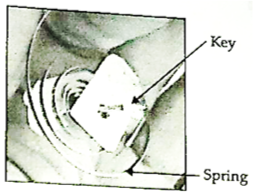
Clockwork refers to the inner workings of mechanical clock or watch (where it is known as "movement") and different types of toys which work using a series of gears driven by a spring. Clockwork device is completely mechanical and its essential parts are:
- A key (or crown) which you wind to add energy
- A spiral spring in which the energy is stored
- A set of gears through which the spring's energy is released. The gears control how quickly (or slowly) a clockwork machine can do things. Such as in mechanical clock/watch the mechanism is the set of hands that sweep around the dial to tell the time. In a clockwork car toy, the gears drive the wheels.
Winding the clockwork with the key means tightening a sturdy metal spring, called the mainspring. It is the process of storing potential energy. Clockwork springs are usually twists of thick steel, so tightening them (forcing the spring to occupy a much smaller space) is actually quite hard work. With each turn of the key, fingers do work and potential energy is stored in the spring. The amount of energy stored depends on the size and tension of the spring. Harder a spring is to turn and longer it is wound, the more energy it stores.
Image

While the spring uncoils, the potential energy is converted into kinetic energy through gears, cams, cranks and shafts which allow wheels to move faster or slower. In an ancient clock, gears transform the speed of a rotating shaft so that it drives the second hand at one speed, the minute hand at $\frac{1}{60}$ of that speed, and the hour hand at $\frac{1}{3600}$ of that speed. Clockwork toy cars often use gears to make themselves race along at surprising speed.

1. What is the meaning of movement of old age mechanical clocks?
(a) The pendulum of the clock
(b) The gears which move the hands of the clock
(c) A spring and combination of gears which move the hands of the clock
(d) The hands of the clock
2. What type of energy is stored in the spring while winding it?
(a) Potential  (b) Heat  (c) Both kinetic and potential  (d) Kinetic
3. When the spring of a clockwork uncoils
(a) Kinetic energy is converted into potential energy
(b) Potential energy is converted into kinetic
(c) Potential energy is converted into heat, light and sound energy
(d) Kinetic energy is converted into heat, light and sound energy
OR
More energy is stored in a spring if the
(a) Spring is larger, harder and wound fur a longer time
(b) Spring is smaller, harder and wound for a shorter time
(c) Spring is larger, harder and wound for a shurter time
(d) Spring is larger, softer and wound for a shorter time
4. In clockwork devices, ____________ transform the speed of a rotating ____________ to drive wheels slower or faster.
(a) Shaft, spring  (b) shaft, gear  (c) Gear, Shaft  (d) Spring, gear
View full solution
Q 174 Marks Question4 Marks
View full solution
A marble rolls along a table at a constant speed of $1.00 m / s$ and then falls off the edge of the table to the floor 1.00 m below,
i. How long does the marble take to reach the floor?
ii. At what horizontal distance from the edge of the table does the marble land?
iii. What is its velocity as it strikes the floor?
View full solution
Show that for a particle in linear S.H.M., the average kinetic energy over a period of oscillation is equal to the average potential energy over the same period. At what distance from the mean position is the kinetic energy in simple harmonic oscillator equal to potential energy?
View full solution
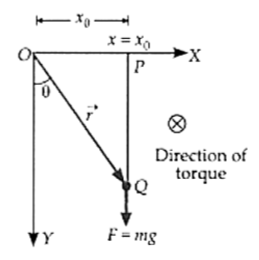
A particle of mass $m$ is released from point P at $x = x _0$ on the X -axis from origin O and falls vertically along the Y-axis, as shown in Fig.
Image

i. Find the torque $t$ acting on the particle at a time $t$ when it is at point Q with respect to O .
ii. Find the angular momentum L of the particle about O at this time t .
iii. Show that $\tau=\frac{d L}{d t}$ in this example.
View full solution
On an open ground, a motorist follows a track that turns to his left by an angle of $60^{\circ}$ after every 500 m . Starting from a given turn, specify the displacement of the motorist at the third, sixth and eighth turn. Compare the magnitude of the displacement with the total path length covered by the motorist in each case.
View full solution
Asseertion: Thermodynamics processes in nature are irreversible.
Reason: Dissipative effects cannot be eliminated.
  • A
    Assertion and reason both are correct statements and reason is correct explanation for assertion.
  • B
    Assertion and reason both are correct statements but reason is not correct explanation for assertion.
  • C
    Assertion is correct statement but reason is wrong statement.
  • D
    Assertion is wrong statement but reason is correct statement.
View full solution
Assertion (A): If $\vec{A}$ is parallel to $\vec{B}$ then $\vec{A} \times \vec{B}$ is a null vector.
Reason (R): The magnitude cross product of two vectors is given by, $|\vec{A} \times \vec{B}|= AB \sin \theta$.
  • A
    Both A and R are true and R is the correct explanation of A.
  • B
    Both A and R are true but R is not the correct explanation of A.
  • C
    A is true but R is false.
  • D
    A is false but R is true.
View full solution
Assertion: In elastic collision between two bodies, the relative speed of the bodies after collision is equal to the relative speed before the collision.
Reason: In an elastic collision, the linear momentum is conserved.
  • A
    Assertion and reason both are correct statements and reason is correct explanation for assertion.
  • B
    Assertion and reason both are correct statements but reason is not correct explanation for assertion.
  • C
    Assertion is correct statement but reason is wrong statement.
  • D
    Assertion is wrong statement but reason is correct statement.
View full solution
Assertion: Moon travellers tie heavy weight at their back before landing on moon.
Reason: The value of g is small at moon.
  • A
    Assertion and reason both are correct statements and reason is correct explanation for assertion.
  • B
    Assertion and reason both are correct statements but reason is not correct explanation for assertion.
  • C
    Assertion is correct statement but reason is wrong statement.
  • D
    Assertion is wrong statement but reason is correct statement.
View full solution

Generate a Model Paper 8 paper free

Pick question groups from the list above, set marks and difficulty, and export a branded PDF with step-by-step answer keys. First 3 chapters free — no signup.

Download App