Questions

3 Marks Question

Take a timed test

8 questions · self-marked practice — reveal the answer and mark yourself.

Question 13 Marks
A moving neutron with speed $10^6 m / s$ collides with a deuteron at rest and sticks to it. Find the speed of the combination if masses of the neutron and deuteron are $1.67 \times 10^{-27} kg$ and $3.34 \times 10^{-27} kg$, respectively.
View full question & answer
Question 23 Marks
State three basic laws of motion. Show that the first law of motion gives the definition of force and the second law of motion gives the measure of force.
Answer
Newton's First Law of Motion also known as Law of Inertia states that every object persists to stay in uniform motion in a straight line or in the state of rest unless an external force acts upon it. In a simpler form, the first law of motion may also be stated as "If the net external force on a body is zero, its acceleration is zero. Acceleration can be non-zero only if there is a net external force on the body".
Newton's Second Law of Motion states that force is equal to the change in momentum per change in time. For a constant mass, force equals mass times acceleration, i.e.
$
F=ma
$
Thus, $\vec{F} \propto \frac{\Delta \vec{p}}{\Delta t}$ or $\vec{F}=k \frac{\Delta \vec{p}}{\Delta t}$, where k is a constant of proportionality, $\Delta p$ is the change in momentum and $p = mv$.
Newton's Third Law of Motion: It states that "For every action, there is an equal and opposite reaction".
According to the first law of motion, in the absence of an external force, a body will maintain its position of rest or state of uniform motion along a straight line. Thus, to change the position of rest or uniform motion of a body, we shall have to apply external force. If the external force is large enough, it may change the state of rest or of uniform motion. However, if the magnitude of the force is small then it may not be able to change that state. Hence, "force is that external cause (push or pull) which changes or tries to change the state of rest or of uniform motion along a straight line of a given body".
Also, we know that,
$
F=ma
$
where F is the vector sum of all forces acting on the body, m is the mass of body and equation can be regarded as a statement Newton's 2nd law of motion.
This relation can be used to have the measure of a force.
View full question & answer
Question 33 Marks
Calculate the stress developed inside a tooth cavity filled with copper when hot tea at temperature of $57^{\circ} C$ is drunk. You can take body (tooth) temperature to be $37^{\circ} C$ and $\alpha=1.7 \times 10^{-5} / K$. Bulk modulus for copper $=140$ $\times 10^9 N / m ^2$.
Answer
First of all, the stress on the object(tooth) developed over here is dependent on bulk modulus of the material and the temperature difference. That's the stress is called a thermal stress over here.
Now, change in temperature $\Delta T=57-37=20^{\circ} C =20 K$ (since temperature difference is same here in both the scales)
Coefficient of linear expansion $\alpha$ of (tooth) body $=1.7 \times 10^{-5} K^{-1}$
Cubical expansion $\gamma=3 \alpha=3 \times 1.7 \times 10^{-5}=5.1 \times 10^{-5} K^{-1},\left[ As , \alpha=\frac{\gamma}{3}\right]$
Let the volume of the cavity be V and its volume increased by $\Delta V$ due to increase in temperature $\Delta T$.
Then from the defination of coefficient of volume expansion,
$
\begin{aligned}
& \Delta V=\gamma V \cdot \Delta T \\
& \Rightarrow \frac{\Delta V}{V}=\gamma \Delta T
\end{aligned}
$
Thermal stress produced $=$ Bulk modulus $\times$ Volume strain
$
=B \times \frac{\Delta V}{V}=B \times \gamma \times \Delta T
$
Hence, thermal stress $=140 \times 10^9 \times 5.1 \times 10^{-5} \times 20=14280 \times 10^4 N / m ^2$, as bulk modulus $=140 \times 10^9 N / m ^2($ given $)$
$
=1.428 \times 10^8 Nm^{-2}
$
This stress is about $10^3$ times of atmospheric pressure i.e., $1.013 \times 10^5 Nm ^{-2}$.
View full question & answer
Question 43 Marks
The reading of pressure meter attached to a closed pipe is $3.5 \times 10^5 Nm ^{-2}$. On opening the valve of the pipe, the reading of the pressure meter is reduced to $3.0 \times 10^5 Nm ^{-2}$. Calculate the speed of the water flowing in the pipe.
Answer
Before opening the valve:
$
p_1=3.5 \times 10^5 Nm^{-2}, v_1=0
$
After opening the valve:
$
P_2=3.0 \times 10^5 Nm^{-2}, v_2=?
$
In horizontal flow, P.E. remains unchanged. So Bernoulli's theorem can be written as
$
\begin{aligned}
& P_2+\frac{1}{2} \rho v_2^2=p_1+\frac{1}{2} \rho v_1^2 \\
& 3.0 \times 10^5+\frac{1}{2} \times 10^3 \times v_2^2=3.5 \times 10^5+\frac{1}{2} \times 10^3 \times(0)^2 \\
& \frac{1}{2} \times 10^3 \times v_2^2=(3.5-3.0) \times 10^5=0.5 \times 10^5 \\
& \text { or } v_2^2=2 \times 0.5 \times 10^2=100 \\
& \text { or } v_2=10 ms^{-1}
\end{aligned}
$
View full question & answer
Question 53 Marks
A ball floats on the surface of water in a container exposed to the atmosphere. Will the ball remain immersed at its initial depth or will it sink or rise somewhat if the container is shifted to the moon?
View full question & answer
Question 63 Marks
In a glass capillary tube, water rises upto a height of 10.0 cm while mercury fall down by 5.0 cm in the same capillary. If the angles of contact for mercury glass is $60^{\circ}$ and water glass is $0^{\circ}$, then find the ratio of surface tension of mercury and water.
Answer
For water, $h _1=10.0 cm=0.1 m$
$
\rho_1=10^3 kg / m^3, \theta=0^{\circ}
$
For mercury, $h _2=5.0 cm=0.05 m$
$
\rho_2=13.6 \times 10^3 kg / m^3, \theta=60^{\circ}
$
Suppose $S_1$ and $S_2$ are the surface tensions for water and mercury, respectively, then
$
S_1=\frac{h_1 R \rho_1 g}{2 \cos \theta_1} \text { and } S_2=\frac{h_2 R \rho_2 g}{2 \cos \theta_2}
$
The ratio of surface tension of mercury and water,
$
\begin{aligned}
& \frac{S_2}{S_1}=\frac{h_2 R \rho_2 g}{2 \cos \theta_2} \times \frac{2 \cos \theta_1}{h_1 R \rho_1 g} \\
& \frac{S_2}{S_1}=\frac{h_2 \rho_2 \cos \theta_1}{h_1 \rho_1 \cos \theta_2} \\
& =\frac{0.05 \times 13.6 \times 10^3 \times \cos 0^{\circ}}{0.1 \times 1000 \times \cos 60^{\circ}}=13.6: 1
\end{aligned}
$
View full question & answer
Question 73 Marks
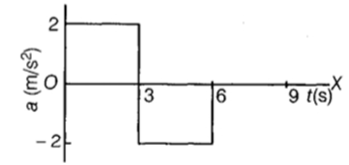
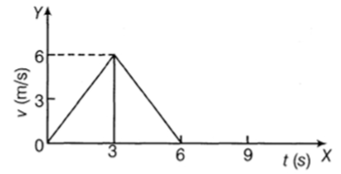
At $t=0$, a particle is at rest at origin. Its acceleration is $2 m / s ^2$ for the first 3 s and $-2 m / s ^2$ for next 3 s . Plot the acceleration versus time and velocity versus time graph.
View full question & answer
Question 83 Marks
In a refrigerator, heat from inside of a refrigerator at 270 K is transferred to a room at 300 K .
i. What is its coefficient of performance?
ii. How much heat will be delivered to the room for each joule of electric energy consumed? Assume the refrigerator to be an ideal one.
Answer
Given: Temp of source $T_1=300 K$ and $T e m p$ of $\operatorname{sink} T_2=270 K$
i. Coefficient of performance, $\alpha=\frac{T_2}{T_1-T_2}=\frac{270}{300-270}=9$
ii. Electric energy consumed by refrigerator = Work done by external agency on refrigerator Here, $W =1 J$
As $\alpha=\frac{Q_2}{W}$, hence $Q _2=W \times \alpha=1 J \times 9=9 J$
Thus, the heat delievered to the room, $Q _1= Q _2+ W =9 J+1 J=10 J$.
View full question & answer
3 Marks Question - Physics STD 11 Science Questions - Vidyadip