Question 15 Marks
A marble rolls along a table at a constant speed of $1.00 m / s$ and then falls off the edge of the table to the floor 1.00 m below,
i. How long does the marble take to reach the floor?
ii. At what horizontal distance from the edge of the table does the marble land?
iii. What is its velocity as it strikes the floor?
i. How long does the marble take to reach the floor?
ii. At what horizontal distance from the edge of the table does the marble land?
iii. What is its velocity as it strikes the floor?
Answer
View full question & answer→As the marble was rolling on the table, therefore it has horizontal velocity and it will act as a projectile as soon as it leaves the edge of the table and fall freely under the effect of gravity.
Since, the marble is initially moving horizontally, $v _{ y 0}=0$ and $v _{ x 0}=1.00 m / s$. We must consider the origin to be at the edge of the table, so that $x _0= y _0=0$
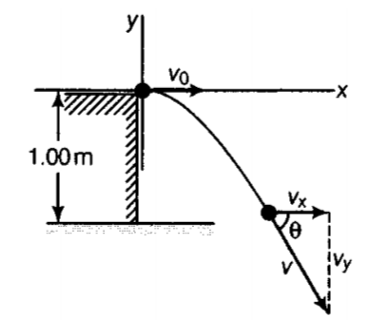
i. $t=?$ and $y=-1.00 m$
$
\begin{aligned}
& \therefore y=\frac{-1}{2} gt^2 \\
& \Rightarrow t=\sqrt{\frac{-2 y}{g}}=\sqrt{\frac{(-2)(-1.00)}{9.8}}=0.452 s
\end{aligned}
$
ii. $x =$ ?, when $t =0.452 s$
$
\therefore x=v_{x 0} t=1.00 \times 0.452 s=0.452 m
$
iii. $v =$ ?, $\theta=$ ? at $t =0.452 s$
The $x$-component of velocity is constant throughout the motion,
$
v_{x}=v_{x 0}=1.00 m / s
$
The $y$-component of velocity is given by
$
\begin{aligned}
& v_{y}=v_{y 0}-gt=0-9.8 \times 0.452=-4.43 m / s \\
& \therefore v=\sqrt{v_x^2+v_y^2}=\sqrt{(1.00)^2+(-4.43)^2}=4.54 m / s \text {, the magnitude of the resultant velocity of the motion. } \\
& \theta=\tan ^{-1}\left|\frac{v_y}{v_x}\right|=\frac{4.43}{1.00}=77.3^{\circ}
\end{aligned}
$
As the marble hits the floor, its velocity is $4.54 m / s$ directed $77.3^{\circ}$ downward with respect to the horizontal.
Since, the marble is initially moving horizontally, $v _{ y 0}=0$ and $v _{ x 0}=1.00 m / s$. We must consider the origin to be at the edge of the table, so that $x _0= y _0=0$
i. $t=?$ and $y=-1.00 m$
$
\begin{aligned}
& \therefore y=\frac{-1}{2} gt^2 \\
& \Rightarrow t=\sqrt{\frac{-2 y}{g}}=\sqrt{\frac{(-2)(-1.00)}{9.8}}=0.452 s
\end{aligned}
$
ii. $x =$ ?, when $t =0.452 s$
$
\therefore x=v_{x 0} t=1.00 \times 0.452 s=0.452 m
$
iii. $v =$ ?, $\theta=$ ? at $t =0.452 s$
The $x$-component of velocity is constant throughout the motion,
$
v_{x}=v_{x 0}=1.00 m / s
$
The $y$-component of velocity is given by
$
\begin{aligned}
& v_{y}=v_{y 0}-gt=0-9.8 \times 0.452=-4.43 m / s \\
& \therefore v=\sqrt{v_x^2+v_y^2}=\sqrt{(1.00)^2+(-4.43)^2}=4.54 m / s \text {, the magnitude of the resultant velocity of the motion. } \\
& \theta=\tan ^{-1}\left|\frac{v_y}{v_x}\right|=\frac{4.43}{1.00}=77.3^{\circ}
\end{aligned}
$
As the marble hits the floor, its velocity is $4.54 m / s$ directed $77.3^{\circ}$ downward with respect to the horizontal.