Questions

3 Marks Question

Take a timed test

8 questions · self-marked practice — reveal the answer and mark yourself.

Question 13 Marks
The manual of a car instructs the owner to inflate the tyres to a pressure of 200 kPa .
i. What is the recommended gauge pressure?
ii. What is the recommended absolute pressure?
iii. If after the required inflation of the tyres, the car is driven to a mountain peak where the atmospheric pressure is $10 \%$ below that at sea level, what will the tyre gauge read?
View full question & answer
Question 23 Marks
Briefly explain Magnus effect.
Answer
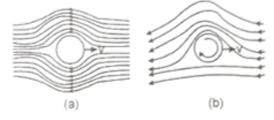
Magnus effect, generation of a sidewise force on a spinning cylindrical or spherical solid immersed in a fluid (liquid or gas) when there is relative motion between the spinning body and the fluid. It is responsible for the "curve" of a served tennis ball or a driven golf ball and affects the trajectory of a spinning artillery shell.
A spinning object moving through a fluid departs from its straight path because of pressure differences that develop in the fluid as a result of velocity changes induced by the spinning body. The Magnus effect is a particular manifestation of Bernoulli's theroem, fluid pressure decreases at points where the speed of the fluid increases. In the case of a ball spinning through the air, the turning ball drags some of the air around with it. Viewed from the position of the ball, the air is rushing by on all sides. The drag of the side of the ball turning into the air (into the direction the ball is traveling) retards the airflow, whereas on the other side the drag speeds up the airflow. Greater pressure on the side where the airflow is slowed down forces the ball in the direction of the low-pressure region on the opposite side, where a relative increase in airflow occurs.
Image
View full question & answer
Question 33 Marks
Give the magnitude and direction of the net force acting on a stone of mass 0.1 kg ,
a. just after it is dropped from the window of a stationary train,
b. just after it is dropped from the window of a train running at a constant velocity of $36 km / h$.
c. just after it is dropped from the window of a train accelerating with $1 ms^{-2}$,
d. lying on the floor of a train which is accelerating with $1 ms^{-2}$, the stone being at rest relative to the train.
Neglect air resistance throughout.
View full question & answer
Question 43 Marks
A glass plate of length 10 cm , breadth 4 cm and thickness 0.4 cm , weighs 20 g in air. It is held vertically with a long side horizontal and half the plate immersed in water. What will be its apparent weight? The surface tension of water $=70$ dyne $cm ^{-1}$.
Answer
Here $l =10 cm, b =4 cm, t =0.4 cm, m =20 g, \sigma=70$ dyne $cm ^{-1}$
Various forces acting on the plate are
i. Weight of the plate acting vertically downwards,
$
=mg=20 \times 980 \text { dyne }=20 g f
$
ii. Force due to surface tension acting vertically downwards,
$
\begin{aligned}
& F=\sigma \times \text { Length of plate in contact with water } \\
& =\sigma \times 2 \text { (length }+ \text { thickness) } \\
& =70 \times 2(10+0.4)=70 \times 20.8 \text { dyne } \\
& =\frac{70 \times 20.8}{980} g f=1.4857 g
\end{aligned}
$
iii. Upwards thrust due to liquid $=$ Weight of the liquid displaced
$=$ Volume of liquid displaced $\times$ density $\times g$
$=\left(1 \times \frac{b}{2} \times t \right) \times \rho \times g$
$=\left(10 \times \frac{4}{2} \times 0.4\right) 1 \times 980$ dyne
$=\frac{8 \times 980}{980} g f =8 g f$
$\therefore$ Apparent weight $=20+1.4857-8=13.4857 g f$
View full question & answer
Question 53 Marks
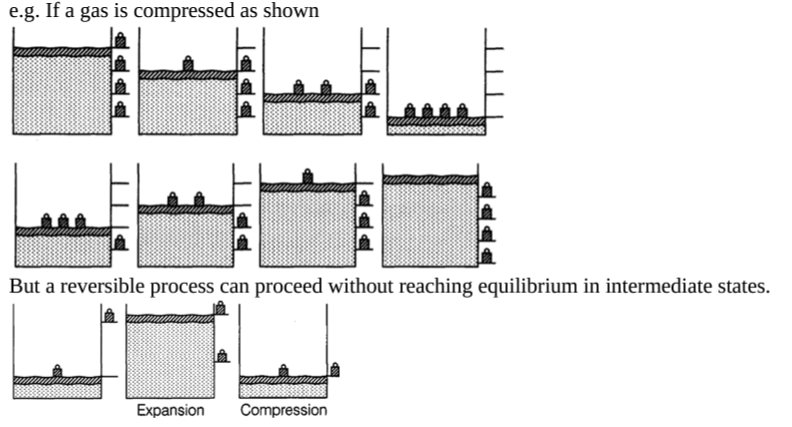
Explain with the suitable example that a reversible process must be carried slowly and a fast process is necessarily irreversible.
View full question & answer
Question 63 Marks
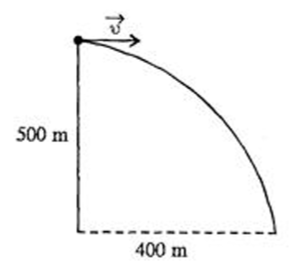
A 100 kg gun fires a ball of 1 kg horizontally from a cliff of height 500 m . It falls on the ground at a distance of 400 m from the bottom of the cliff. Find the recoil velocity of the gun. (acceleration due to gravity $=10 ms^{-2}$ ).
Answer

Image
Let the horizontal speed of the ball is $u m s^{-1}$ its vertical component will be zero.
Consider the motion off ball vertically downward
Here, mass of ball, $m _{ b }=1 kg$, Mass of gun, $M _{ G }=100 kg$
$u _{ b }=$ initial velocity of ball,
$v _{ b }=$ final velocity of ball,
$v _{ g }=$ final velocity of gun
$
\begin{aligned}
& u=0, s=h=500 m, g=10 s m^{-2} \\
& s=u t+\frac{1}{2} a t^2 \\
& 500=a \times t+\frac{1}{2} \times 10 t^2 \Rightarrow t^2=\frac{500}{5}=100 \\
& t=\sqrt{100}=10 sec
\end{aligned}
$
Horizontal distance covered by the ball is $x=u \times 10$
$
400=v \times 10 \Rightarrow v=40 m / sec
$
By the law of conservation of momentum
$
\begin{aligned}
& m_b u_j+M_G u_g=m_b v_b+M_G v_G \\
& \Rightarrow m_b \times 0+M_G \times 0=1 \times 40+100 v_G \\
& 100 v_{G}=-40
\end{aligned}
$
Recoil velocity of Gun $=\frac{-40}{100} m s^{-1}=\frac{-2}{5} m s^{-1}=-0.4 ms^{-1}$ i.e opposite to the speed of ball.
View full question & answer
Question 73 Marks
A body starting from rest accelerates uniformly at the rate of $10 cms ^{-2}$ and retards uniform $y$ at the rate of 20 $cms ^{-2}$. Find the least time in Which it can complete the journey of 5 km if the maximum velocity attained by the body is $72 kmh ^{-1}$.
Answer
i. For motion with uniform acceleration:
$
u=0, v=72 km^{-1}=20 ms^{-1}, a=10 cms^{-2}=0.1 ms^{-2}, t=t_1=?, s=?
$
As $v = u +$ at
$
\therefore 20=0+0.1 \times t_1 \text { or } t_1=200 s
$
Also, $v ^2= u ^2+2$ as
$
\therefore 20^2=0^2+2 \times 0.1 \times s \text { or } s=2000 m=2 km
$
ii. For motion with uniform retardation:
$
u=20 ms^{-1}, v=0, a=-20 cms^{-2}=-0.21 ms^{-2}, t=t_2=? s=?
$
As $v = u +$ at
$
\therefore 0=20-0.2 \times t_2
$
Again, $t _2=100 s$
Again, $v ^2= u ^2+2$ as
$
\begin{aligned}
& \therefore 0=20^2+2 \times(-0.2) s \\
& \text { or } s=1000 m=1 km
\end{aligned}
$
Remaining part of journey $=5-(2+1)=2 km=2000 m$
This journey occurs at the uniform maximum velocity of $20 ms^{-1}$
iii. For motion with uniform velocity:
$
u=20 ms^{-1}, s=2000 m, t=t_3=\text { ? }
$
Time, $t _3=\frac{s}{u}=\frac{2000}{20}=100 s$
Total time $=t_1+t_2+t_3=200+100+100=400 s$
View full question & answer
Question 83 Marks
A clock with an iron pendulum keeps the correct time at $20^{\circ} C$. How much will it lose or gain if the temperature changes to $40^{\circ} C$ ? Coefficient of cubical expansion of iron $=36 \times 10^{-6}{ }^{\circ} C ^{-1}$.
Answer
Time period of simple pendulum,
$
T_{20}=2 s
$
Let $T _{40}$ be the time period at $40^{\circ} C$. If $l _0, l _{20}, l _{40}$ be the lengths of the pendulum at $0^{\circ} C , 20^{\circ} C$ and $40^{\circ} C$ respectively, then
$
\begin{aligned}
& l_{20}=l_0(1+20 \alpha) \\
& l_{40}=l_0(1+40 \alpha)
\end{aligned}
$
$
\begin{aligned}
& T_{20}=2 \pi \sqrt{\frac{l_{20}}{g}}=2 \pi \sqrt{\frac{l_0(1+20 \alpha)}{g}} \\
& T_{40}=2 \pi \sqrt{\frac{l_{40}}{g}}=2 \pi \sqrt{\frac{l_0(1+40 \alpha)}{g}} \\
& \therefore \frac{T_{40}}{T_{20}}=\sqrt{\frac{1+40 \alpha}{1+20 \alpha}}=(1+40 \alpha)^{1 / 2}(1+20 \alpha)^{-1 / 2}
\end{aligned}
$
$
\begin{aligned}
& =\left(1+\frac{1}{2} \times 40 \alpha\right)\left(1-\frac{1}{2} \times 20 \alpha\right) \text { [Using Binomial theorem] } \\
& =(1+20 \alpha)(1-10 \alpha)=1+10 \alpha
\end{aligned}
$
Fractional loss in time
$
\begin{aligned}
& =\frac{T_{40}-T_{20}}{T_{20}}=10 \alpha \\
& =10 \times 1.2 \times 10^{-5}=1.2 \times 10^{-4}
\end{aligned}
$
As the temperature increases, time period also increases. The clock runs slow.
Time lost in 24 hours
$
=1.2 \times 10^{-4} \times 24 \times 3600=10.368 s
$
View full question & answer
3 Marks Question - Physics STD 11 Science Questions - Vidyadip