Questions

5 Marks Questions

Take a timed test

7 questions · self-marked practice — reveal the answer and mark yourself.

Question 15 Marks
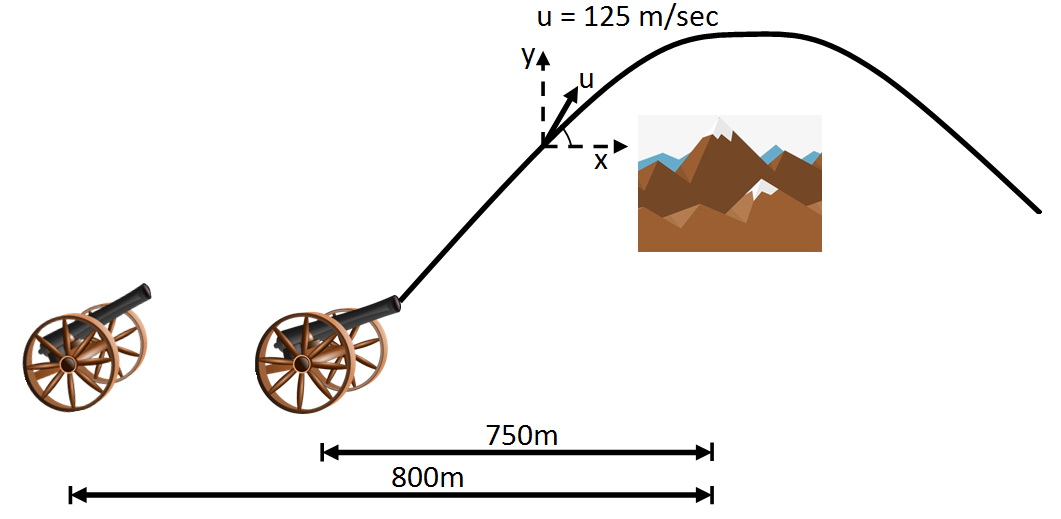
A hill is 500m high. Supplies are to be sent across the hill using a canon that can hurl packets at a speed of 125m/ s over the hill. The canon is located at a distance of 800m from the foot of hill and can be moved on the ground at a speed of 2m/ s; so that its distance from the hill can be adjusted. What is the shortest time in which a packet can reach on the ground across the hill? Take g =10m/ s2.
Answer

Speed of packets = 125m/ s

Height of hill = 500m

To cross the hill by packet the vertical components of the speed of packet (125m s-1) must be minimised so that it can attain a height of 500m and the distance between Hill and Cannon must be half the range of packet.

$\text{v}^2=\text{u}^2+2\text{gh}$

$0=\text{u}^2_\text{y}-2\text{gh}$

$\text{u}_\text{y}=\sqrt{2\text{gh}}=\sqrt{2\times10\times500}$

$=\sqrt{10000}$

$\text{u}_\text{y}=100\text{m/s}$

$\text{u}^2=\text{u}^2_\text{x}+\text{u}^2_\text{y}$

$(125)^2=\text{u}^2_\text{x}+100^2$

$\Rightarrow\ \text{u}^2_\text{x}=125^2-100^2$

$\text{u}^2_\text{x}=(125-100)(125+100)$

$=25\times225$

$\text{u}_\text{x}=5\times15$

$\Rightarrow\ \text{u}_\text{x}=75\text{m/s}$

Vertical motion of packet

$\text{v}_\text{y}=\text{u}_\text{y}+\text{gt}$

$0=100-10\text{t}$

$\therefore\ \text{Total time of }\frac{1}2\text{ flight}=10\text{sec}$ [Total time to reach the top of hill]

So the cannon must be at $\frac{1}2$ the range = horizontal distance in 10sec

$=\text{u}_\text{x}\times10=75\times10\text{m}=750$

Hence, the distance between hill and cannon = 750m

So the distance to which cannon must move toward the hill = 800 - 750 = 50m

Time taken to move cannon in 50m $=\frac{\text{distance}}{\text{speed}}=\frac{50}{2}=25\text{sec}$

Hence, the total time taken by packet from 800m away from hill to reach other side

= 25s + 10s + 10s = 45 seconds.
View full question & answer
Question 25 Marks
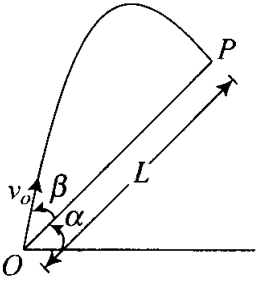
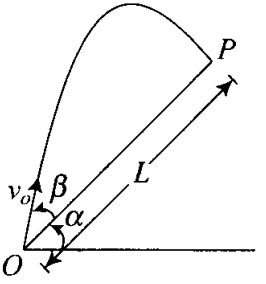
A particle is projected in air at an angle $\beta$ to a surface which itself is inclined at an angle $\alpha$ to the horizontal (Fig.).

  1. Time of flight.
(Hint: This problem can be solved in two different ways:

  1. Point P at which particle hits the plane can be seen as intersection of its trajectory (parobola) and straight line. Remember particle is projected at an angle $(\alpha+\beta)$ w.r.t. horizontal.
  2. We can take x-direction along the plane and y-direction perpendicular to the plane. In that case resolve g (acceleration due to gravity) in two differrent components, gx along the plane and gy perpendicular to the plane. Now the problem can be solved as two independent motions in x and y directions respectively with time as a common parameter.)
Answer
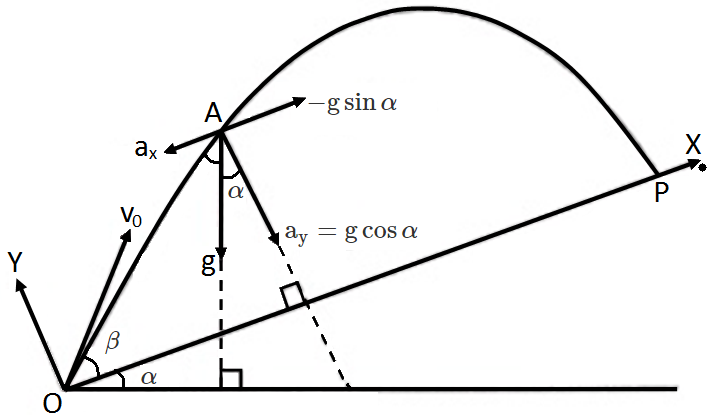
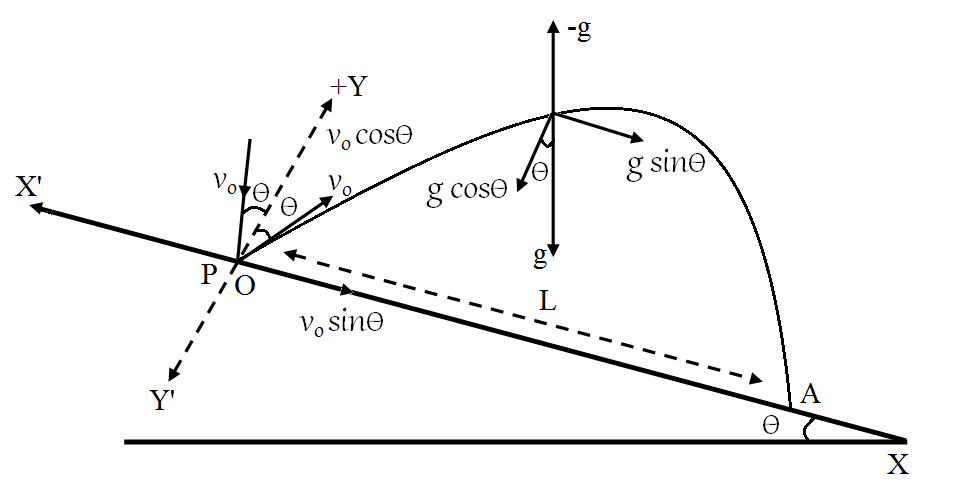
Consider new cartesian coordinates in which X-axis is along inclined plane OP and OY axis perpendicular to it as shown in the figure. Consider the motion of the projectile from OAP.

$\text{a}_\text{y}=-\text{g}\cos\alpha$

$\text{a}_\text{x}=\text{g}\sin\alpha$At O and PY = 0

$\text{u}_\text{y}=\text{v}_0\sin\beta,\text{t}=\text{T}$

The motion of projectile along New OY axis.

$\text{s} = \text{u}\text{t}+\frac{1}{2}\text{g}\text{t}^{2}$

$\text{s}=0, \text{u}=\text{u}_\text{y}=\text{v}_0\sin\beta \ \text{g}=\text{g}_\text{y}=-\text{g}\cos\alpha \ \text{t}=\text{T}$

$0=\text{v}_0\sin\beta(\text{T})+\frac{1}{2}(-\text{g}\cos\alpha)\text{T}^2$

$0=\text{v}_0\sin\beta(\text{T})+\frac{\text{g}}{2}\cos\alpha\text{(T)}^2$

$\text{T}=\Big[\text{v}_0\sin\beta-\text{T}\frac{\text{g}}{2}\cos\alpha\Big]=0$

Either $\text{T}=0$ or $\text{v}_0\sin\beta-\frac{\text{gt}}{2}\cos\alpha=0$

$\frac{\text{gt}}{2}\cos\alpha=\text{v}_0\sin\beta$

$\therefore$ Time of flight from O to P is $\text{T}=\frac{2\text{v}_0\sin\beta}{\text{g}\cos\alpha}$

At $\text{T}=0$ projectile is at O

and at $\text{T}=\frac{2\text{v}_0\sin\beta}{\text{g}\cos\alpha}$ it is at P.

View full question & answer
Question 35 Marks
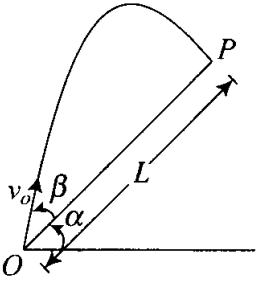
A particle is projected in air at an angle $\beta$ to a surface which itself is inclined at an angle $\alpha$ to the horizontal (Fig.).

  1. β at which range will be maximum.
(Hint: This problem can be solved in two different ways:

  1. Point P at which particle hits the plane can be seen as intersection of its trajectory (parobola) and straight line. Remember particle is projected at an angle $(\alpha+\beta)$ w.r.t. horizontal.
  2. We can take x-direction along the plane and y-direction perpendicular to the plane. In that case resolve g (acceleration due to gravity) in two differrent components, gx along the plane and gy perpendicular to the plane. Now the problem can be solved as two independent motions in x and y directions respectively with time as a common parameter.)
Answer
Consider new cartesian coordinates in which X-axis is along inclined plane OP and OY axis perpendicular to it as shown in the figure. Consider the motion of the projectile from OAP.

$\text{a}_\text{y}=-\text{g}\cos\alpha$

$\text{a}_\text{x}=\text{g}\sin\alpha$

For L will be maximum pr maximum range along with new OX axis. From above relation of L, it will be maximum when $\sin\beta\cos(\alpha+\beta)$ is maximum as $\alpha$ is a constant angle of inclination of the plane. So $\cos^2\alpha$ is constant.

Consider $\text{Z}=\sin\beta\cos(\alpha+\beta)$

$=\sin\beta[\cos\alpha\cos\beta-\sin\alpha\sin\beta]$

$=\frac{1}{2}[\cos\alpha \ 2\sin\beta\cos\beta-\sin\alpha \ 2\sin^2\beta]$

$=\frac{1}{2}[\cos\alpha \ \sin2\beta-\sin\alpha+(1-\cos \ 2\beta)]$

$=\frac{1}{2}[\cos\alpha \ \sin2\beta-\sin\alpha+\sin\alpha\cos \ 2\beta]$

$=\frac{1}{2}[\cos\alpha \ \sin2\beta+\sin\alpha\cos \ 2\beta-\sin\alpha]$

$\text{Z}=\frac{1}{2}[\sin(2\beta+\alpha-\sin\alpha)]$

For Z maximum

$\sin(2\beta+\alpha)=1$

$\sin(2\beta+\alpha)=\sin90^\circ$

$2\beta+\alpha=90^\circ$

$2\beta=90^\circ-\alpha$

$\Rightarrow\beta=\frac{90^\circ}{2}-\frac{\alpha}{2}=45^\circ-\frac{\alpha}{2}$

$\therefore\beta=\frac{\pi}{4}-\frac{\alpha}{2}$ radian.

View full question & answer
Question 45 Marks
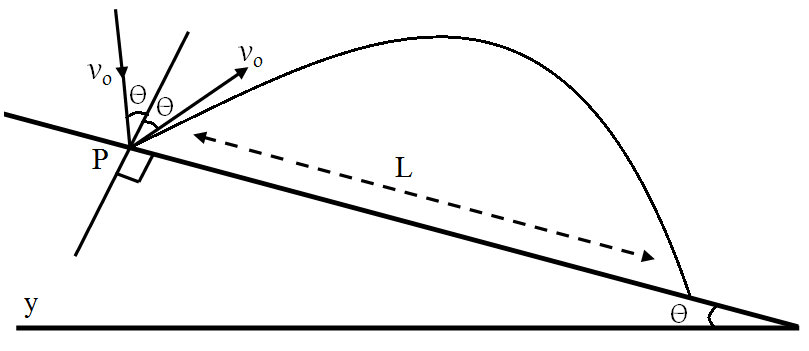
A particle falling vertically from a height hits a plane surface inclined to horizontal at an angle $\theta$ with speed $\text{v}_0$ and rebounds elastically. Find the distance along the plane where if will hit second time.

(Hint:

  1. After rebound, particle still has speed Vo to start.
  2. Work out angle particle speed has with horizontal after it rebounds.
  3. Rest is similar to if particle is projected up the incline.
Answer
Particle rebounces from P so it will be an elastic collision. As it strikes plane inclined at  $\text{v}_0$ speed so speed of particle after rebounces will be $\text{v}_0$

Again consider the new axia X'OX and YOY' axis at P as origin 'O'. The componenets of g and $\text{v}_0$ in new OX and OY axis are:

$\text{v}_\text{x}=\text{v}_0\sin\theta\text{ and v}_\text{y}=\text{v}_0\cos\theta$

$\text{g}_\text{x}=\text{g}\cos\theta,\text{g}_\text{y}=\text{g}\sin\theta$ acting vertically downwords 

Consider the motion of particle from O to A in new YOY' axis.

$\text{s}_\text{y}=\text{u}_\text{y}\text{t}+\frac{1}{2}\text{a}_\text{y}\text{t}^2$

$\text{s}_\text{y}=0\ \text{v}_\text{y}=\text{v}_0\cos\theta\ \text{a}_\text{y}=-\text{g}\sin\theta $ (upward)

$\therefore\text{t=T}$ (time of flight)

$0=\text{T}\Big[\text{v}_0\cos\theta-\frac{1}{2}\text{g}\text{ sin}\theta\text{ T}\Big]$

This means either $\text{T}=0\text{ or v}_0\cos\theta-\frac{\text{g}\cos\theta(\text{T})}{2}=0$

T cannot be zero $\Rightarrow\text{T}=\frac{2\text{v}_0\cos\theta}{\text{g}\cos\theta}$

$\text{T}=\frac{2\text{v}_0}{\text{g}}$

Now consider the motion along OX axis.

$\text{S}_\text{x}=\text{L, u}_\text{x}=\upsilon_0\sin\theta,\text{a}_\text{x}=\text{g}\sin\theta,\text{t}=\text{T}=\frac{2\upsilon_0}{\text{g}}$

$\text{S}_\text{x}=\text{u}_\text{x}\text{t}+\frac{1}{2}\text{a}_\text{x}\text{t}^2$

$\text{L}=\Big[\frac{2\text{v}_\text{0}}{\text{g}}\Big]\text{v}_0\sin\theta+\frac{1}{2}\text{g}\sin\theta\Big[\frac{2\text{v}_0}{\text{g}}\Big]^2$

$\text{L}=\frac{2\text{v}^2_0}{\text{g}}\sin\theta+\frac{1}{2}\text{g}\sin\theta.\frac{4\text{v}^2_0}{\text{g}^2}$

$=\frac{2\text{v}^2_0}{\text{g}}[\sin\theta+\sin\theta]=\frac{2\text{v}^2_0}{\text{g}}2\sin\theta$

$\Rightarrow\text{L}=\frac{4\text{v}^2_0}{\text{g}}\sin\theta.$

View full question & answer
Question 55 Marks
A man wants to reach from A to the opposite corner of the square C Fig. The sides of the square are 100m. A central square of 50m × 50m is filled with sand. Outside this square, he can walk at a speed 1m/ s. In the central square, he can walk only at a speed of $\upsilon\text{m/ s}(\upsilon<1)$. What is smallest value of v for which he can reach faster via a straight path through the sand than any path in the square outside the sand?

Answer
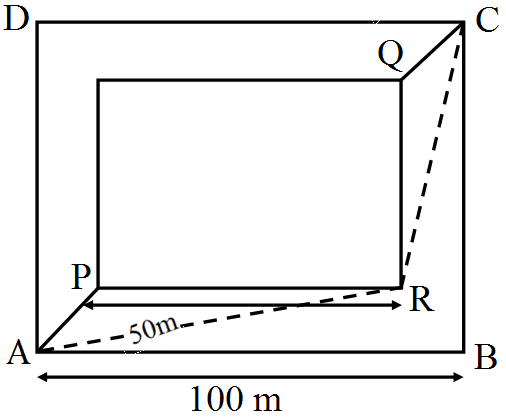
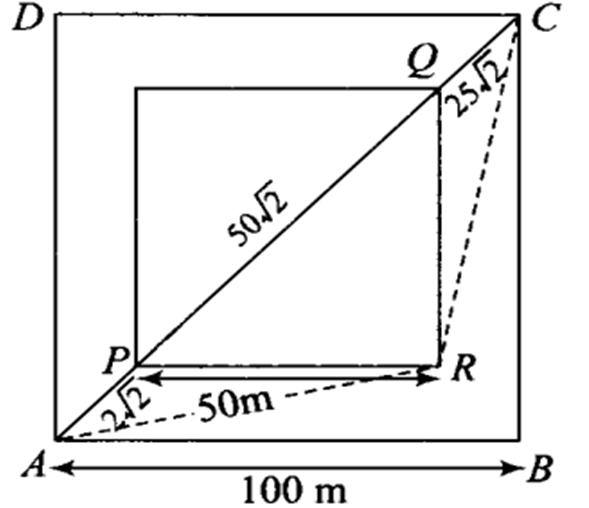
As shown in the adjacent diagram.

The man walk throught the sand on the path APQC via straight line, so, time taken by him to go from A to C is
$\text{T}_\text{sand}=\frac{\text{AP+QC}}{1}+\frac{\text{PQ}}{\text{v}}$

$=\frac{25\sqrt{2}+25\sqrt{2}}{1}+\frac{50\sqrt{2}}{\text{v}}$

$=50\sqrt{2}+\frac{50\sqrt{2}}{\text{v}}$

$=50\sqrt{2}\Big(\frac{1}{\text{v}}+1\Big)$

Clearly from figure the shortest path outside the sand will be ARC. Time taken to go from A to C via this path is

$\text{T}_\text{outside}=\frac{\text{AR+RC}}{1}\text{s}$

Clearly, $\text{AR}=\sqrt{75^2+25^2}$$=\sqrt{75\times75\times+25\times25}$

$=5\times5\sqrt{9+1}$ $=25\sqrt{10}\text{m}$

$\text{RC}=\text{AR}=\sqrt{75^2+25^2}$ $=25\sqrt{10}\text{m}$

$\Rightarrow\text{T}_\text{outside}2\text{AR}=2\times25\sqrt{10}\text{s}$ $=50\sqrt{10}\text{s}$

For $\text{T}_\text{sand}<\text{T}_\text{outside}$

$\Rightarrow50\sqrt{2}\Big(\frac{1}{\text{v}}+1\Big)<2\times25\sqrt{10}$

$\Rightarrow\frac{2\sqrt{2}}{2}\Big(\frac{1}{\text{v}}+1\Big)\sqrt{10}$

$\Rightarrow\frac{1}{\text{v}}+<\frac{2\sqrt{10}}{2\sqrt{2}}$ $=\frac{\sqrt{5}}{2}\times2=\sqrt{5}$

$\frac{1}{\text{v}}<\frac{\sqrt{5}}{2}\times2-1\Rightarrow\frac{1}{\text{v}}<\sqrt{5}-1$

$\Rightarrow\text{v}>\frac{1}{\sqrt{5}-1}\approx0.81\text{m/ s}\Rightarrow\text{v}>0.81\text{m/ s}$

View full question & answer
Question 65 Marks
A fighter plane is flying horizontally at an altitude of 1.5km with speed 720km/ h. At what angle of sight (w.r.t. horizontal) when the target is seen, should the pilot drop the bomb in order to attack the target?
Answer

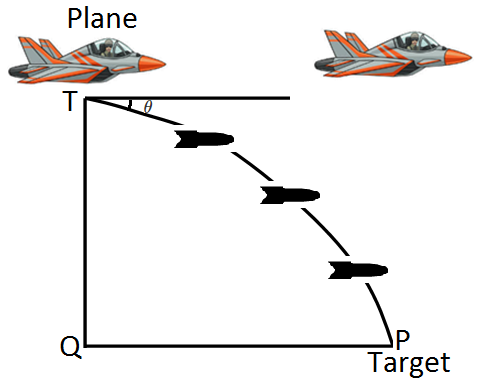
Let pilot drops the bomb t sec before the point Q vertically up the target T.

The horizontal velocity of the bomb will to equal to the velocity of the fighter plane, but vertical component of it is zero. So in time t bomb must cover the vertical distance TQ as free fall with initial velocity zero.
$\text{u}=0,\text{H}=1.5\text{km}=1500\text{m, g}=+10\text{m/s}^2$

$\text{H}=\text{ut}+\frac{1}2\text{gt}^2$

$1500=0+\frac{1}210\text{t}^2$

$\text{t}=\sqrt{\frac{1500}{5}}=\sqrt{300}=10\sqrt3\text{ second}.$

$\therefore$ Distance covered by plane or bomb PQ = ut

$\text{PQ}=200\times10\sqrt3=2000\sqrt3\text{m}$

$\tan\theta=\frac{\text{TQ}}{\text{PQ}}=\frac{1500}{2000\sqrt3}.\frac{\sqrt3}{\sqrt3}=\frac{15\sqrt3}{20\times3}=\frac{\sqrt3}{4}$

$\tan\theta=\frac{1.732}{4}=0.433=\tan^{-1}23^\circ42'$

$\Rightarrow\ \theta=23^\circ42'.$

View full question & answer
Question 75 Marks
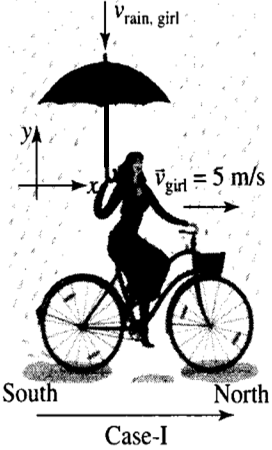
A girl riding a bicycle with a speed of 5m/ s towards north direction, observes rain falling vertically down. If she increases her speed to 10m/ s, rain appears to meet her at 45° to the vertical. What is the speed of the rain? In what direction does rain fall as observed by a ground based observer?
(Hint: Assume north to be $\hat{\text{i}}$ direction and vertically downward to be $-\hat{\text{j}}$. Let the rain velocity $\text{v}_\text{r}$ be $\text{a}\hat{\text{i}}+\text{b}\hat{\text{j}}.$ The velocity of rain as observed by the girl is always Vr-Vgirl. Draw the vector diagram/s for the information given and find a and b. You may draw all vectors in the reference frame of ground based observer)
Answer
$\text{V}_{\text{rg}}$ is the velocity of rain appears to the girl.

We must draw all vectors in the reference frame of ground-based observer.

Assume north to be $\hat{\text{i}}$ direction and vertically downward to be$(-\hat{\text{j}})$.

Let the rain velocity

$\text{v}_\text{r}=\text{a}\hat{\text{i}}+\text{b}\hat{\text{j}}$

Case I: According to the problem, velocity of

$\text{girl}=\text{v}_\text{g}=({5\text{m/ s}})\hat{\text{i}}$

Let $\text{v}_\text{rg}=$ velocity of rain w.r.t girl

$=\text{v}_\text{r}-\text{v}_\text{g}=(\text{a}\hat{\text{i}}+\text{b}\hat{\text{j}})-5\hat{\text{i}}=(\text{a}-5)\hat{\text{i}}+\text{b}\hat{\text{j}}$

According to question, rain appears to fall vertically downward.

Hence,$\text{a}-5=0\Rightarrow\text{a}=5$

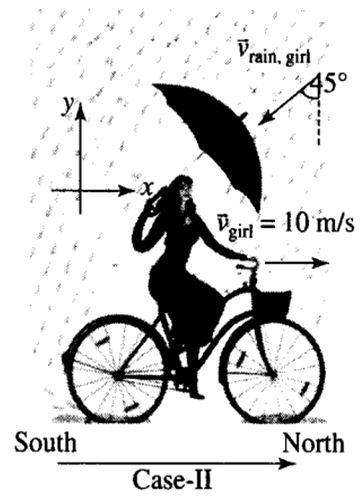
Case II: Now velocity of the girl after increasing her speed,

$\text{v}_\text{g}=(10\text{m/ s})\hat{\text{i}}$

$\therefore \ \text{v}_\text{rg}=\text{v}_\text{r}-\text{v}_\text{g}$

$=(\text{a}\hat{\text{i}}+\text{b}\hat{\text{j}})-10\hat{\text{i}}=(\text{a}-10)\hat{\text{i}}+\text{b}\hat{\text{j}}$

According to questions rain appears to fall at 45° to the vertical, hence

$\tan45^\circ=\frac{\text{b}}{\text{a}-10}=1$

$\Rightarrow \ \ \text{b}=\text{a}-10=5-10=-5$

Hence, velocity of rain $=\text{a}\hat{\text{i}}+\text{b}\hat{\text{j}}$

$\Rightarrow \ \ \text{v}_\text{r}=5\hat{\text{i}}-5\hat{\text{j}}$

Speed of rain

$=|\text{v}_\text{r}|=\sqrt{(5)^2+(-5)^2}=\sqrt{50}=5\sqrt{2}\text{m/s}$

View full question & answer
5 Marks Questions - Physics STD 11 Science Questions - Vidyadip