Question
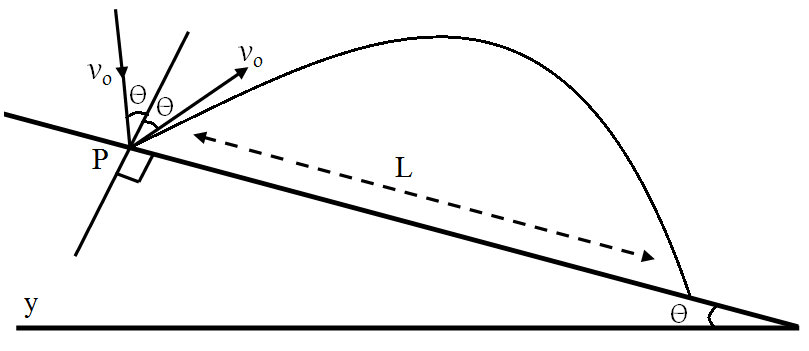
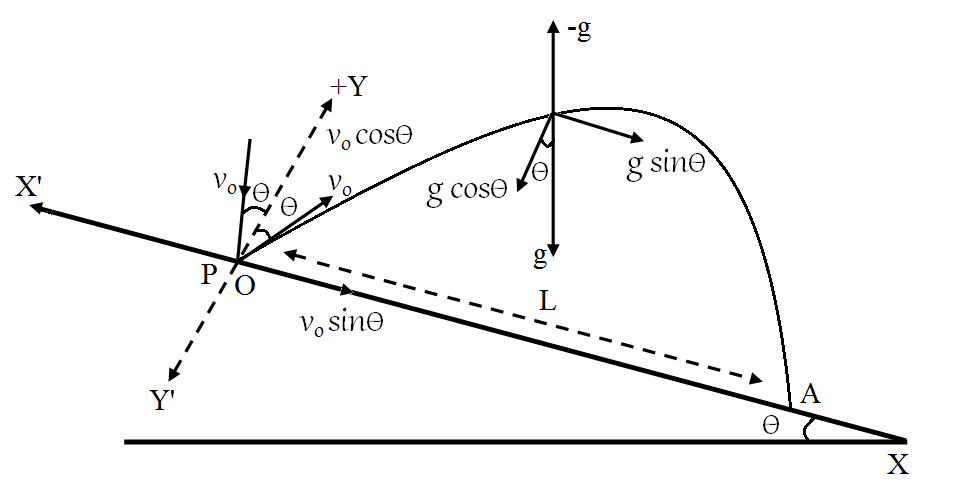
A particle falling vertically from a height hits a plane surface inclined to horizontal at an angle $\theta$ with speed $\text{v}_0$ and rebounds elastically. Find the distance along the plane where if will hit second time.
(Hint:

  1. After rebound, particle still has speed Vo to start.
  2. Work out angle particle speed has with horizontal after it rebounds.
  3. Rest is similar to if particle is projected up the incline.
Answer

Particle rebounces from P so it will be an elastic collision. As it strikes plane inclined at  $\text{v}_0$ speed so speed of particle after rebounces will be $\text{v}_0$

Again consider the new axia X'OX and YOY' axis at P as origin 'O'. The componenets of g and $\text{v}_0$ in new OX and OY axis are:

$\text{v}_\text{x}=\text{v}_0\sin\theta\text{ and v}_\text{y}=\text{v}_0\cos\theta$

$\text{g}_\text{x}=\text{g}\cos\theta,\text{g}_\text{y}=\text{g}\sin\theta$ acting vertically downwords 

Consider the motion of particle from O to A in new YOY' axis.

$\text{s}_\text{y}=\text{u}_\text{y}\text{t}+\frac{1}{2}\text{a}_\text{y}\text{t}^2$

$\text{s}_\text{y}=0\ \text{v}_\text{y}=\text{v}_0\cos\theta\ \text{a}_\text{y}=-\text{g}\sin\theta $ (upward)

$\therefore\text{t=T}$ (time of flight)

$0=\text{T}\Big[\text{v}_0\cos\theta-\frac{1}{2}\text{g}\text{ sin}\theta\text{ T}\Big]$

This means either $\text{T}=0\text{ or v}_0\cos\theta-\frac{\text{g}\cos\theta(\text{T})}{2}=0$

T cannot be zero $\Rightarrow\text{T}=\frac{2\text{v}_0\cos\theta}{\text{g}\cos\theta}$

$\text{T}=\frac{2\text{v}_0}{\text{g}}$

Now consider the motion along OX axis.

$\text{S}_\text{x}=\text{L, u}_\text{x}=\upsilon_0\sin\theta,\text{a}_\text{x}=\text{g}\sin\theta,\text{t}=\text{T}=\frac{2\upsilon_0}{\text{g}}$

$\text{S}_\text{x}=\text{u}_\text{x}\text{t}+\frac{1}{2}\text{a}_\text{x}\text{t}^2$

$\text{L}=\Big[\frac{2\text{v}_\text{0}}{\text{g}}\Big]\text{v}_0\sin\theta+\frac{1}{2}\text{g}\sin\theta\Big[\frac{2\text{v}_0}{\text{g}}\Big]^2$

$\text{L}=\frac{2\text{v}^2_0}{\text{g}}\sin\theta+\frac{1}{2}\text{g}\sin\theta.\frac{4\text{v}^2_0}{\text{g}^2}$

$=\frac{2\text{v}^2_0}{\text{g}}[\sin\theta+\sin\theta]=\frac{2\text{v}^2_0}{\text{g}}2\sin\theta$

$\Rightarrow\text{L}=\frac{4\text{v}^2_0}{\text{g}}\sin\theta.$

Need a full question paper?

Generate a complete, print-ready paper with questions like this in minutes — across 16+ boards, with answer keys.

Start Generating Free

Similar questions

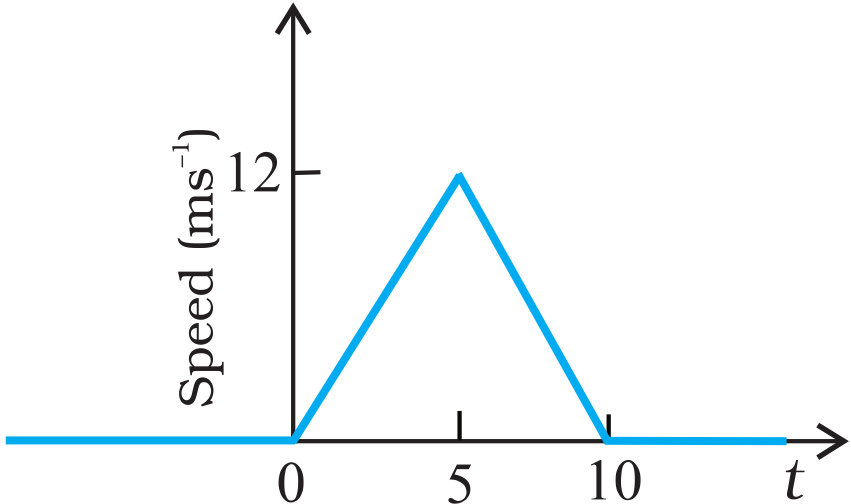
The speed-time graph of a particle moving along a fixed direction is shown in. Obtain the distance traversed by the particle between.
  1. t = 0s to 10s,
  2. t = 2s to 6s.

What is the average speed of the particle over the intervals in (a) and (b)?
The two blocks in an Atwood machine have masses 2.0kg and 3.0kg. Find the work done by gravity during the fourth second after the system is released from rest.
For the wave on a string described in Exercise 15.11, do all the points on the string oscillate with the same,
  1. Frequency,
  2. Phase,
  3. Amplitude?
A block of mass 2.0kg moving at 2.0m/s collides head on with another block of equal mass kept at rest.
  1. Find the maximum possible loss in kinetic energy due to the collision.
  2. If the actual loss in kinetic energy is half of this maximum, find the coefficient of restitution.
A geyser heats water flowing at the rate of 3.0 litres per minute from 27°C to 77°C. If the geyser operates on a gas burner, what is the rate of consumption of the fuel if its heat of combustion is 4.0 × 10⁴J/g?
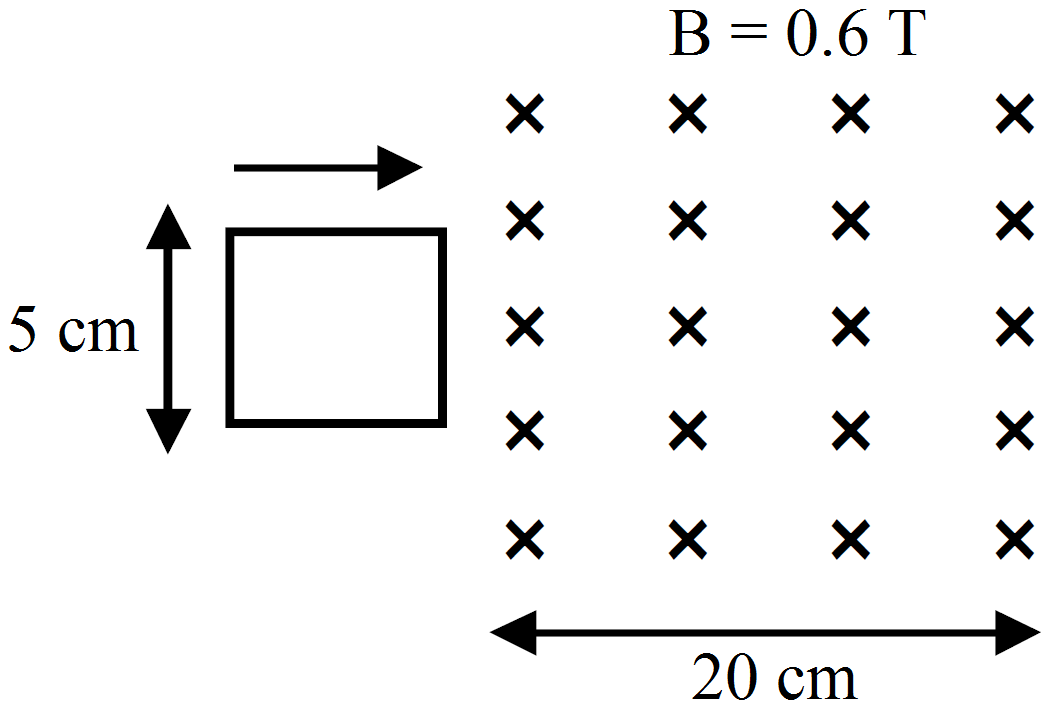
Figure shows a square loop of side 5cm being moved towards right at a constant speed of 1cm/s. The front edge enters the 20cm wide magnetic field at t = 0. Find the emf induced in the loop at:
  1. t = 2s
  2. t = 10s
  3. t = 22s
  4. t = 30s.

A body of mass 0.40 kg moving initially with a constant speed of $10 ms^{-1}$ to the north is subject to a constant force of 8.0 N directed towards the south for 30 s . Take the instant the force is applied to be $t=0$, the position of the body at that time to be $x=0$, and predict its position at $t=-5 s, 25 s, 100 s$.
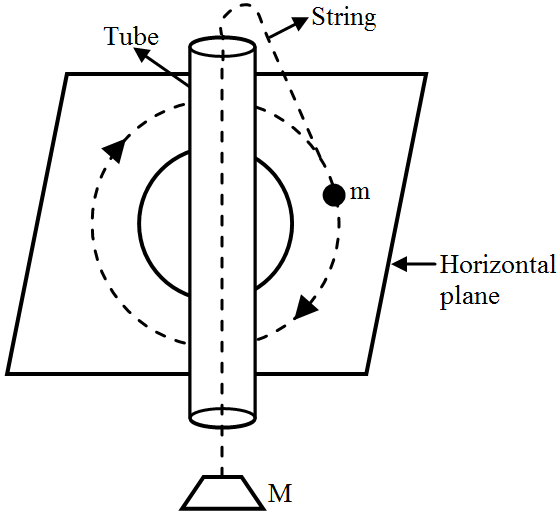
A large mass 'M' and a small mass ‘m' hang at the two ends of a string that passes over a smooth tube. The mass m moves around in a circular path which

lies in the horizontal plane. The length of the string from the mass m to the top of the tube is l and $\theta$ is the angle this length makes with the vertical. What should be the frequency of rotation of the mass m so that mass M remains stationary?

A capacitor having a capacitance of $100\mu\text{F}$ is charged to a potential difference of 50V.
  1. What is the magnitude of the charge on each plate?
  2. The charging battery is disconnected and a dielectric of dielectric constant 2.5 is inserted. Calculate the new potential difference between the plates.
  3. What charge would have produced this potential difference in absence of the dielectric slab.
  4. Find the charge induced at a surface of the dielectric slab.
Explain gravitational potential at a point in gravitational field. Give relation between gravitational field intensity and gravitational potential.