Questions · Page 3 of 3

1 Marks Question

Question 1011 Mark
Two springs of force constant k1 and k2 are joined in parallel. What is the force constant of the combination?
Answer
Force constant k of parallel combination is given by k = k1 + k2. Thus, force constant of the parallel combination is equal to the sum of individual force constants of two springs.
View full question & answer
Question 1041 Mark
Why should the amplitude of the vibrating pendulum be small?
Answer
When amplitude of the vibrating pendulum is small, then angular displacement of the bob used in simple pendulum is small. Here the restoring force

$\text{F}=\text{mg}\sin\theta=\text{mg}\theta=\frac{\text{mgx}}{\text{l}}$ 

Where x is the displacement of the bob and I is the length of pendulum . Hence $\text{F}\propto\text{x}$ Since F is directed towards mean position, therefore the motion of the bob of simple pendulum will be S. H. M.if $\theta$ is small.

View full question & answer
Question 1051 Mark
At what points is the energy entirely kinetic and potential in SHM?
Answer
At mean position, the energy is entirely K.E. At extreme positions, the energy is entirely P.E.
View full question & answer
Question 1061 Mark
If the body is given a small displacement from the mean position, a force comes in to play which tends to bring the body back to the mean point, this give rise to vibrations. Define phase of a vibrating particle.
Answer
The phase of a vibrating particle at any instant of time is the state of particle as regards to its position and state of motion.
View full question & answer
Question 1071 Mark
Is simple harmonic motion always linear?
Answer
No, it is not essential. Simple harmonic motion may be either a linear simple harmonic motion or an angular SHM.
View full question & answer
Question 1081 Mark
Which of the following examples represent (nearly) simple harmonic motion and which represent periodic but not simple harmonic motion?
Motion of a ball bearing inside a smooth curved bowl, when released from a point slightly above the lower most point.
Answer
It is simple harmonic motion because the ball moves to and fro about the lowermost point of the bowl when released. Also, the ball comes back to its initial position in the same period of time, again and again.
View full question & answer
Question 1091 Mark
During the oscillation of the bob of a simple pendulum, what is the quantity that remains constant?
Answer
Total mechanical energy associated always remains constant.
View full question & answer
Question 1101 Mark
How would the period of spring mess system change when it is med€ to oscillatc horizontally and then vertically?
Answer
Time period is independent of g. So no change.
View full question & answer
Question 1121 Mark
Which of the following examples represent (nearly) simple harmonic motion and which represent periodic but not simple harmonic motion?
Motion of an oscillating mercury column in a U-tube.
Answer
It is a simple harmonic motion because the mercury moves to and fro on the same path, about the fixed position, with a certain period of time.
View full question & answer
Question 1131 Mark
Give the geometrical meaning of S.H.M.
Answer
Geometrically S.H.M. refers to the projection of a uniform circular motion along any diameter.
View full question & answer
Question 1141 Mark
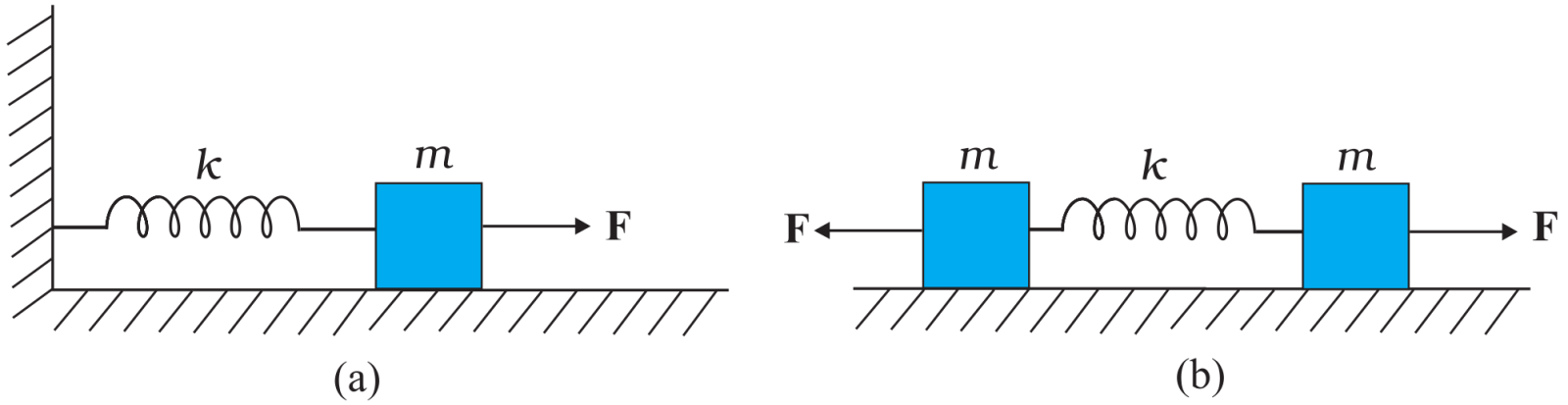
Figure (a) shows a spring of force constant k clamped rigidly at one end and a mass m attached to its free end. A force F applied at the free end stretches the spring. Figure (b) shows the same spring with both ends free and attached to a mass m at either end. Each end of the spring in Fig. (b) is stretched by the same force F.

What is the maximum extension of the spring in the two cases?

Answer
The maximum extension of the spring in both cases will = Flk, where k is the spring constant of the springs used.
View full question & answer
Question 1151 Mark
Can a motion be periodic but not oscillatory? If your answer is yes, give an example and if not explain why?
Answer
Yes, uniform circular motion is the example of it.
View full question & answer
Question 1161 Mark
Give the name of three important characteristics of a SHM.
Answer
Three important characteristics of an SHM are amplitude, time period (or frequency) and phase.
View full question & answer
Question 1171 Mark
A spring of force constant k is broken into n equal parts (n > 0). What will be the spring factor of each part?
Answer
The spring factor of each equal part is nk.
View full question & answer
Question 1181 Mark
What are the basic properties required by a system to oscillate?
Answer
Inertia and elasticity are the properties which are required by a system to oscillate.
View full question & answer
Question 1191 Mark
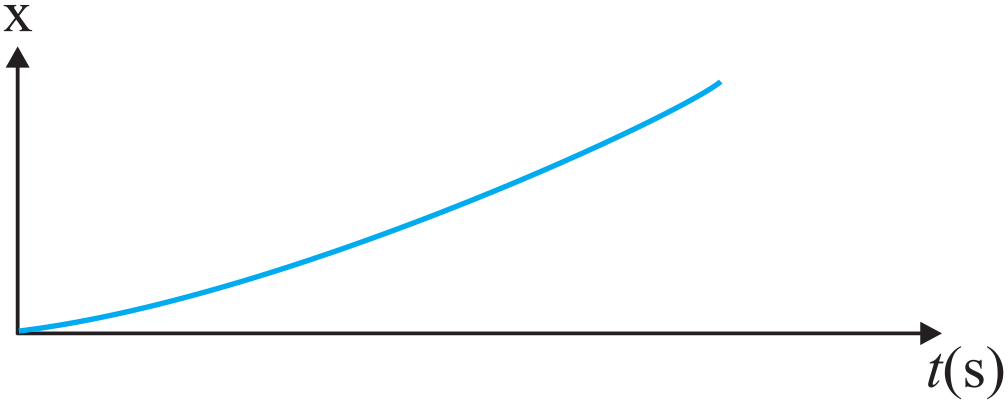
Fig. depicts four x-t plots for linear motion of a particle. Which of the plots represent periodic motion? What is the period of motion (in case of periodic motion)?

Answer
It is not a periodic motion. This represents a unidirectional, linear uniform motion. There is no repetition of motion in this case.
View full question & answer
Question 1201 Mark
What are simple harmonic (or sinusoidal functions)?
Answer
Bounded trigonometric functions (Sinusoidal-sine and cosine) having their second derivative proportional to them are called simple harmonic functions.
View full question & answer
Question 1211 Mark
What do you mean by resonance in oscillation?
Answer
When the natural frequency of oscillation and the frequency of the force oscillating it are same then there is said to be resonance in oscillation.
View full question & answer
Question 1221 Mark
What determines the natural frequency of a body?
Answer
Natural frequency of a body depends upon:
  1. Elastic properties of the material of the body and.
  2. Dimensions of the body.
View full question & answer
Question 1231 Mark
State the conditions when motion of a particle can be an SHM.
Answer
For SHM, the restoring force on the particle must be proportional to its displacement and directed towards mean position.
View full question & answer
Question 1241 Mark
Two clocks, one working with oscillating pendulum and the other with spring are given. Which one will you use in satellite?
Answer
The clock with spring is preferred, since it is not influenced by variation in g.
View full question & answer
Question 1251 Mark
Why the amplitude of the vibrating pendulum should be small?
Answer
For S.H.M., restoring force should always be pointing towards the mean position which is not possible at large angles.
View full question & answer
Question 1261 Mark
What is the main difference between forced oscillations and resonance?
Answer
In forced oscillations, a body oscillates with the help of external periodic force with a frequency different from natural frequency of body but in resonance a body oscillates with its own natural frequency with the help of an external periodic force whose frequency is equal to natural frequency of body.
View full question & answer
Question 1271 Mark
Can the motion of an artificial satellite around earth be taken as S.H.M?
Answer
No, it is a circular and periodic motion but not to and fro about a mean position which is essential for SHM.
View full question & answer
Question 1281 Mark
What is the phase difference between particle velocity and particle acceleration in SHM?
Answer
Particle acceleration in SHM is ahead in phase by $\frac{\pi}{2}$ as compared to the particle velocity.
View full question & answer
Question 1291 Mark
Is the damping force constant on a system executing S.H.M?
Answer
No. It is directly proportional to velocity which is a variable with time.
View full question & answer
Question 1301 Mark
Why a point on a rotating wheel cannot be considered as executing S.H.M.?
Answer
It is only periodic and not oscillatory.
View full question & answer
Question 1311 Mark
Define force constant.
Answer
Force constant is defined as the restoring force developed in a body per unit displacement.
View full question & answer
Question 1321 Mark
On what factors does the energy of a harmonic oscillator depend?
Answer
Energy of a harmonic oscillator depends on the mass, frequency and amplitude of oscillation.
View full question & answer
Question 1331 Mark
At what point the velocity and acceleration are zero in S.H.M?
Answer
The velocity is zero at the extreme point of motion and acceleration is zero at the mean position of motion.
View full question & answer
Question 1341 Mark
A particle is executing S.H.M. Identify the positions of the particle where:
  1. K.E. of the particle is zero.
  2. P.E. is zero.
  3. P.E. is one fourth of the total energy.
  4. P.E. and K.E. are equal.
Answer
  1. At extreme position (x = A)
  2. At mean position (x = 0)
  3. $\frac{1}{2}\text{m}\omega^2(\text{A}^2-\text{x}^2)=\frac{1}{4}\times\frac{1}{2}\text{m}\omega^2\text{A}^2$

$\Rightarrow\text{x}=\frac{\sqrt{3}\text{A}}{2}$

  1. $\frac{1}{2}\text{m}\omega^2(\text{A}^2-\text{x}^2)=\frac{1}{2}\text{m}\omega^2\text{A}^2$

$\Rightarrow\text{x}=\frac{\text{A}}{\sqrt{2}}$

View full question & answer
Question 1351 Mark
Answer the following questions:

What is the frequency of oscillation of a simple pendulum mounted in a cabin that is freely falling under gravity?

Answer
When a simple pendulum mounted in a cabin falls freely under gravity, its acceleration is zero. Hence the frequency of oscillation of this simple pendulum is zero.
View full question & answer
Question 1361 Mark
How is the path difference related to phase difference?
Answer
Path difference $=\frac{\lambda}{2\pi}\times\text{phase difference}$
View full question & answer
1 Marks Question - Page 3 - Physics STD 11 Science Questions - Vidyadip