Question 14 Marks
Read the passage given below and answer the following questions from (i) to (v). There are no physical examples of absolutely pure simple harmonic motion. In practice we come across systems that execute simple harmonic motion approximately under certain conditions. Oscillations due to a spring: The simplest observable example of simple harmonic motion is the small oscillations of a block of mass m fixed to a spring, which in turn is fixed to a rigid wall. The block is placed on a frictionless horizontal surface. If the block is pulled on one side and is released, it then executes a to and fro motion about the mean position. Let x = 0, indicate the position of the centre of the block when the spring is in equilibrium. The positions marked as –A and +A indicate the maximum displacements to the left and the right of the mean position. We have already learnt that springs have special properties, which were first discovered by the English physicist Robert Hooke. He had shown that such a system when deformed is subject to a restoring force, the magnitude of which is proportional to the deformation or the displacement and acts in opposite direction. This is known as Hooke’s law. It holds good for displacements small in comparison to the length of the spring. At any time t, if the displacement of the block from its mean position is x, the restoring force F acting on the block is, F(x) = –k x The constant of proportionality, k, is called the spring constant, its value is governed by the elastic properties of the spring. A stiff spring has large k and a soft spring has small k. Equation is same as the force law for SHM and therefore the system executes a simple harmonic motion.
Damped oscillations
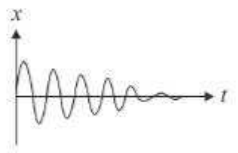
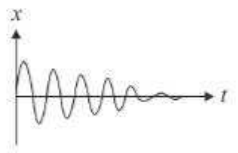
We know that the motion of a simple pendulum, swinging in air, dies out eventually. Why does it happen? This is because the air drag and the friction at the support oppose the motion of the pendulum and dissipate its energy gradually. The pendulum is said to execute damped oscillations. In damped oscillations, the energy of the system is dissipated continuously; but, for small damping, the oscillations remain approximately periodic. The dissipating forces are generally the frictional forces. The damping force is generally proportional to velocity of the bob and acts opposite to the direction of velocity. If the damping force is denoted by Fd, we have Fd = –bv where the positive constant b depends on characteristics of the medium (viscosity, for example) and the size and shape of the block, is usually valid only for small velocity.- Damping force is directly proportional to:
- Velocity
- Area
- Acceleration
- None of these
- Oscillations due to spring performs SHM for:
- Only small oscillations of spring
- Only for large oscillations of spring
- Both large as well as small oscillations of spring
- None of these
- Give expression for restoring force in spring while performing small SHM oscillations.
- Explain damped oscillations.
- Explain oscillations due to spring.
Answer
View full question & answer→- a) Velocity.
- a) Only small oscillations of spring.
- At any time t, if the displacement of the block from its mean position is x, the restoring force F acting on the block is, F (x) = –k x The constant of proportionality, k, is called the spring constant, its value is governed by the elastic properties of the spring
- In the motion of a simple pendulum, swinging in air amplitude became zero after some time. This is because the air drag and the friction oppose the motion of the pendulum and dissipate its energy gradually. The pendulum is said to execute damped oscillations. In damped oscillations, the energy of the system is dissipated continuously. The damping force is generally proportional to velocity of the bob and acts opposite to the direction of velocity. If the damping force is denoted by Fd, we have Fd = –b v. Where the positive constant b depends on characteristics of the medium and the size and shape of the block.
- the small oscillations of a block of mass m fixed to a spring, which in turn is fixed to a rigid wall. The block is placed on a frictionless horizontal surface. If the block is pulled on one side and is released, it then executes to and fro motion about the mean position. Let x = 0, indicate the position of the centre of the block when the spring is in equilibrium. We know that springs have special property that when deformed is subject to a restoring force, the magnitude of which is proportional to the deformation or the displacement and acts in opposite direction. It holds good for displacements small in comparison to the length of the spring. At any time t, if the displacement of the block from its mean position is x, the restoring force F acting on the block is, F (x) = –k x
The constant of proportionality, k, is called the spring constant, its value is governed by the elastic properties of the spring. A stiff spring has large k and a soft spring has small k. Equation is same as the force law for SHM and therefore the system executes a simple harmonic motion.
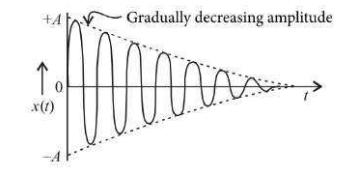 The force producing a resistance to the oscillation is called damping force.