Questions

3 Marks Question

🎯

Test yourself on this topic

16 questions · timed · auto-graded

Question 13 Marks
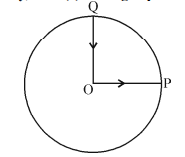
A cyclist starts from the centre O of a circular park of radius 1 km, reaches the edge P of the park, then cycles along the circumference, and returns to the centre along QO as shown in Fig. If the round trip takes 10 min, what is the (a) net displacement (b) average velocity, and (c) average speed of the cyclist?
Image
Answer
It is given here :
(a) Radius of circular path $=1 km$
Displacement of cyclist will be zero since the position of starting point and position of ending point are the same.
(b) Mean velocty of the cyclist
$=\frac{\text { Total displacement }}{\text { Total time taken }} $
$=\frac{0}{\text { Total time }}=0$
(c) $ \text { Mean speed } =\frac{\text { Total path length }}{\text { Total time taken }} $
$=\frac{ OP + PQ + QO }{\text { Total time }}$
$=\frac{1 km+\frac{1}{4} \times 2 \pi r+1 km}{10 \text { minutes }} $
$\quad$$\quad$$\quad$$\because OP = QO =1 km $
=$\frac{1 km+\frac{2 n \times 1}{4} \times 1 km}{10 / 60 h} $
$=\frac{2 km+\frac{3.14}{2} km}{1 / 6 h}=\frac{(2+1.57) km }{1 / 6 h} $
$=3.57 \times 6=21.42$ $km / h$
View full question & answer
Question 23 Marks
Read each statement below carefully and state with reason, if it is true or false :
(a) The magnitude of a vector is always a scalar,
(b) each component of a vector is always a scalar,
(c) the total path length is always equal to the magnitude of the displacement vector of a particle.
(d) the average speed of a particle (defined as total path length divided by the time taken to cover the path) is either greater or equal to the magnitude of average velocity of the particle over the same interval of time, (e) Three vectors not lying in a plane can never add up to give a null vector.
Answer
(a) It is true, since the magnitude of a vector is always a number.
(b) It is wrong, since the component of every vector is also a vector.
(c) False, it is true only when the particle moves along a straight line in the same direction.
(d) True, because the total path length is equal to or greater than the displacement vector. Hence, the average speed is greater than or equal to the magnitude of average velocity.
(e) True, to get the zero vector the third vector should have same magnitude but opposite direction.
View full question & answer
Question 33 Marks
State with reasons, whether the following algebraic operations with scalar and vector physical quantities are meaningful :
(a) adding any two scalars, (b) adding a scalar to a vector of the same dimensions, (c) multiplying any vector by any scalar, (d) multiplying any two scalars, (e) adding any two vectors, (f) adding a component of a vector to the same vector.
Answer
(a) No, because two scalars of same nature can be added.
(b) No, adding vector of same dimension in a scalar is not meaningful because scalars of same dimensions can be added. A scalar and a vector can't be added.
(c) Multiplication of a vector by a scalar is possible. It is an algebraic process because when we multiply a vector with a scalar we get a scalar times vector, which gives the magnitude of vector. That is, if we mutliply acceleration $(\vec{a})$ by mass $(m)$, we get force $\overrightarrow{ F }=m \vec{a}$, which is a meaningful process.
(d) Yes, multiplication of two scalars gives a meaningful result. Since, we multiply power P by time $(t)$, we get work $(w)= P \times t$ which is meaningful algebraic process.
(e) No, because both vectors can be added if they are of same nature.
(f) Yes, in a vector, its components can be added becuase both the vectors are of same nature, i.e. having the same dimension.
View full question & answer
Question 43 Marks
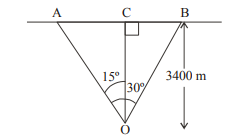
An aircraft is flying at a height of 3400 m above the ground. If the angle subtendent at a ground observation point by the aircraft position 10.0 s a part is 30º, what is the speed of the aircraft?
View full question & answer
Question 53 Marks
Read each statement below carefully and state, with reasons and examples, if it is true or false :
A scalar quantity is one that
(a) is conserved in a process
(b) can never take negative values
(c) must be dimensionless
(d) does not vary from one point to another in space
(e) Has the same value for observers with different orientations of axes.
Answer
(a) False, because many scalar quantities are not conserved, such as kinetic energy is a scalar quantity which is not conserved in inelastic collision.
(b) False, because some scalar quantities can be negative. Just as temperature, despite being a scalar quantity, can be negative. Similarly charge is also a scalar quantity and can also be negative.
(c) False, many scalar quantities are not dimensionless. For example, mass, density, charge etc. are scalar quantities but they have dimensions.
(d) False, because many scalar quantities change from one point to another, such as density of liquid, temperature, gravitational potential, charge, density change from one point to another.
(e) True, the value of a scalar quantity doesn't change due to rotation of the axes, e.g., mass is independent of coordinates of axes.
View full question & answer
Question 63 Marks
An aircraft executes a horizontal loop of radius 1.00 km with a steady speed of 900 km/h. Compare its centripetal acceleration with the accelertion due to gravity.
Answer
It is given, $ v =900 km / h $
$=900 \times \frac{5}{18} m / s $
$=50 \times 5=250 m / s $
$r =1.00 km=1000 m$
Centripetal acceleration
$a_c=r \omega^2=r \times\left(\frac{v}{r}\right)^2 $
$=\frac{v^2}{r}=\frac{(250)^2}{1000} $
$=\frac{250 \times 250}{1000}=62.5 m / s^2 $
$\therefore \frac{\text { Centripetal acceleration }}{\text { Acceleration due to gravity }}=\frac{a_c}{g} $
$=\frac{62.5 m / s^2}{9.8 m / s^2} $
$=6.38$
View full question & answer
Question 73 Marks
A stone tied to the end of a string 80 cm long is whirled in a horizontal circle with a constant speed. If the stone makes 14 revolutions in 25 s. what is the magnitude and direction of acceleration of the stone?
Answer
It is given, r = 80 cm = 0·8 m
Frequency $(\eta)=\frac{14}{25}$ per second
Angular velocity $(\omega) =2 \pi \eta=\frac{2 \times 22}{7} \times \frac{14}{25} $
$\omega =\frac{88}{25} rad / sec$
$\therefore$ Value of centripetal acceleration :
$a_c =r \omega^2 $
$=0.8 \times\left(\frac{88}{25}\right)^2 $
$=\frac{0.8 \times 88 \times 88}{25 \times 25}=9.91 m / s^2$
The direction of acceleration at each point will be along the radius and towards the centre.
View full question & answer
Question 83 Marks
A passenger arriving in a new town wishes to go from the station to a hotel located 10 km away on a straight road from the station. A dishonest cabman takes him along a circuitous path 23 km long and reaches the hotel in 28 min. What is (a) the average speed of the taxi, (b) the magnitude of average velocity? Are the two equal?
Answer
$ \text { Actual total distance covered } =23 km $
$\text { Magnitude of displacement } =10 km $
$\text { Total time } =28 min=\frac{28}{60} h $ = $\frac{7}{15} h$
(a)Mean speed of taxi
$=\frac{\text { Total actual distance covered }}{\text { Time taken }} $
$=\frac{23 km}{7 / 15 h}=\frac{23 \times 15 km / h}{7} $
$=49.3 km / h$
(b) Magnitude of mean velocity
$=\frac{\text { Magnitude of displacement }}{\text { Time taken }} $
$=\frac{10 km}{7 / 15 h}=\frac{10 \times 15}{7}$ $km / h $
$=\frac{150}{7} km / h=21.43 km / h$
Here the magnitude of mean speed is not equal to magnitude of mean velocity.
View full question & answer
Question 93 Marks
Find the maximum revolution per minute of a body of 500 gram tied to a 1.5 m long string, if the string can bear a maximum tension of 40 N .
Answer
$\begin{array}{l}
m=\text { mass of body }=500 g=0.5 kg \\
R=\text { radius of circle }=1.5 m \\
F_c=\text { centripetal force }=40 N
\end{array}$
Now,
$\begin{aligned}
F_c & =\text { mass } \times \text { acceleration } \\
F_c & =m a_r \\
& =\frac{m v^2}{R}=\frac{m}{R}(R \omega)^2 \quad \because v=R \omega \\
& =\frac{m R^2 \omega^2}{R}=m R \omega^2 \\
& =m R(2 \pi f)^2=4 \pi^2 m R f^2 \\
f^2 & =\frac{F_c}{4 \pi^2 m R} \\
f & =\sqrt{\frac{F_c}{4 \pi^2 m R}}=\sqrt{\frac{40}{4 \times(3.14)^2 \times 0.5 \times 1.5}} \\
& =\sqrt{1.351}=1.162 revolution / sec \\
& =1.162 \times 60=69.74 rev / min
\end{aligned}$
Hence, the body can revolve at rate of 69 revolution/ minute without breakage of string.
View full question & answer
Question 103 Marks
A player can throw a stone to a maximum horizontal distance of 100 m . What is the maximum vertical height to which the player can throw the same stone?
Answer
Given that
But
$\begin{aligned}
R_{\max } & =100 m \\
R_{\max } & =\frac{u^2}{g}=100 m \\
u^2 & =100 g
\end{aligned}$
$\therefore$
For vertical position,
$\begin{aligned}
v^2 & =u^2+2 g h \\
0 & =100 g-2 g H \\
2 g H & =100 g \\
H & =\frac{100 g}{2 g}=50 m
\end{aligned}$
View full question & answer
Question 113 Marks
The position vector of a particle depends on time as follows (in meters).
$\vec{r}=\left(2+3 t-t^3\right) \hat{i}+\left(-t+t^2\right) \hat{j}+\left(7 t+t^3\right) \hat{k}$
Find (i) Displacement of particle from $t=0 sec$ to $t=1 sec$ (ii) At $t=1 sec$, find the magnitude of instantaneous velocity and instantaneous acceleration of particle.
Answer
(1) At $t=0$, Position vector
$\begin{array}{l}
\overrightarrow{r_1}=2 \hat{i} \quad \text { At } t=1, \text { Position vector } \\
\overrightarrow{r_2}=\left(2+3 \times 1-1^3\right) \hat{i}+\left(-1+1^2\right) \hat{j}+\left(7 \times 1+1^3\right) \hat{k} \\
\overrightarrow{r_2}=4 \hat{i}+0 . \hat{j}+8 \hat{k}
\end{array}$
Hence, displacement
$\begin{aligned}
\Delta \vec{r} & =\overrightarrow{r_2}-\overrightarrow{r_1} \\
& =4 \hat{i}+0 \cdot \hat{j}+8 \hat{k}-2 \hat{i} \\
& =2 \hat{i}+8 \hat{k} m
\end{aligned}$
(ii)
$\begin{aligned}
\vec{v} & =\frac{d \vec{r}}{d t} \\
& =\frac{d}{d t}\left\{\left(2-3 t-t^3\right) \hat{i}+\left(-t+t^2\right) \hat{j}+\left(7 t+t^3\right) \hat{k}\right\} \\
v & =\left(3-3 t^2\right) \hat{i}+(-1+2 t) \hat{j}+\left(7+3 t^2\right) \hat{k}
\end{aligned}$
and $\quad \vec{a}=\frac{d \overrightarrow{ v }}{d t}=(0-6 t) \hat{i}+(0+2) \hat{j}+(0+6 t) \hat{k}$
$\begin{aligned}
\vec{a} & =-6 \hat{i}+2 \hat{j}+6 \hat{k} \quad t=1 sec \\
\vec{v} & =0 . \hat{i}+\hat{j}+\left(7+3 \times 1^2\right) \hat{k} \\
& =\hat{j}+10 \hat{k} m / s
\end{aligned}$
$t=1 sec$
$\begin{aligned}
\therefore|\vec{v}| & =\sqrt{(1)^2+(10)^2}=\sqrt{1+100}=\sqrt{101} \\
& =10.05 m / s
\end{aligned}$
Similarly, put $t=1 sec$
$\begin{aligned}
\vec{a} & =-6 \hat{i}+2 \hat{j}+6 \hat{k} ms^{-2} \\
\therefore \quad|\vec{a}| & =\sqrt{(-6)^2+(2)^2+(6)^2}=\sqrt{36+4+36}=\sqrt{76} \\
& =8.72 m / s^2
\end{aligned}$
View full question & answer
Question 123 Marks
The resultant of two vector $\vec{P}$ and $\vec{Q}$ is $\vec{R}$. If the direction of $\vec{Q}$ is reversed, then the resulting vector becomes $\vec{S}$. Then prove that,
$
R ^2+ S ^2=2\left( P ^2+ Q ^2\right)
$
Answer
It is given,
$\begin{array}{l}
\overrightarrow{R}=\overrightarrow{P}+\overrightarrow{Q} \\
\overrightarrow{S}=\overrightarrow{P}-\overrightarrow{Q}
\end{array}$
If angle between $\vec{P}$ and $\vec{Q}$ is $\theta$, then
$\begin{aligned}
R & =\sqrt{P^2+Q^2+2 PQ \cos \theta} \\
R^2 & =P^2+Q^2+2 PQ \cos \theta \ \ldots(1)
\end{aligned}$
If angle between $\vec{P}$ and $\vec{Q}$ is $\alpha$, then
$\begin{aligned}
\alpha & =(180-\theta) \\
\because \quad \overrightarrow{S} & =(\overrightarrow{P}-\overrightarrow{Q}) \\
\therefore \quad S & =\sqrt{P^2+Q^2+2 PQ \cos \alpha} \\
S & =\sqrt{P^2+Q^2+2 PQ \cos (180-\theta)} \\
& =\sqrt{P^2+Q^2-2 PQ \cos \theta} \\
S^2 & =P^2+Q^2-2 PQ \cos \theta \ \ldots(2)
\end{aligned}$
Add equations (1) and (2), we get
$R^2+S^2=2\left(P^2+Q^2\right)$
View full question & answer
Question 133 Marks
The horizontal range of cannon ball is $R$. If the greatest heights of two paths, for which this is possible, are $h$ and $h ^{\prime}$ then prove that
$4 \sqrt{h h^{\prime}}=R$
Answer
Consider the cannon ball with velocity $u$ and at angles $\theta$ and $\left(\frac{\pi}{2}-\theta\right)$ with the horizontal then range
$R=\frac{u^2 \sin 2 \theta}{g}$
If projectile angle is $\theta$, then maximum height
$h=\frac{u^2 \sin ^2 \theta}{2 g} \ \ldots(1)$
If projectile angle is $\left(\frac{\pi}{2}-\theta\right)$, then maximum height is
$\begin{array}{l}
h^{\prime}=\frac{u^2 \sin ^2\left(\frac{\pi}{2}-\theta\right)}{2 g} \\
h^{\prime}=\frac{u^2 \cos ^2 \theta}{2 g} \ \ldots(2)
\end{array}$
From equations (1) and (2)
$\begin{aligned}
h h^{\prime} & =\frac{u^2 \sin ^2 \theta}{2 g} \times \frac{u^2 \cos ^2 \theta}{2 g} \\
h h^{\prime} & =\frac{u^4 \sin ^2 \theta \cos ^2 \theta}{4 g^2} \\
\therefore \quad 4 h h^{\prime} & =\frac{u^4 \sin ^2 \theta \cos ^2 \theta}{g^2} \\
\text { or } \quad 16 h h^{\prime} & =\frac{u^4 \times(2 \sin \theta \cos \theta)^2}{g^2} \\
16 h h^{\prime} & =\frac{u^4 \sin ^2 2 \theta}{g^2}
\end{aligned}$
We take square root on both side,
$\begin{aligned}
4 \sqrt{h h^{\prime}} & =\frac{u^2 \sin 2 \theta}{g}=R \\
R & =4 \sqrt{h h^{\prime}}
\end{aligned}$ Hence Proved.
View full question & answer
Question 143 Marks
Prove that in projectile motion, when bodies are projected at angle $\left(45^{\circ}+\phi\right)$ and $\left(45^{\circ}-\phi\right)$ from the horizontal, their horizontal range will be same.
Answer
 We know that by projecting an object at angle $\theta$,
$R=\frac{u^2 \sin 2 \theta}{g}$
But it is given that when object is projected at angle $(45+\phi)$ and $\left(45^{\circ}-\phi\right)$ from the horizontal, their ranges are same.
$
\begin{array}{l}
R_1=\frac{u^2 \sin 2\left(45^{\circ}+\phi\right)}{g} \\
R_1=\frac{u^2 \sin \left(90^{\circ}+2 \phi\right)}{g} \\
R_1=\frac{u^2 \cos 2 \phi}{g}.....(1)
\end{array}
$
similarly,
$
\begin{array}{l}
R_2=\frac{u^2 \sin 2\left(45^{\circ}-\phi\right)}{g} \\
R_2=\frac{u^2 \sin \left(90^{\circ}-2 \phi\right)}{g} \\
R_2=\frac{u^2 \cos 2 \phi}{g}.....(2)
\end{array}
$

From equations (1) and (2), it is clear
$R_1=R_2$
View full question & answer
Question 153 Marks
What is the meaning of the components of vectors along $X, Y, Z$ axes and prove that $\cos ^2 \alpha+\cos ^2$ $\beta+\cos ^2 r=1$.
View full question & answer
Question 163 Marks
The time of flight of a projectile is $T$ and horizontal range is $R$. What will be the projectile angle?Or The time of flight is $T$ and horizontal range is $R$ of a projectile. Prove that the angle of projection of a projectile is $\theta=\tan ^{-1}\left(\frac{g T^2}{2 R}\right)$.
Answer
Time of flight, $\quad T =\frac{2 u \sin \theta}{g}$
Horizontal range, $\quad R =\frac{u^2 \sin 2 \theta}{g}$
On square of equation (1)
$T^2=\frac{4 u^2 \sin ^2 \theta}{g}$
By dividing equation (3) to equation (2)
$\begin{array}{rlrl}
\frac{T^2}{R} & =\frac{\frac{4 u^2 \sin ^2 \theta}{g}}{\frac{u^2 \sin 2 \theta}{g}} \\
\Rightarrow \quad & \frac{g T^2}{R} & =\frac{4 \sin ^2 \theta}{\sin 2 \theta}=\frac{4 \sin ^2 \theta}{2 \sin \theta \cos \theta} \\
\Rightarrow \quad & \frac{g T^2}{R} & =\frac{2 \sin \theta}{\cos \theta}=2 \tan \theta \\
\therefore \quad & \frac{g T^2}{R} & =\tan \theta \\
\therefore \quad & \theta & =\tan ^{-1}\left(\frac{g T^2}{2 R}\right)
\end{array}$
View full question & answer
3 Marks Question - Physics STD 11 Science Questions - Vidyadip