Questions

3 Marks Question

🎯

Test yourself on this topic

7 questions · timed · auto-graded

Question 13 Marks
Does the escape speed of a body from the earth depend on (a) the mass of the body, (b) the location from where it is projected, (c) the direction of projection, (d) the height of the location from where the body is launched?
Answer
(a) We know that escape velocity $v_E=\sqrt{\frac{2 GM _E}{R_E}}$, where $M _E$ and $R _E$ are the mass of the earth and its radius. Clearly, $V _{ E }$ doesn't depend on the mass, hence the escape velocity also does not depend on the mass.
(b) Yes, since $v _{ E }=\sqrt{2 g R _{ E }}$
Here the value of $g$ varies at differnt heights. That is why $v _{ E }$ also depends on altitude conditions.
(c) No, it doesn't depend on the direction of projection. Since $v _{ E }$ is independent of the direction of projection.
(d) Yes, it is from where the object is launched as mentioned in (b). This depends on the altitude of the situation.
View full question & answer
Question 23 Marks
Suppose there existed a planet that went around the Sun twice as fast as the earth. What would be its orbital size as compared to that of the earth?
Answer
As we know the Earth completes one revolution around the sun in one year.
$
\therefore \quad T_{E}=1 \text { year }
$
Since it is given that,
$
\begin{aligned}
T_{P} & =\frac{1}{2} T_{E} \\
r_{E} & =1 AU, r_{P}=?
\end{aligned}
$
According to Kepler's thrid law,
$
\begin{aligned}
\left(\frac{r_{P}}{r_{E}}\right)^3 & =\left(\frac{T_{P}}{T_{E}}\right)^2 \\
\therefore \quad r_{P} & =r_{E}\left(\frac{T_{P}}{T_{E}}\right)^{2 / 3} \\
& =1\left(\frac{\frac{1}{2} T_{E}}{T_{E}}\right)^{2 / 3}=\left(\frac{1}{2}\right)^{2 / 3}=\left(\frac{1}{4}\right)^{1 / 3} \\
& =0.63 AU
\end{aligned}
$
View full question & answer
Question 33 Marks
A satellite orbits the earth at a height of 400 km above the surface. How much energy must be expended to rocket the satellite out of the earth’s gravitational influence? Mass of the satellite = 200 kg ; mass of the earth $=6.0 \times 10^{24} kg$; radius of the earth $=6.4 \times 10^6 m ; G =6.67 \times 10^{-11} Nm ^2 kg^{-2}$.
Answer
Energy required to take the satellite out of the gravitational influence of the Earth.
$\begin{array}{l}=\text { Binding energy of satellite } \\ =+\frac{1}{2} \frac{ GM m}{ R +h}\end{array}$
Put the values,
$\begin{array}{l}=\frac{1}{2} \times \frac{6.67 \times 10^{-11} \times 6.0 \times 10^{24} \times 200}{6.4 \times 10^6+400 \times 10^3} \\ =\frac{6.67 \times 3 \times 2 \times 10^{15}}{64 \times 10^5+4 \times 10^5} \\ =\frac{6.67 \times 6 \times 10^{15}}{68 \times 10^5}=\frac{66.7 \times 6 \times 10^9}{68}\end{array}$
$\approx 5.9 \times 10^9$ Joule
View full question & answer
Question 43 Marks
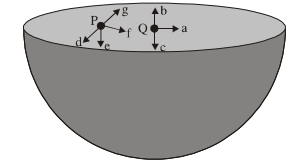
In the following two exercises, choose the correct answer from among the given ones : The gravitational intensity at the centre of a hemispherical shell of uniform mass density has the direction indicated by the arrow.
Image
View full question & answer
Question 53 Marks
Answer the following :
(a) You can shield a charge from electrical forces by putting it inside a hollow conductor. Can you shield a body from the gravitational influence of nearby matter by putting it inside a hollow sphere or by some other
means?
(b) An astronaut inside a small space ship orbiting around the earth cannot detect gravity. If the space station orbiting around the earth has a large size, can he hope to detect gravity?
(c) If you compare the gravitational force on the earth due to the sun to that due to the moon, you would find that the Sun’s pull is greater than the moon’s pull. (you can check this yourself using the data available in the succeeding exercises). However, the tidal effect of the moon’s pull is greater than the tidal effect of sun.Why?
Answer
(a) No, the electric force depends on the nature of the intermediate medium, whereas the intermediate medium has effect on the gravitational force, hence the gravity doesn’t have the function of shielding as such i.e., Gravitational shielding is not possible.
(b) Yes, if the space station is very large then the astronaut can detect the force of gravity because the effect
of gravity is sufficient.
(c) The distance between the earth and moon is very less than the distance between sun and earth. The effect of tide is inversely proportional to the cube of distance, that is, it doesn't obey the square inversely proportional rule which applies to the force of gravity, which is why the moon has more effect on the tide than the sun
View full question & answer
Question 63 Marks
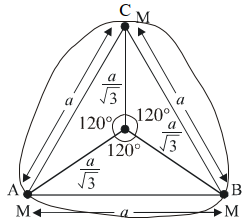
Three objects of equal mass $M$ are located at the vertices of an equilateral triangle of side $a$. At what speed should the three bodies be rotated on a circle so that the triangle moves on the circumference of the circular chamber and the side of the triangle remains unchanged.
Answer
The distance of each object of mass M placed on the vertices of triangle $A B C$ from the center of the triangle will be $=\frac{a}{\sqrt{3}}$
Image
Suppose all three bodies are rotated on a circle with speed $v$ so that the triangle moves on the circumference of the circular orbit then the force acting on each mass
$=\frac{Mv^2}{\frac{a}{\sqrt{3}}}$
The resultatnt force of attraction on each mass due to the other two masses
$\begin{array}{l}
=\frac{GM^2}{a^2} \cos 30^{\circ}+\frac{GM^2}{a^2} \cos 30^{\circ} \\
=\frac{GM^2}{a^2} \times \frac{\sqrt{3}}{2}+\frac{GM^2}{a^2} \times \frac{\sqrt{3}}{2} \\
=\frac{2 GM^2}{a^2} \times \frac{\sqrt{3}}{2}=\sqrt{3} \frac{GM^2}{a^2}
\end{array}$
The resultant force of gravity acting on each mass will be equal to the resultant centripetal force acting on it.
$\begin{aligned}
\therefore \quad \frac{Mv^2}{\frac{a}{\sqrt{3}}} & =\frac{\sqrt{3} GM^2}{a^2} \\
v^2 & =\frac{\sqrt{3} GM^2}{a^2} \times \frac{a}{\sqrt{3} \times M} \\
v^2 & =\frac{GM}{a} \\
v & =\sqrt{\frac{GM}{a}}
\end{aligned}$
View full question & answer
Question 73 Marks
The radius of a planet is three times the radius of the Earth but the density of both is same. If $v_p$ on $v_e$ are the escape velocities on the planet and the earth then prove that $v_P=3 v_e$.
Answer
 We know that escape velocity on Earth,
$v_e=\sqrt{\left(\frac{2 GM_e}{R_c}\right)}=\sqrt{\frac{2 G\left(4 / 3 \pi R_e^3 d_c\right)}{R_c}}$
Here $d_e$ is the mean density of earth,
$v_e=R_c \sqrt{\frac{8 \pi G d_c}{3}}.....(1)$
Similarly, escape velocity on planet,
$v_p=R_p \sqrt{\frac{8 \pi G d_p}{3}}.....(2)$
From equations (1) and (2)
$\frac{v_p}{v_c}=\frac{R_p}{R_c} \sqrt{\frac{d_p}{d_c}}$
According to question,
$d_p=d_e \text { and } R_p=3 R_e$
Put the value,
Hence,
$\frac{v_p}{v_c}=\frac{3 R_c}{R_c} \times \sqrt{\frac{d_c}{d_c}}=3$
Hence,
$v_p=3 v_e\quad \text { Ans. }$
View full question & answer
3 Marks Question - Physics STD 11 Science Questions - Vidyadip