Question types

PART - 2 CH - 12 Kinetic Theory question types

140 questions across 9 question groups — pick any mix to generate a Physics paper with step-by-step answer keys.

140
Questions
9
Question groups
5
Question types
Sample Questions

PART - 2 CH - 12 Kinetic Theory questions

One sample from each question group in this chapter. Select any group above to see the full set with answer keys.

Which of the following statements is true regarding the molecular kinetic theory of gases?
  • A
    pressure of gas is directly proportional to the mean speed of the molecule.
  • B
    The root mean square speed of molecules is directly proportional to pressure.
  • The average energy per molecule is directly proportional to the absolute temperature
  • D
    None of the above

Answer: C.

View full solution
The reason for the force exerted by a gas on the wall of the vessel is that the molecules of the gas:
  • A
    Losing its kinetic energy
  • B
    Clinging to the walls
  • Their momentum is changing due to collision
  • D
    are accelerating towards the walls.

Answer: C.

View full solution
Oxygen and hydrogen are at the same tempeature T. The kinetic energy of the oxygen molecule is equal to the kinetic energy of the hydrogen molecule.
  • A
    will be 16 times
  • B
    will be 4 times
  • will be equal
  • D
    will be one-fourth

Answer: C.

View full solution
The value of root mean square velocity at normal temperature and pressure will be maximum for which of following gases?
  • A
    Oxygen
  • B
    Air
  • Hydrogen
  • D
    Helium

Answer: C.

View full solution
Two gases A and B have been mixed. Each has volume V, pressure P and temperature is T, then what will be the value of pressure of their mixture?
View full solution
If the density of a gas is kept constant but the root mean square velocity of the gas molecules is doubled, then how much will the pressure of the gas increase?
View full solution
At what temperature will the root mean square velocity of helium molecules be half the root mean square velocity of hydrogen molecules at normal temperature and pressure?
View full solution
8 gm of oxygen, 14 gm of nitrogen and 22 gm of carbon dioxide are mixed in a vessel of 10 liters volume and $27^{\circ} C$. Find the pressure exerted by the mixture.
View full solution
The diameter of an oxygen molecule is approximately $3 \text Å $. Calculate the mean free path of oxygen molecules and the mean time taken between collisions at normal temperature and pressure. At normal temperature and pressure the number of molecules per cubic is $3 \times 10^{19}$.
View full solution
The free path of molecules of a gas at $27^{\circ} C$ temperature is $2.76 \times 10^{-5}$ meter. If the diameter of the molcule is $3.0 \text Å $, then find the pressure of the gas.
View full solution
Q 304 Marks Question4 Marks
An air bubble, whose volume is $1.0 cm^3$ rises from the bottom of a 40 m deep lake where the temperature is $12^{\circ} C$ and comes to the surface where the temperature is $35^{\circ} C$. Now what will be its volume?
View full solution
Q 314 Marks Question4 Marks
Find the ratio of the volume of oxygen molecules and the total volume occupied by them at STP. Take the diameter of an oxygen molecule as 3Å.
View full solution
AB
1. Any gas behave at high temperature and low pressure(A) $\frac{89}{27 b^2}$
2. The value of $N_A$ will be(B) $6.023 \times 10^{26}$ per kg mol.
3. $P _{ C }=$(C) Like ideal gas
4. $T _{ C }=$(D)$\frac{a}{27 b^2}$
5. In a container the mean free path of molecule is inversely proportional to(E) Density
View full solution
AB
1. Dalton's Partial Pressure law(A) $\frac{2}{3}$
2. PV =(B) Excessive
3. The part of mean K.E of unit volume gas isequal to(C) $\begin{array}{l} P = P _1+ P _2+  P _3+\ldots\end{array}$
4. The value of KE. due to r.m.s. velocity is zero(D) $\frac{1}{3} MC _{r m s}^2$
5. The gas that's density ( $\rho$ ) become less than value of $C _{ rms }$(E) zero
View full solution
In an oxygen cylinder whose volume is 30 litres the initial pressure of oxygen is 15 atm and temperature is $27^{\circ} C$. After taking out some gas from it, the gauge pressure falls to 11 atm and the temperature fall to $17^{\circ} C$. Find out how much oxygen has been removed from the cylinder ( $R=8.31 J$ $mol ^{-1} K^{-1}$, molecular mass of oxygen $O _2=32 u$ )
View full solution
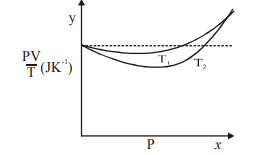
In the figure, graphs of PV/T and P for $1.00 \times 10^{-3} kg$ mass of oxygen at two different temperature are shown.
Image
(a) What does the dotted line show?
(b) What is true : $T _1> T _2$ or $T _1< T _2$ ?
(c) What is the value of PV/T where the curves meet on the $y$-axis?
(d) If we make a similar graph for $1.00 \times 10^{-3} kg$ hydrogen, will the value of PV/T be same at the point where the curves meet the $y$-axis?
If not, for what mass of hydrogen will the value of PV/T be the same as for the region of low pressure and high temperature? (Molecular mass of $H _2=2.02$ $u$, Mass of $O_2=32.04 u, R=8.31 J mol ^{-1} K^{-1}$ )
View full solution
Estimate the mean free path and collision frequency of nitrogen molecules in a cylinder of nitrogen gas at 2.0 atm pressure and $17^{\circ} C$ temperature take the radius of nitrogen molecule to be approximately 1.0. Compare the collision time with the time taken by the molecules to move freely between two collisions (Molecular mass of nitrogen $=28.0 u$ ).
View full solution
What is the law of equal division of energy, prove it the tatal energy of $\text n$ moles of gas molecules is $\text E =\frac{ 1 }{ 2 } \text {fnRT}$ energy. Explain the specific heats of monatomic, diatomic and triatomic gases from uniform distribution.
View full solution

Generate a PART - 2 CH - 12 Kinetic Theory paper free

Pick question groups from the list above, set marks and difficulty, and export a branded PDF with step-by-step answer keys. First 3 chapters free — no signup.

Download App