Question
Explain temperature on the basis of molecular kinetic theory.

Answer

When heat is given to a substance the given heat gets distributed among the molecules of the substance. After achieving the molecules of the which the molecules of the substance start performing simple harmonic motion with greater amplitude around their normal position. When the substance is liquid or gas, as the amplitude of vibrations of the molecules increases, the linear and rotational motions also increase and the increase total kinetic energy is equal to the heat given. In this way the heat given to the substance is converted en to the total K.E. of the molecules of the substance and the increase in temperature of a certain amout of the substance is proportional to the increase in heat given.
Therefore heat given to a certain amount of substance is an increase in temperature or an increase in the total kinetic energy of the molecules of a certain amount of substance.
We know that at 0 K the K.E. of the molecules of a substances is zero. If the total K.E. $\theta$ of a molecule in a certain amount of substance at T K is $
\theta \propto T .
$

Need a full question paper?

Generate a complete, print-ready paper with questions like this in minutes — across 16+ boards, with answer keys.
Start Generating Free

Similar questions

The bob of a simple pendulum is hollow and has been filled with water. There is a small hole below it. If this sphere continuously performs simple harmonic motion and water keeps falling out of the hole, then how will the period of oscillations change?
A trolley of mass 300 kg carrying a sandbag of 25 kg is moving uniformly with a speed of 27 km/h on a frictionless track. After a while, sand starts leaking out of a hole on the floor of the trolley at the rate of 0.05 kg s–1. What is the speed of the trolley after the entire sand bag is empty?
A projectile is fired from the top of a 40m high cliff with an initial speed of 50m/s at an unknown angle. Find its speed when it hits the ground.
Show that $\vec{\text{a}}.(\vec{\text{b}}\times\vec{\text{c}})$ is equal in magnitude to the volume of a parallelopiped formed by the three vectors $\vec{\text{a}},\vec{\text{b}}$ and $\vec{\text{c}}.$
Determine the speed with which the earth would have to rotate on its axis so that a person on the equator would weigh 3/5th as much as at present. Take the equatorial radius as 6400km.
Two loudspeakers are arranged facing each other at some distance. Will a person standing behind one of the loudspeakers clearly hear the sound of the other loudspeaker or the clarity will be seriously damaged because of the 'collision' of the two sounds in between?
Two vectors have magnitudes 2m and 3m. The angle between them is 60°. Find:
  1. The scalar product of the two vectors.
  2. The magnitude of their vector product.
What are transverse waves? Give examples too.
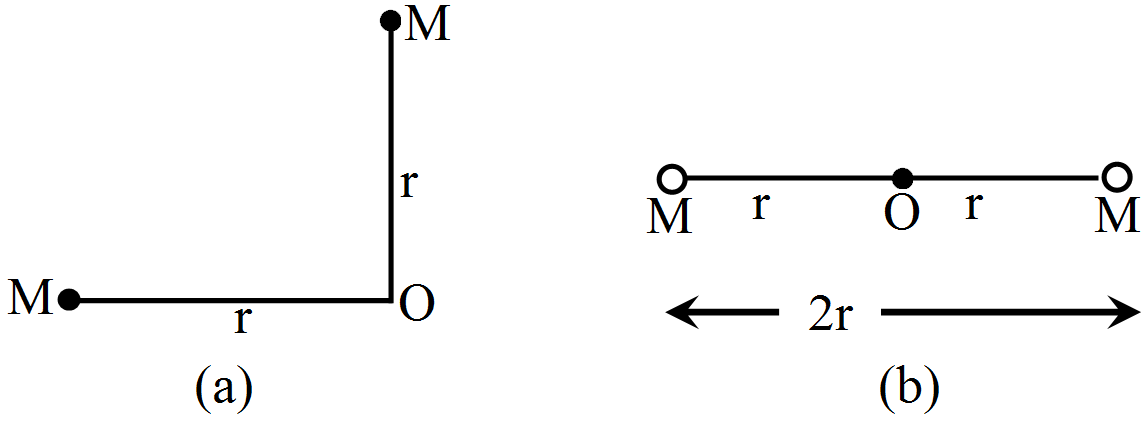
The masses M in the two figures are identical. Which of the two systems has the smaller gravitational potential energy? Why?

One person says that the potential energy of a particular book kept in an almirah is 20J and the other says it is 30J. Is one of them necessarily wrong?