Questions

4 Marks Question

🎯

Test yourself on this topic

3 questions · timed · auto-graded

Question 14 Marks
A spring balance has a scale that reads from 0 to 50 kg . The length of the scale is 20 cm . A body suspended from this balance, when displaced and released, oscillates with a period of 0.6 s . What is the weight of the body ?
View full question & answer
Question 24 Marks
The acceleration due to gravity on the surface of moon is $1.7 ms^{-2}$. What is the time period of a simple pendulum on the surface of moon if its time period on the surface of earth is 3.5 s ? ( $g$ on the surface of earth is $9.8 m s ^{-2}$ ).
Answer
Given :
$
\begin{aligned}
g_{m} & =1.7 m / s^2 \\
g_{e} & =9.8 m / s^2 \\
T_{m} & =? \text { and } T_{e}=3.5 \\
T & =2 \pi \sqrt{\frac{l}{g}}
\end{aligned}
$
Freedom for the earth
$T _{ e }=2 \pi \sqrt{\frac{l}{g_{ e }}}$$\ldots$(1)
For moon
$T _m=2 \pi \sqrt{\frac{l}{g_m}}$$\ldots$(2)
Dividing equation (1) by equation (2)
$
\begin{aligned}
\frac{T_m}{T_e} & =\frac{2 \pi \sqrt{\frac{l}{g_m}}}{2 \pi \sqrt{\frac{l}{g_e}}} \\
\frac{T_m}{T_e} & =\sqrt{\frac{g_e}{g_m}} \\
T_m & =T_e \sqrt{\frac{g_e}{g_m}}
\end{aligned}
$
Put value
$
=3.5 \sqrt{\frac{9.8}{1.7}}
$
$\begin{aligned} & =3.5 \sqrt{5.7647}=3.5 \times 2.4 \\ \because \quad T_m & =8.45\end{aligned}$
Therefore, the time period on the surface of the moon.= 8.45 second
View full question & answer
Question 34 Marks
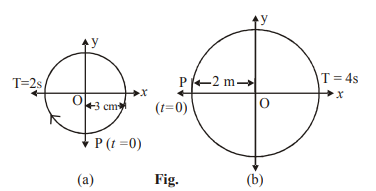
Figures correspond to two circular motions. The radius of the circle, the period of revolution, the initial position, and the sense of revolution (i.e. clockwise or anti-clockwise) are indicated on each figure.
Image
Obtain the corresponding simple harmonic motions of the $x$-projection of the radius vector of the revolving particle $P$, in each case.
Answer
From the figure (a)
OP is in the direction of $\frac{\pi}{2}$ angle of $\frac{\pi}{2}$ since the speed the needle with the $x$-axis thus $\phi=+\frac{\pi}{2}$ radian of clock.
Thus the projectile S.H.M. on the axis of OP at time will given the equation
$
\begin{aligned}
x & =A \cos \left(\frac{2 \pi t}{T}+\phi\right) \\
& =3 \cos \left(\frac{2 \pi t}{2}+\frac{\pi}{2}\right) \\
A & =3 cm, T=2 sec \\
x & =3 \cos \left(\pi t+\frac{\pi}{2}\right)=-3 \sin \pi t \\
x & =-3 \sin \pi t cm
\end{aligned}
$
Figure (b) is
$
T=4 s, A=2 m
$
$t=0$, OP makes an angle of $\pi$ with the positive direction of $x$-axis i.e.
$\begin{aligned} \phi & =+\pi \\ x & = A \cos \left(\frac{2 \pi}{T} t+\phi\right) \\ & =2 \cos \left(\frac{2 \pi t}{T}+\pi\right)=-2 \cos \left(\frac{\pi}{2} t\right)\end{aligned}$
$x=-2 \cos \left(\frac{\pi}{2} t\right) m$
View full question & answer
4 Marks Question - Physics STD 11 Science Questions - Vidyadip