Questions

4 Marks Question

Take a timed test

6 questions · self-marked practice — reveal the answer and mark yourself.

Question 14 Marks
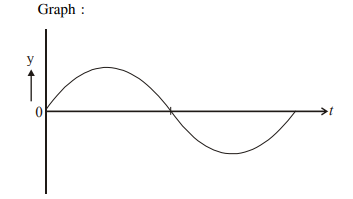
A transverse harmonic wave on a string is described by
$y(x, t)=3.0 \sin \left(36 t+0.018 x+\frac{\pi}{4}\right)$
where x and y are in cm and t in s. The positive direction of x is from left to right.
For the wave, plot the displacement ($y$) versus ($t$) versus ($t$) graphs for x = 0, 2 and 4 cm . What are the shapes of these graphs? In which aspects does the oscillatory motion in travelling wave differ from one point to another : amplitude, frequency or phase?
View full question & answer
Question 24 Marks
A stone dropped from the top of a tower of height 300 m splashes into the water of a pond near the base of the tower. When is the splash heard at the top given that the speed of sound in air is $340 ms^{-1}$ ? $\left(g=9.8 ms^{-1}\right)$
Answer
Given that :
Height of tower $h =300 m, g =9.8 ms^{-2}$
Speed of sound $v=340 m / s$
Let stone hit to water after $t _1$ time. Then from second law of motions
$
s=u t+\frac{1}{2} a t^2
$
Put the value
$
300=0 \times t_1+\frac{1}{2} \times 9.8 \times t_1^2
$
Since the initial velocity of stone $u=0 m / s$
$
\begin{aligned}
300 & =4.9 t_1^2 \\
t_1^2 & =\sqrt{\frac{300}{4.9}} \\
t_1 & =\sqrt{\frac{3000}{49}}=7.82 \text { second }
\end{aligned}
$
time which is taken by sound in reached at the top of tower after hitting.
$
\therefore \quad t_2=\frac{h}{v}=\frac{300}{340}
$
$
t_2=0.88 sec
$
$\therefore$ The time in hearing of hitting sound at top
$
t=t_1+t_2=7.82+0.88=8.7 \text { second }
$
View full question & answer
Question 34 Marks
A pipe 20 cm long is closed at one end. Which harmonic mode of the pipe is resonantly excited by a 430 Hz source? Will the same source be in resonance with the pipe if both ends are open? (Speed of sound in air is $340 ms^{-1}$).
Answer
Given : $\quad v=340 m / s$
Frequency of catalist source $n=430 Hz$
We know that frequency of rth mode of close pipe
$
n=(2 r-1) \frac{v}{4 l}
$
Put the value $\quad 430=\frac{(2 r-1) \times 340}{4 \times 0.2}$
or $\quad \frac{430 \times 4 \times 0.2}{340}=2 r-1$
$\begin{array}{l}1.012=2 r-1 \\ 2.012=2 r\end{array}$
$\therefore \quad r=\frac{2.012}{2}=1.006 \simeq 1.01$
Means, the first frequency of argon pipe or basic mode of cycle.
$r$ th mode's frequency in case of open tube :
$
n_r=\frac{r . v}{2 l}
$
Where length of basic mode $\lambda=2 l$
Put the value
$430=\frac{r \times 340}{2 \times 0.2}$
or $\quad 430 \times 2 \times 0.2=340 r$
or$\quad$$
r=\frac{430 \times 2 \times 0.2}{340}=\frac{172}{340}
$
The value of $r$ should be an integer, that is the same source can't be in resonance with the open argon tube.
View full question & answer
Question 44 Marks
A wire stretched between two rigid supports vibrates in its fundamental mode with a frequency of 45 Hz. The mass of the wire is $3.5 \times 10^{-2}$ kg and its linear mass density is $4.0 \times 10^{-2} kg m ^{-1}$. What is (a) the speed of a transverse wave on the string and (b) the tension in the string?
Answer
Given :
Frequency $n =45$
Mass of wire $( M )=3.5 \times 10^{-2} kg$
$m=$ Unit length mass $=$ Linear mass density $=4.0 \times 10^{-2} kg / m$
Let if length of wire is $l$ then
$\text { Formula }l =\frac{M}{m}=\frac{3.5 \times 10^{-2}}{4 \times 10^{-2}} $
$=0.875 m$
(a) Speed of transverse wave in wire $v =$ ?
(b) Tension in wire $T =$ ?
(a) Frequency of basic mode in oscillation
$n=\frac{v}{\lambda}=\frac{v}{2 l}$
$\because$ Basic mode in oscillation
$L=\frac{\lambda}{2}$
or $\quad\lambda=2 l$
$\therefore \quad v =n \times 2 l$
Put the value
$v =45 \times 2 \times 0.875 $
$=78.75 m / s $
$\simeq 79 m / s$
(b) We can find tension in wire
$v=\sqrt{\frac{T}{m}}$
or $\quad T=v^2 \times m$
Put the value
$T =(78.75)^2 \times 4 \times 10^{-2} $
$=248.06 N$
View full question & answer
Question 54 Marks
The transverse displacement of a string (clamped at its both ends) is given by
$y(x, t)=0.06 \sin \left(\frac{2 \pi}{3} x\right) \cos (120 \pi t)$
where x and y are in mand in s. The length of the string is 1.5 m and its mass is $3.0 \times 10^{-2} kg$.
(i) For the wave on a string, do all the points on the string oscillate with the same (a) frequency, (b) phase, (c) amplitude? Explain your answers, (ii) What is the amplitude of a point 0.375 m away from one end?
Answer
(i) A all point of string excepted nodes frequency and phase are same but not amplitude. Its reason that equation $y(x, t)=0.06 \sin \left(\frac{2 \pi}{3} x\right) \cos (120 \pi t)$ represent to stationary wave. Which have different-different amplitude at different point. At nodes amplitude is zero and at antinode amplitude is maximum. But frequency and time period is same.
(ii) Given equation
$y(x, t)=0.06 \sin \left(\frac{2 \pi}{3} x\right) \cos (120 \pi t)$
Its amplitude
$a =0.06 \sin \left(\frac{2 \pi}{3} x\right) $
$x =0.375 m $
$a =0.06 \sin \left(\frac{2 \pi}{3} \times 0.375\right) $
$=0.06 \sin \left(\frac{\pi}{4}\right)=0.06 \times \frac{1}{\sqrt{2}}$
$=\frac{0.06}{1.414}=0.042 m$
View full question & answer
Question 64 Marks
A string of mass 2.50 kg is under a tension of 200 N. The length of the stretched string is 20.0 m. If the transverse jerk is struck at one end of the string, how long does the disturbance take to reach the other end?
Answer
Given that :
Mass of stretched string $M =2.50 kg$
length of string $l=20.0 m$
Tension in string T $=200 N$
Unit length mass of string $=m$
$\begin{aligned} m & =\frac{ M }{l}=\frac{2.50}{20.0} \\ m & =0.125 kg / m \end{aligned}$
Velocity of transervse wave
$
\begin{aligned}
v & =\sqrt{\frac{T}{m}} \\
\text { Put the value } \quad v & =\sqrt{\frac{200}{0.125}}=\sqrt{\frac{200 \times 1000}{125}}
\end{aligned}
$
$
\begin{array}{l}
=\sqrt{200 \times 8}=\sqrt{1600} \\
=40 m / s
\end{array}
$
Let $t$ time is consumed by disturbance
Hence time $\quad t=\frac{\text { length of string }}{\text { velocity of string }}$
$=\frac{l}{v}=\frac{20}{40}=0.5$ second
View full question & answer