Question
A wire stretched between two rigid supports vibrates in its fundamental mode with a frequency of 45 Hz. The mass of the wire is $3.5 \times 10^{-2}$ kg and its linear mass density is $4.0 \times 10^{-2} kg m ^{-1}$. What is (a) the speed of a transverse wave on the string and (b) the tension in the string?
Answer

Given :
Frequency $n =45$
Mass of wire $( M )=3.5 \times 10^{-2} kg$
$m=$ Unit length mass $=$ Linear mass density $=4.0 \times 10^{-2} kg / m$
Let if length of wire is $l$ then
$\text { Formula }l =\frac{M}{m}=\frac{3.5 \times 10^{-2}}{4 \times 10^{-2}} $
$=0.875 m$
(a) Speed of transverse wave in wire $v =$ ?
(b) Tension in wire $T =$ ?
(a) Frequency of basic mode in oscillation
$n=\frac{v}{\lambda}=\frac{v}{2 l}$
$\because$ Basic mode in oscillation
$L=\frac{\lambda}{2}$
or $\quad\lambda=2 l$
$\therefore \quad v =n \times 2 l$
Put the value
$v =45 \times 2 \times 0.875 $
$=78.75 m / s $
$\simeq 79 m / s$
(b) We can find tension in wire
$v=\sqrt{\frac{T}{m}}$
or $\quad T=v^2 \times m$
Put the value
$T =(78.75)^2 \times 4 \times 10^{-2} $
$=248.06 N$

Need a full question paper?

Generate a complete, print-ready paper with questions like this in minutes — across 16+ boards, with answer keys.

Start Generating Free

Similar questions

The plate current, plate voltage and grid voltage of a 6F6 triode tube are related as $\text{i}_\text{p}=41(\text{V}_\text{p}+7\text{V}_\text{g})^{1.41}$ where Vp and Vg are in volts and ip in microamperes. The tube is operated at Vp = 250V, Vg = -20V. Calculate (a) the tube current, (b) the plate resistance, (c) the mutual conductance and (d) the amplification factor.
Why don't we have interference when two candles are placed close to each other and the intensity is seen at a distant screen? What happens if the candles are replaced by laser sources?
In a TV picture tube electrons are ejected from the cathode with negligible speed and reach a velocity of 5 × 10⁶m/s in travelling one centimeter. Assuming straight line motion, find the constant force exerted on the electron. The mass of the electron is 9.1 × 10⁻³¹kg.
A metal rod is placed along the axis of a solenoid carrying a high-freqμency alternating current. It is found that the rod gets heated. Explain why the rod gets heated.
A collision experiment is done on a horizontal table kept in an elevator. Do you expect a change in the results if the elevator is accelerated up or down because of the noninertial character of the frame?
A van is standing on a frictionless portion of a horizontal road. To start the engine, the vehicle must be set in motion in the forward direction. How can the persons sitting inside the van do it without coming out and pushing from behind?
Calculate $\frac{\text{n(T)}}{\text{n}(1000\text{K})}$ for tungsten emitter at T = 300K, 2000K and 3000K, where n(T) represents the number of thermions emitted per second by the surface at temperature T. Work function of tungsten is 4.52eV.
Read the passage given below and answer the following questions from (i) to (v).
Measurement of Physical Quantity All engineering phenomena deal with definite and measured quantities and so depend on the making of the measurement. We must be clear and precise in making these measurements. To make a measurement, magnitude of the physical quantity (unknown) is compared. The record of a measurement consists of three parts, i.e. the dimension of the quantity, the unit which represents a standard quantity and a number which is the ratio of the measured quantity to the standard quantity. 
  1. A device which is used for measurement of length to an accuracy of about 10”5m, is:
  1. screw gauge
  2. spherometer
  3. vernier callipers
  4. Either (a) or (b)
  1. Which of the technique is not used for measuring time intervals?
  1. Electrical oscillator
  2. Atomic clock
  3. Spring oscillator
  4. Decay of elementary particles
  1. The mean length of an object is 5cm. Which of the following measurements is most accurate?
  1. 4.9cm
  2. 4.805cm
  3. 5.25 cm
  4. 5.4 cm 63.
  1. If the length of rectangle I = 105 cm, breadth b = 2.1 cm and minimum possible measurement by scale = 0.1 cm, then the area is
  1. 22.0cm2
  2. 21.0cm2
  3. 22.5cm2
  4. 21.5cm
  1. Age of the universe is about 1010 yr, whereas the mankind has existed for 106 yr. For how many seconds would the man have existed, if age of universe were 1day?
  1. 9.2s
  2. 10.2s
  3. 8.6s
  4. 10.5s
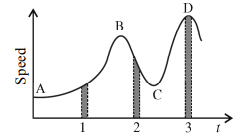
Figure gives a speed-time graph of a particle in motion along a constant direction. Three equal intervals of time are shown. In which interval is the average acceleration greatest in magnitude? In which interval is the average speed greatest? Choosing the positive direction as the constant direction of motion, give the signs of $v$ and a in the three intervals. What are the accelerations at the points A, B, C and D?
 Image
The ceiling of a long hall is 25 m high. What is the maximum horizontal distance that a ball thrown with a speed of $4 0 ms ^{-1}$ can go without hitting the ceiling of the hall?