Question types

Physics and Mathematics question types

60 questions across 5 question groups — pick any mix to generate a Physics paper with step-by-step answer keys.

60
Questions
5
Question groups
5
Question types
Sample Questions

Physics and Mathematics questions

One sample from each question group in this chapter. Select any group above to see the full set with answer keys.

The magnitude of the vector product of two vectors $\big|\overrightarrow{\text{A}}\big|$ and $\big|\overrightarrow{\text{B}}\big|$ may be:
  1. Greater than AB.
  2. Equal to AB.
  3. Less than AB.
  4. Equal to zero.
View full solution
The resultant of $\overrightarrow{\text{A}}$ and $\overrightarrow{\text{B}}$ makes an angle a with $\overrightarrow{\text{A}}$ and $\beta$ with $\overrightarrow{\text{B}},$

  1. $\alpha<\beta$

  2. $\alpha<\beta \text{ if}\text{ A}<\text{B}$

  3. $\alpha<\beta \text{ if}\text{ A}>\text{B}$

  4. $\alpha<\beta \text{ if}\text{ A}=\text{B}$

View full solution
Let $\overrightarrow{\text{C}}=\overrightarrow{\text{A}}+\overrightarrow{\text{B}}.$
  1. $|\overrightarrow{\text{C}}|$ is always greater than $|\overrightarrow{\text{A}}|$
  2. It is possible to have $|\overrightarrow{\text{C}}|<|\overrightarrow{\text{A}}|$ and $|\overrightarrow{\text{C}}|<|\overrightarrow{\text{B}}|$
  3. C is always equal to A + B
  4. C is never equal to A + B.
View full solution
Let the angle between two nonzero vectors $\overrightarrow{\text{A}}$ and $\overrightarrow{\text{B}}$ be 120° and its resultant be $\vec{\text{c}}:$
  1. C must be equal to $|\text{A}-\text{B}|$
  2. C must be less than $|\text{A}-\text{B}|$
  3. C must be greater than $|\text{A}-\text{B}|$
  4. C may be equal to $|\text{A}-\text{B}|$
View full solution
A vector $\overrightarrow{\text{A}}$ points vertically upward and $\overrightarrow{\text{B}}$ points towards north. The vector product $\overrightarrow{\text{A}}\times\overrightarrow{\text{B}}$ is:
  1. Along west.
  2. Along east.
  3. Zero.
  4. Vertically downward.
View full solution
If $\vec{\text{A}}=2\vec{\text{i}}+3\vec{\text{j}}+4\vec{\text{k}}$ and $\vec{\text{B}}=4\vec{\text{i}}+3\vec{\text{j}}+2\vec{\text{k}},$ find $\vec{\text{A}}\times\vec{\text{B}}.$
View full solution
The length of the string of a simple pendulum is measured with a metre scale to be 90.0cm. The radius of the bob plus the length of the hook is calculated to be 2.13cm using measurements with a slide callipers. What is the effective length of the pendulum? (The effective length is defined as the distance between the point of suspension and the centre of the bob.)
View full solution
Let $\overrightarrow{\text{A}}=5\vec{\text{i}}-4\vec{\text{j}}$ and $\overrightarrow{\text{B}}=-7.5\vec{\text{i}}+6\vec{\text{j}}.$
  1. Do we have $\overrightarrow{\text{B}}\text{k}\vec{\text{A}}?$
  2. Can we say $\frac{\overrightarrow{\text{B}}}{\overrightarrow{\text{A}}}=\text{k}?$
View full solution
Let $\vec{\text{a}}=2\vec{\text{i}}+3\vec{\text{j}}+4\vec{\text{k}}$ and $\vec{\text{b}}=3\vec{\text{i}}+4\vec{\text{j}}+5\vec{\text{k}}.$ Find the angle between them.
View full solution
Q 153 Marks Question3 Marks
The momentum p of a particle changes with time t according to the relation $\frac{\text{dp}}{\text{dt}}=(10\text{N})+(2\text{N/s)t}.$ If the momentum is zero at t = 0, what will the momentum be at t = 10s?
View full solution
Q 163 Marks Question3 Marks
Let $\varepsilon_1$ and $\varepsilon_2$ be the angles made by $\overrightarrow{\text{A}}$ and $-\overrightarrow{\text{A}}$ with the positive X-axis. Show that $\tan\varepsilon_1=\tan\varepsilon_2.$ Thus, giving tane does not uniquely determine the direction of $\overrightarrow{\text{A}}.$
View full solution
Q 173 Marks Question3 Marks
A vector $\overrightarrow{\text{A}}$ makes an angle of 20° and $\overrightarrow{\text{B}}$ makes an angle of 110° with the X-axis. The magnitudes of these vectors are 3 m and 4 m respectively. Find the resultant.
View full solution
Q 183 Marks Question3 Marks
Let $\overrightarrow{\text{A}}$ and $\overrightarrow{\text{B}}$ be the two vectors of magnitude 10 unit each. If they are inclined to the X-axis at angles 30° and 60° respectively, find the resultant.
View full solution
Q 193 Marks Question3 Marks
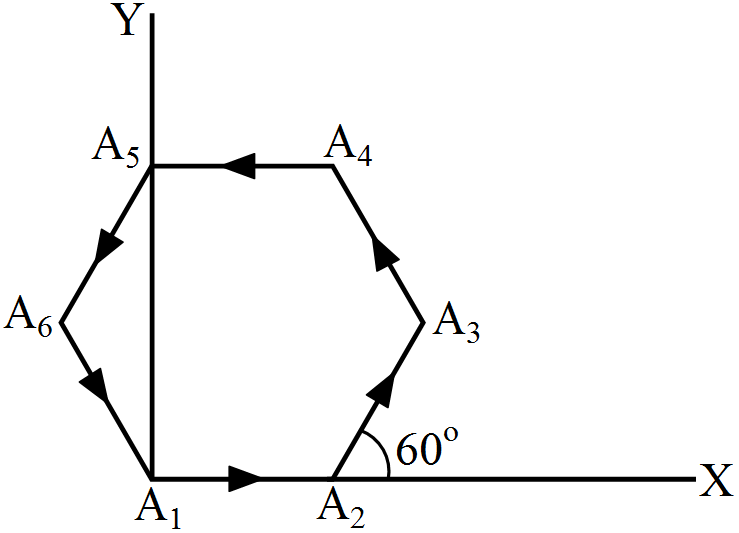
Let AAA3 A4 A5 A6 A1 be a regular hexagon. Write the x-components of the vectors represented by the six sides taken in order. Use the fact that the resultant of these six vectors is zero, to prove that

$\cos0+\cos\frac{\pi}{3}+\cos\frac{2\pi}{3}+\cos\frac{3\pi}{3}+\cos\frac{4\pi}{3}+\cos\frac{5\pi}{3}=0.$

Use the known cosine values to verify the result.

View full solution
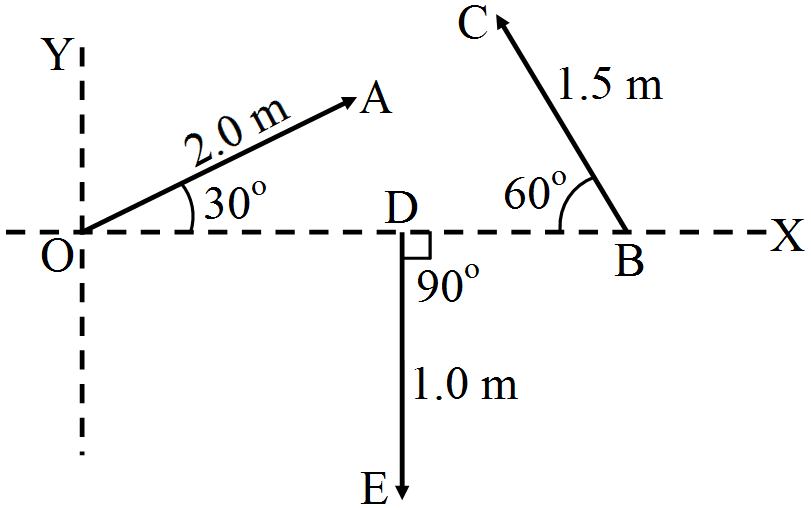
Refer to figure. Find
  1. The magnitude.
  2. x and y components
  3. The angle with the X-axis of the resultant of $\overrightarrow{\text{OA}},\overrightarrow{\text{BC}}$ and $\overrightarrow{\text{DE}}.$
View full solution
Add vectors $\overrightarrow{\text{A}},\overrightarrow{\text{B}}$ and $\overrightarrow{\text{C}}$ each having magnitude of 100 unit and inclined to the X-axis at angles 45°, 135° and 315° respectively.
View full solution

Generate a Physics and Mathematics paper free

Pick question groups from the list above, set marks and difficulty, and export a branded PDF with step-by-step answer keys. First 3 chapters free — no signup.

Download App