1m = 100mm
The minimum no. of significant digit may be 1 (e.g. for measurements like 5mm, 7mm etc) and the maximum no. of significant digits may be 4 (e.g.1000mm)
So, the no. of significant digits may be 1, 2, 3 or 4.
33 questions · self-marked practice — reveal the answer and mark yourself.
As, $\vec{\text{A}}\times\vec{\text{B}}=\text{AB}\sin\theta \ \hat{\text{n}}$
$\text{AB}\sin\theta \ \hat{\text{n}}$ is a vector which is perpendicular to the plane containing $\vec{\text{A}}$ and $\vec{\text{B}},$ this implies that it is also perpendicular to $\vec{\text{A}}.$ As dot product of two perpendicular vector is zero.
Thus $\vec{\text{A}}.(\vec{\text{A}}\times\vec{\text{B}})=0.$
⇒ B = -1.5A
$\Rightarrow\vec{\text{a}}.\vec{\text{b}}=\text{ ab}\cos\theta\Rightarrow\theta=\cos^{-1}\frac{\vec{\text{a}}.\vec{\text{b}}}{\text{ab}}$
$\Rightarrow\cos^{-1}\frac{2\times3+3\times4+4\times5}{\sqrt{2^2+3^3+4^4}\sqrt{3^2+4^2+5^2}}=\cos^{-1}\Big(\frac{38}{\sqrt{1450}}\Big)$
$3 \ \vec{\text{a}}$ is along north having magnitude 13.5 units.
$-4 \ \vec{\text{a}}$ is a vector of magnitude 6 unit due south.
$\Rightarrow\overrightarrow{\text{E}}=-(\overrightarrow{\text{v}}\times\overrightarrow{\text{B}})$
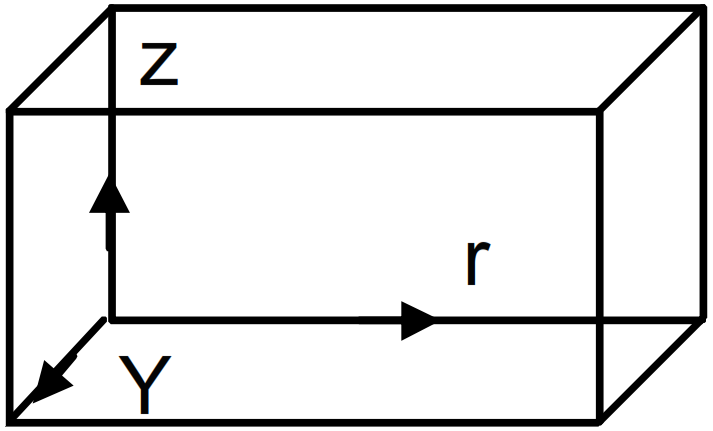
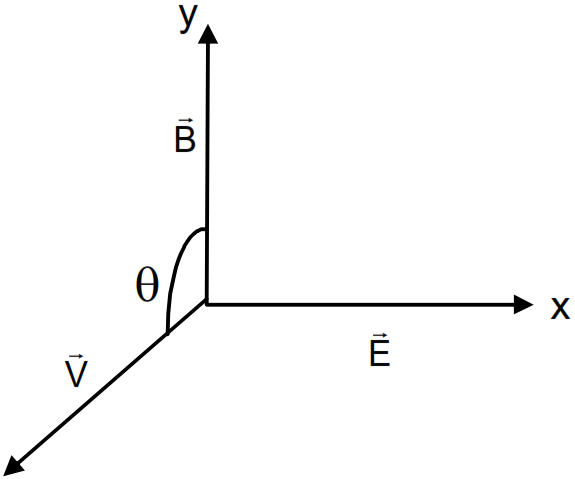
So, the direction of $\overrightarrow{\text{v}}\times\overrightarrow{\text{B}}$ should be opposite to the direction of $\overrightarrow{\text{E}}.$ Hence, $\overrightarrow{\text{v}}$ should be in the positive yz-plane. Again, $\text{E = vB}\sin\theta\Rightarrow\text{v}=\frac{\text{E}}{\text{B}\sin\theta}$ For v to be minimum, $\theta=90^{\circ}$ and so $\text{v}_{\text{min}}=\frac{\text{F}}{\text{B}}$ So, the particle must be projected at a minimum speed of E/B along +ve z-axis$(\theta=90^{\circ})$ as shown in the figure, so that the force is zero.
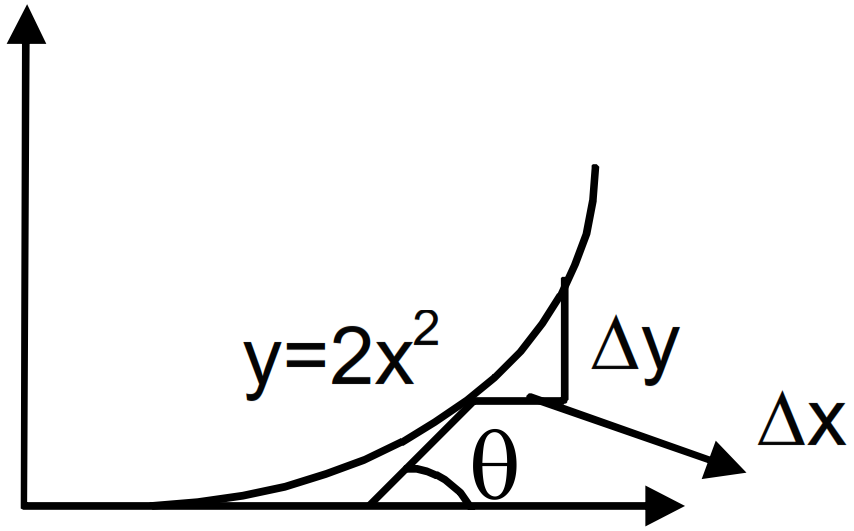
$\Rightarrow\text{dy}=\text{x}^2\text{dx}$
Taking integration of both sides,$\int\text{dy}=\int\text{x}^2\text{dx}\Rightarrow\text{y}=\frac{\text{x}^3}{3}+\text{c}$
$\therefore$ y as a function of x is represented by $\text{y}=\frac{\text{x}^3}{3}+\text{c}.$

| x | 1 | 2 | 3 | 4 | 5 | 6 | 7 | 8 | 9 | 10 |
| y | 2 | 8 | 18 | 32 | 50 | 72 | 98 | 128 | 162 | 200 |

$\therefore$ Rate of change of current $=\frac{\text{di}}{\text{dt}}=\frac{\text{d}}{\text{dt}}\text{i}_0\text{e}^{-\frac{\text{i}}{\text{RC}}}=\text{i}_0\frac{\text{d}}{\text{dt}}\text{e}^{-\frac{\text{t}}{\text{RC}}}=\frac{-\text{i}_0}{\text{RC}}\times\text{e}^{-\frac{\text{t}}{\text{RC}}}$
$\text{i}_0=2\text{A, R}=6\times10^{-5}\Omega,\text{C}=0.0500\times10^{-6}\text{F}=5\times10^{-7}\text{F}$
$\text{i}=2\times\text{e}^{\Big(\frac{-0.3}{6\times0^3\times5\times10^{-7}}\Big)}=2\times\text{e}^{\big(\frac{-0.3}{0.3}\big)}=\frac{2}{\text{e}}\text{amp}$
$\frac{\text{di}}{\text{dt}}=\frac{-\text{i}_0}{\text{RC}}\text{e}^{-\frac{\text{t}}{\text{RC}}}$ when t = 0.3
$\sec\Rightarrow\frac{\text{di}}{\text{dt}}=-\frac{2}{0.30}\text{e}^{\big(\frac{-03}{0.3}\big)}=\frac{-20}{3\text{e}}\text{amp/sec}$
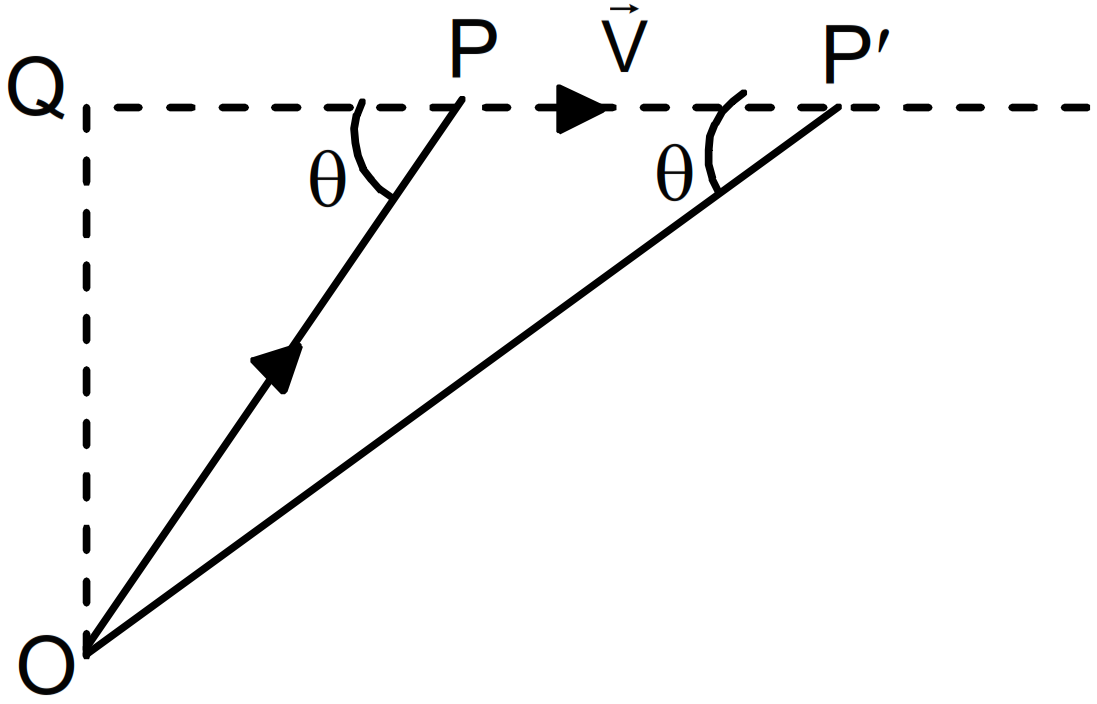
$\overrightarrow{\text{OP}}\times\overrightarrow{\text{v}}=(\text{OP})\sin\theta \ \hat{\text{n}}=\text{v(OP)}\sin\theta \ \hat{\text{n}}=\text{v(OQ)} \ \hat{\text{n}}$
It can be seen from the figure, $\text{OQ = OP}\sin\theta=\text{OP}'\sin\theta'$ So, whatever may be the position of the particle, the magnitude and direction of $\overrightarrow{\text{OP}}\times\vec{\text{v}}$ remain constant.$\therefore\overrightarrow{\text{OP}}\times\vec{\text{v}}$ remain constant.

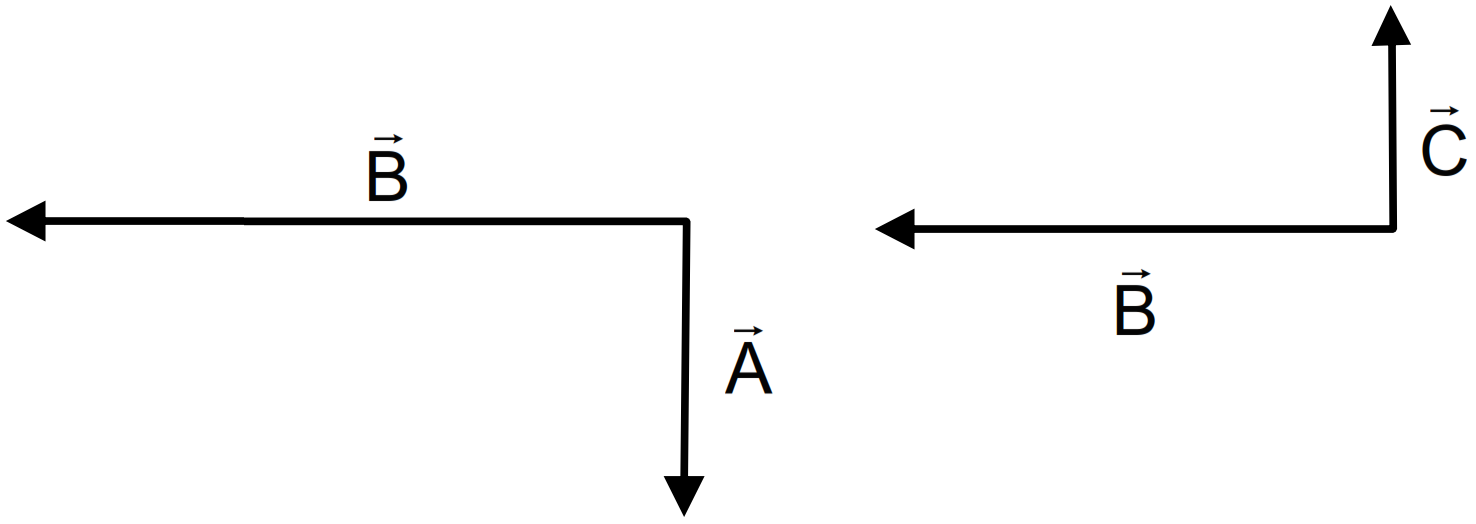
$\overrightarrow{\text{A}}\perp\overrightarrow{\text{B}}:\overrightarrow{\text{B}} \ \text{along west}$
$\overrightarrow{\text{B}}\perp\overrightarrow{\text{C}}:\overrightarrow{\text{A}}\text{ along south}$
$\overrightarrow{\text{C}} \text{along north}$
$\overrightarrow{\text{A}}.\overrightarrow{\text{B}}=0$ $\therefore\overrightarrow{\text{A}}.\overrightarrow{\text{B}}=\overrightarrow{\text{B}}.\overrightarrow{\text{C}}$
$\overrightarrow{\text{B}}.\overrightarrow{\text{C}}=0$ But $\overrightarrow{\text{B}}\neq\overrightarrow{\text{C}}$


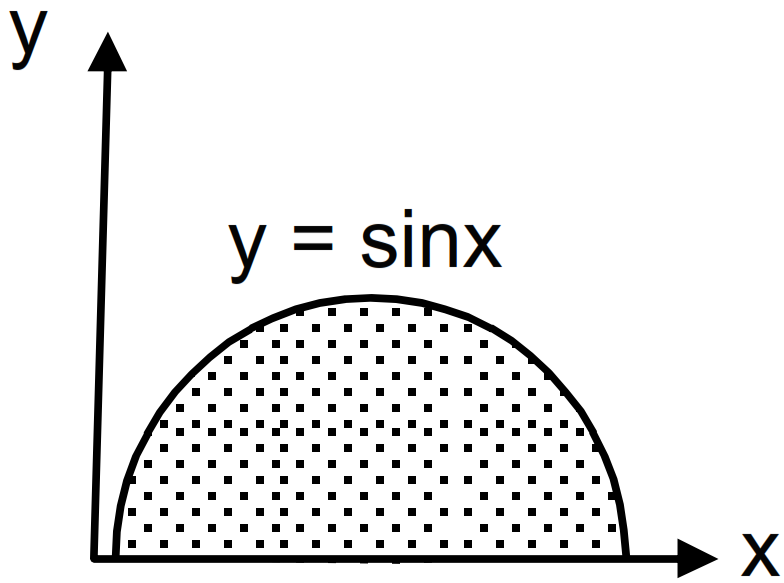
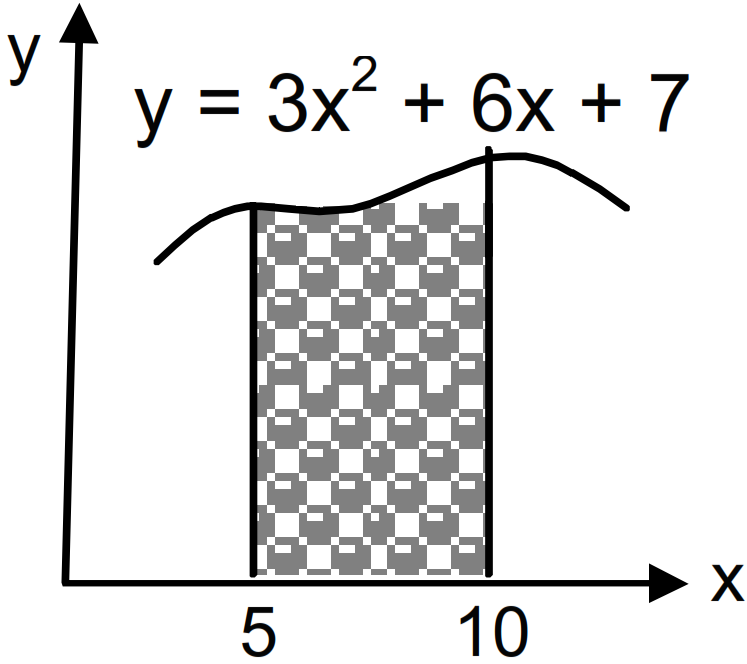
$\therefore$ Area bounded by the curve, x-axis with coordinates with x = 5 and x = 10 is
given by,$\text{Area}=\int\limits^{\text{y}}_{0}\text{dy}=\int\limits^{10}_5(3\text{x}^2+6\text{x}+7)\text{dx}\\=3\frac{\text{x}^3}{3}\Big]^{10}_5+5\frac{\text{x}^2}{3}\Big]^{10}_5+7\text{x}]^{10}_{5}=1135\text{sq. units}$


$\Rightarrow\sqrt{3^2+4^2+2.3.4.\cos\theta}=1$
$\Rightarrow\theta=180^{\circ}$
$\Rightarrow\theta=90^{\circ}$
$\Rightarrow\theta=0^{\circ}$
Angle between them is 0°.
$\vec{\text{a}}$
$\vec{\text{b}}$
$\vec{\text{a}}+\vec{\text{b}}$
$\vec{\text{a}}-\vec{\text{b}}$
$|\vec{\text{a}}|=\sqrt{4^2+3^3}=5$
$|\vec{\text{b}}|=\sqrt{9+16}=5$
$|\vec{\text{a}}+\vec{\text{b}}|=|7\vec{\text{i}}+7\vec{\text{j}}|=7\sqrt{2}$
$\vec{\text{a}}-\vec{\text{b}}=(-3+4)\hat{\text{i}}+(-4+3)\hat{\text{j}}=\hat{\text{i}}-\hat{\text{j}}$
$|\vec{\text{a}}-\vec{\text{b}}|=\sqrt{1^2+(-1)^2}=\sqrt{2}.$
$\overrightarrow{\text{A}}=\overrightarrow{\text{B}}$
$\overrightarrow{\text{A}}\neq\overrightarrow{\text{B}}$
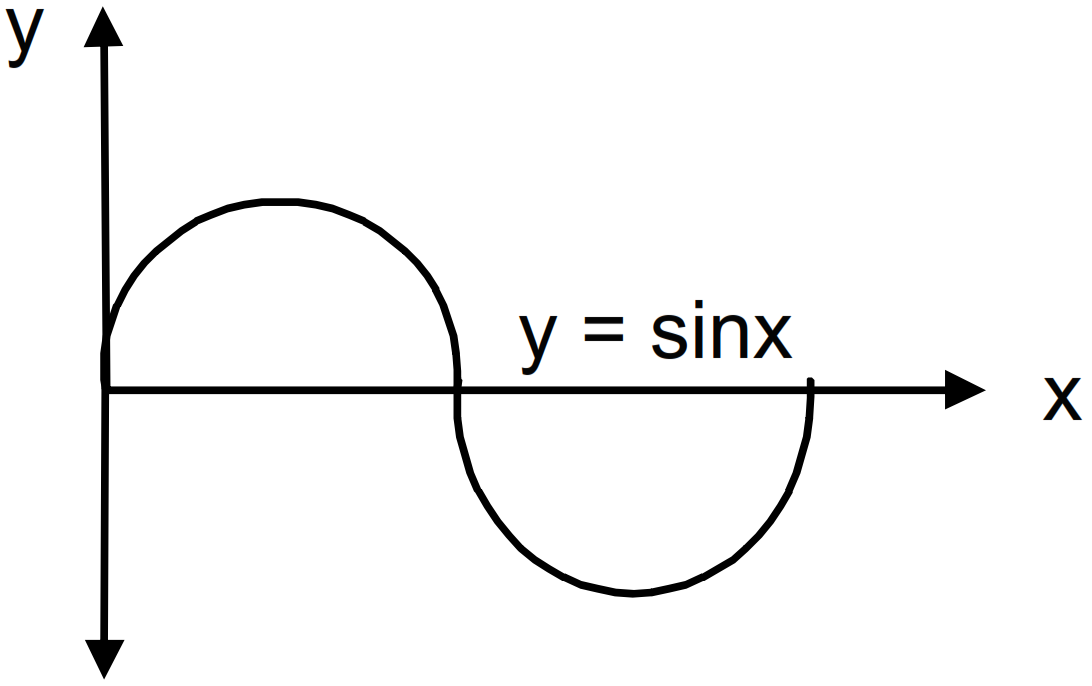
So, $\text{y}+\triangle\text{y}=\sin(\text{x}+\triangle\text{x})$
$\triangle\text{y}=\sin(\text{x}+\triangle\text{x})-\sin\text{x}$
$=\Big(\frac{\pi}{3}+\frac{\pi}{100}\Big)-\sin\frac{\pi}{3}=0.0157$

angle between them $\theta=60^{\circ}$
$\vec{\text{a}}.\vec{\text{b}}=|\vec{\text{a}}|.|\vec{\text{b}}|\cos60^{\circ}=2\times3\times\frac{1}{2}=3\text{m}^2$
$|\vec{\text{a}}\times\vec{\text{b}}|=|\vec{\text{a}}|.|\vec{\text{b}}|\sin60^{\circ}=2\times3\times\sqrt{\frac{3}{2}}=3\sqrt{3}\text{ m}^2$
So, the next two digits are neglected and the value of 4 is increased by 1.
$\therefore$ value becomes 3500