Question types

Thermal Properties of Matter question types

27 questions across 4 question groups — pick any mix to generate a Physics paper with step-by-step answer keys.

27
Questions
4
Question groups
5
Question types
Sample Questions

Thermal Properties of Matter questions

One sample from each question group in this chapter. Select any group above to see the full set with answer keys.

‘Gulab Jamuns’ (assumed to be spherical) are to be heated in an oven. They are available in two sizes, one twice bigger (in radius) than the other. Pizzas (assumed to be discs) are also to be heated in oven. They are also in two sizes, one twice big (in radius) than the other. All four are put together to be heated to oven temperature. Choose the correct option from the following:
  1. Both size gulab jamuns will get heated in the same time.
  2. Smaller gulab jamuns are heated before bigger ones.
  3. Smaller pizzas are heated before bigger ones.
  4. Bigger pizzas are heated before smaller ones.
View full solution
Mark the correct options:
  1. A system X is in thermal equilibrium with Y but not with Z. System Y and Z may be in thermal equilibrium with each other.
  2. A system X is in thermal equilibrium with Y but not with Z. Systems Y and Z are not in thermal equilibrium with each other.
  3. A system X is neither in thermal equilibrium with Y nor with Z. The systems Y and Z must be in thermal equilibrium with each other.
  4. A system X is neither in thermal equilibrium with Y nor with Z. The system Y and Z may be in thermal equilibrium with each other.
View full solution
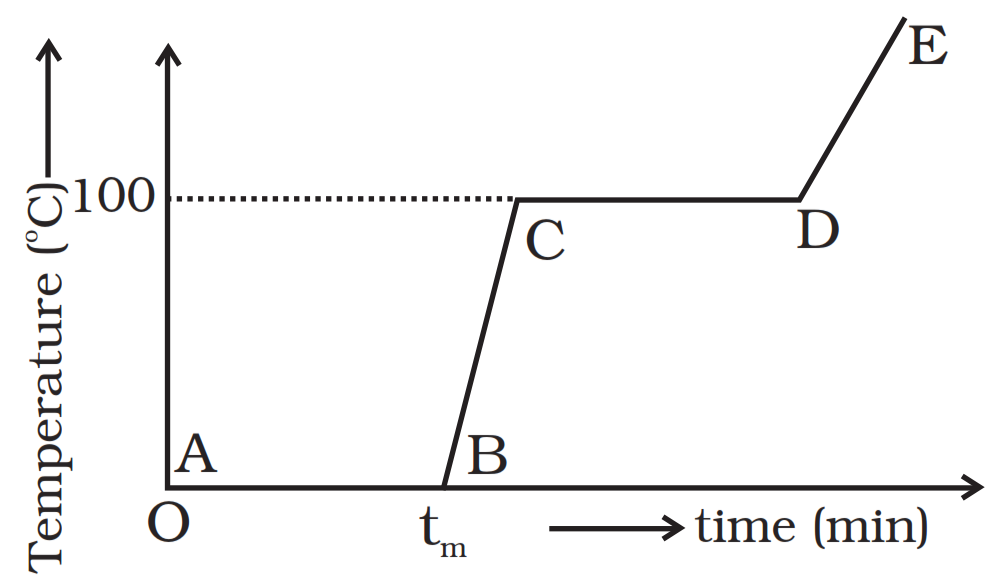
Refer to the plot of temperature versus time showing the changes in the state of ice on heating (not to scale). Which of the following is correct?

  1. The region AB represents ice and water in thermal equilibrium.
  2. At B water starts boiling.
  3. At C all the water gets converted into steam.
  4. C to D represents water and steam in equilibrium at boiling point.
View full solution
As the temperature is increased, the time period of a pendulum:
  1. Increases as its effective length increases even though its centre of mass still remains at the centre of the bob.
  2. Decreases as its effective length increases even though its centre of mass still remains at the centre of the bob.
  3. Increases as its effective length increases due to shifting of centre of mass below the centre of the bob.
  4. Decreases as its effective length remains same but the centre of mass shifts above the centre of the bob.
View full solution
A uniform metallic rod rotates about its perpendicular bisector with constant angular speed. If it is heated uniformly to raise its temperature slightly:
  1. Its speed of rotation increases.
  2. Its speed of rotation decreases.
  3. Its speed of rotation remains same.
  4. Its speed increases because its moment of inertia increases.
View full solution
These days people use steel utensils with copper bottom. This is supposed to be good for uniform heating of food. Explain this effect using the fact that copper is the better conductor.
View full solution
Find out the increase in moment of inertia I of a uniform rod $($coefficient of linear expansion $\alpha)$ about its perpendicular bisector when its temperature is slightly increased by $\Delta\text{T}.$
View full solution
A student records the initial length l, change in temperature $\Delta\text{T}$ and change in length $\Delta\text{l}$ of a rod as follows:
S.NO.
l(m)
$\Delta\text{T(C)}$
$\Delta\text{l}(\text{m})$
1.
2
10
4 × 10-4
2.
1
10
4 × 10-4
3.
2
20
2 × 10⁻⁴
4.
3
10
6 × 10⁻⁴
If the first observation is correct, what can you say about observations 2, 3 and 4.
View full solution
Q 113 Marks Question3 Marks
Why does a metal bar appear hotter than a wooden bar at the same temperature? Equivalently it also appears cooler than wooden bar if they are both colder than room temperature.
View full solution
Q 123 Marks Question3 Marks
100 g of water is supercooled to -10°C. At this point, due to some disturbance mechanised or otherwise some of it suddenly freezes to ice. What will be the temperature of the resultant mixture and how much mass would freeze?
[Sw = 1cal/ g/°C and LWFusion = 80cal/ g]
View full solution
A thin rod having length L0 at 0°C and coefficient of linear expansion $\alpha$ has its two ends maintained at temperatures $\theta_1$ and $\theta_2,$ respectively. Find its new length.
View full solution
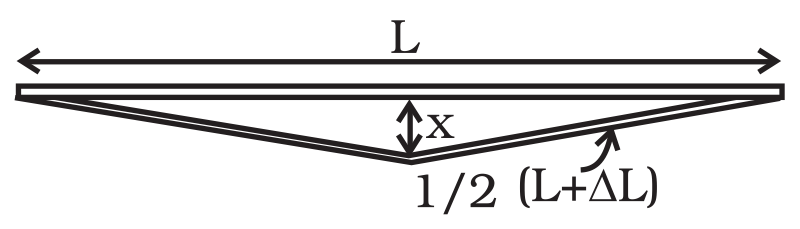
A rail track made of steel having length 10m is clamped on a raillway line at its two ends. On a summer day due to rise in temperature by 20°C , it is deformed as shown in figure. Find x(displacement of the centre) if $\alpha_\text{steel}=1.2\times10^{-5}/{^\circ\text{C}}.$

View full solution
We would like to make a vessel whose volume does not change with temperature (take a hint from the problem above). We can use brass and iron $\big(\beta_\text{ubrass}=6\times10^{-5}/\text{K and }\beta_\text{uiron}=3.55\times10^{-5}\text{K}\big)$ to create a volume of 100cc. How do you think you can achieve this.
View full solution
During summers in India, one of the common practice to keep cool is to make ice balls of crushed ice, dip it in flavoured sugar syrup and sip it. For this a stick is inserted into crushed ice and is squeezed in the palm to make it into the ball. Equivalently in winter, in those areas where it snows, people make snow balls and throw around. Explain the formation of ball out of crushed ice or snow in the light of P–T diagram of water.
View full solution
One day in the morning, Ramesh filled up 1/ 3 bucket of hot water from geyser, to take bath. Remaining 2/ 3 was to be filled by cold water (at room temperature) to bring mixture to a comfortable temperature. Suddenly Ramesh had to attend to something which would take some times, say 5-10 minutes before he could take bath. Now he had two options:
  1. Fill the remaining bucket completely by cold water and then attend to the work.
  2. First attend to the work and fill the remaining bucket just before taking bath. Which option do you think would have kept water warmer? Explain.
View full solution

Generate a Thermal Properties of Matter paper free

Pick question groups from the list above, set marks and difficulty, and export a branded PDF with step-by-step answer keys. First 3 chapters free — no signup.

Download App