Question
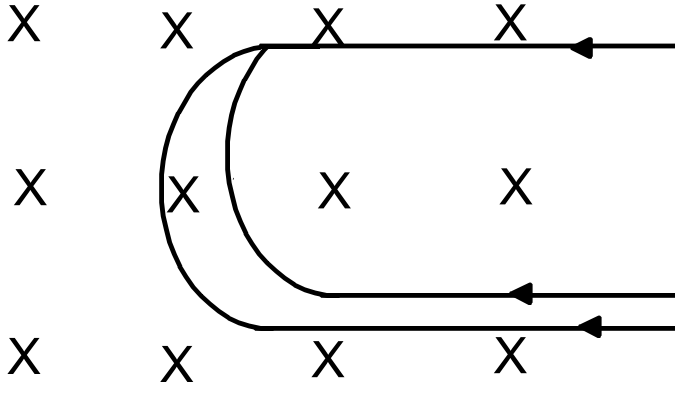
We would like to make a vessel whose volume does not change with temperature (take a hint from the problem above). We can use brass and iron $\big(\beta_\text{ubrass}=6\times10^{-5}/\text{K and }\beta_\text{uiron}=3.55\times10^{-5}\text{K}\big)$ to create a volume of 100cc. How do you think you can achieve this.
Answer

Volume of vessel, V0 = 100cm3

= 10-4 = constant

Volume of iron vessel (VI) - Volume of brass rod (VB) = 10-4m3

⇒ VI - VB = 10-4m3

This condition is possible if

$\beta_\text{I}\text{V}_\text{I}\Delta\text{T}=\beta_\text{B}\text{V}_\text{B}\Delta\text{T}$

$\therefore\ \text{V}_{\text{I}}=\Big(\frac{\beta_\text{B}}{\beta_\text{I}}\Big)\text{V}_\text{B}$

$=\Big(\frac{6\times100^{-5}}{3.55\times10^{-5}}\Big)\text{V}_\text{B}$

$=1.69\text{V}_\text{B}$

From equation (i),

$1.69\text{V}_\text{B}-\text{V}_\text{B}=10^{-4}$

$\Rightarrow\text{V}_\text{B}=\frac{10^{-4}}{0.69}=1.449\times10^{-4}\text{m}^3$

$\Rightarrow\text{V}_\text{B}=\frac{10^{-4}}{0.69}=1449\times10^{-4}\text{m}^3$

$\Rightarrow\text{V}_\text{I}=1.69\text{V}_\text{B}=1.69\times144.9=244.9\text{cm}^3$

Therefore, an iron vessel with a volume of 249.9cm3 fitted with a brass rod of volume 144.9cm3 will serve as a vessel of volume 100cm3, which will not change with temperature.

Need a full question paper?

Generate a complete, print-ready paper with questions like this in minutes — across 16+ boards, with answer keys.

Start Generating Free

Similar questions

A body of mass m is attached to one end of a massless spring which is suspended vertically from a fixed point. The mass is held in hand so that the spring is neither stretched nor compressed. Suddenly the support of the hand is removed. The lowest position attained by the mass during oscillation is 4cm below the point, where it was held in hand.
  1. What is the amplitude of oscillation?
  2. Find the frequency of oscillation?
A block is kept on a horizontal table. The table is undergoing S.H.M. of frequency 3Hz in a horizontal plane. The coefficient of static friction between block and the table surface is 0.72. Find the maximum amplitude of the table at which the block does not slip on the surface.
In a series LCR circuit with an AC source, $\text{R}=300\Omega,\text{C}=20\mu\text{F},\text{L}=1.0\text{ henry},\in_0=50\text{V}$ and $\nu=\frac{50}{\pi}\text{Hz}.$ Find:
  1. The rms current in the circuit.
  2. The rms potential difference across the capacitor, the resistor and the inductor. Note that the sum of the rms potential differences across the three elements is greater than the rms voltage of the source.
Prove that velocity of efflux of an ideal liquid through an orifice is equal to the velocity attained by a freely falling body from the surface of the liquid to the orifice. Also find the horizontal range in terms of height. When is this range maximum?
A narrow beam of singly-charged carbon ions, moving at a constant velocity of 6.0 × 10⁴m s-1, is sent perpendicularly in a rectangular region of uniform magnetic field B = 0.5T It is found that two beams emerge from the field in the backward direction, the separations from the incident beam being 3.0cm and 3.5cm. Identify the isotopes present in the ion beam. Take the mass of an ion = A(1.6 × 10⁻²⁷)kg, where A is the mass number.

State, for each of the following physical quantities, if it is a scalar or a vector : volume, mass, speed, acceleration, density, number of moles, velocity, angular frequency, displacement, angular velocity.
  1. State first law of thermodynamics. What are its limitations? Why Cp > Cv?
  2. An electric heater supplies heat to a system at a rate 100W. If the system performs work at a rate of 75 joules per second at what rate is the internal energy increases.

OR

  1. Derive an expression for the work done during the isothermal expression of x mole of an ideal gas.
  2. A steam engine delivers 5.4 × 10⁸J of work per minute and services 3.6 × 10⁹J of heat per minute from its boiler. What is the efficiency of the engine? How much heat is wasted per minute?
Explain linear simple harmonic motion by taking an example. Find the expression for its period and explain its dependence.
A body of mass m makes an elastic collision with another identical body at rest. Show that if the collision is not head-on, the bodies go at right angle to each other after the collision.
A biconvex thick lens is constructed with glass $(\mu=1.50)$ Each of the surfaces has a radius of 10cm and the thickness at the middle is 5cm. Locate the image of an object placed far away from the lens.