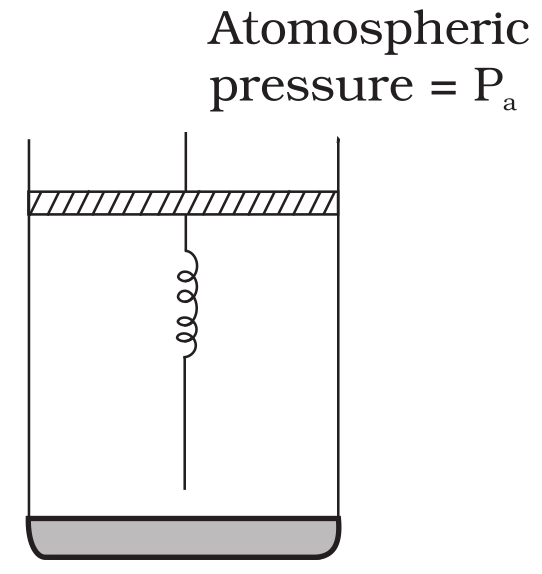
- What is the initial pressure of the system.
- What is the final pressure of the system.
- Uing the first law of thermodynamics, write down a relation between Q, Pa, V, Vo and k.
- It is considered that piston is mass less and piston is balanced by atmospheric pressure (Pa). So the initial pressure of system inside the cylinder = Pa,
- On supply heat Q. Volume of gas increase from V0 to V1 and spring stretched also.So increase in volume = V1 - V0
If displacement of piston is x then volume increase in cylinder )
= Aera of base × height = A × x
A × x = V1 - V0 (A = area of cross section of cylinder)
$\therefore\ \text{x}=\frac{\text{V}_1-\text{V}_0}{\text{A}}$
Force exerted by spring $\text{F}_\text{s}=\text{K}_\text{x}=\frac{\text{K}(\text{V}_1-\text{V}_0)}{\text{A}}$
As the piston is of unit area of cross - section $\therefore\ \text{A}=1$
Force due to spring =$\text{K}(\text{V}_1-\text{V}_0)$ on unit area can be say press due to spring = $\text{K}(\text{V}_1-\text{V}_0)$
Final total pressure on gas $\text{P}_\text{f}=\text{P}_\text{a}+\text{K}(\text{V}_1-\text{V}_0)$
- by 1st law of thermodynamics $\text{dQ}=\text{dU}+\text{dW}$
Now $\text{DQ}=\text{dU}+\text{dW}$
$=\text{c}_\text{v}(\text{T}-\text{T}_0)+\text{P}_\text{a}(\text{V}_1-\text{V}_0)+\frac{1}{2}\text{kx}^2$
$\text{dQ}=\text{C}_\text{V}(\text{T}-\text{T}_0)+\text{P}_\text{a}(\text{V}_1-\text{V}_0)+\frac{1}{2}\text{k}(\text{V}_1-\text{V}_0)^2$
It is required relation.
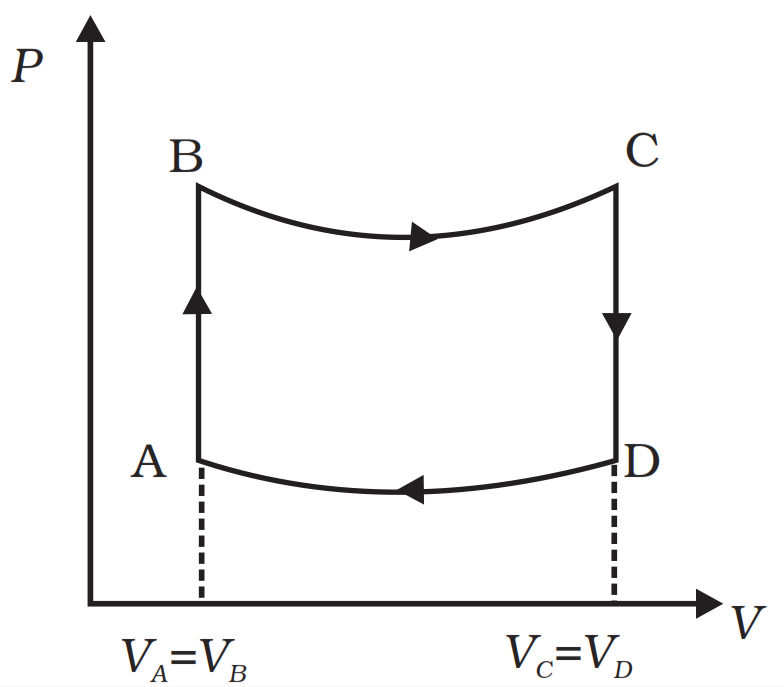
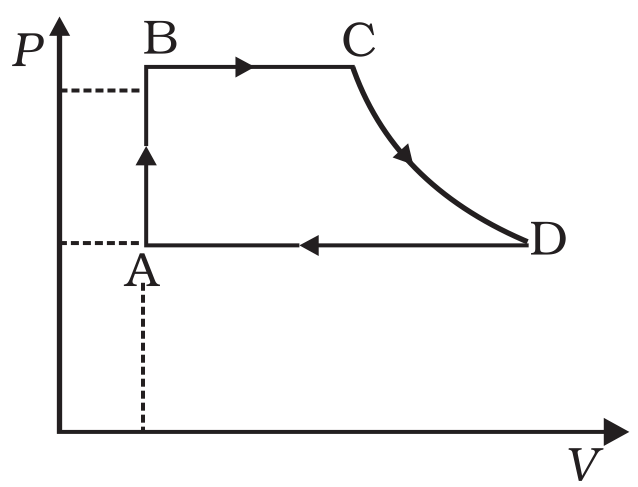 AB : constant volume
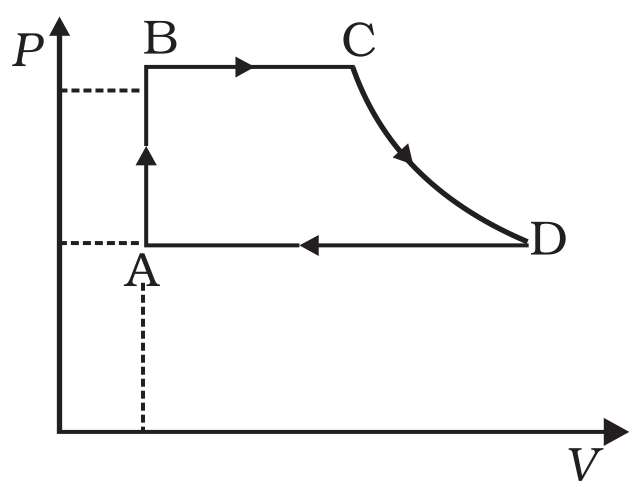 By
By