Question types

Thermodynamics question types

29 questions across 5 question groups — pick any mix to generate a Physics paper with step-by-step answer keys.

29
Questions
5
Question groups
5
Question types
Sample Questions

Thermodynamics questions

One sample from each question group in this chapter. Select any group above to see the full set with answer keys.

If an average person jogs, he produces 14.5 × 10³ cal/ min. This is removed by the evaporation of sweat. The amount of sweat evaporated per minute (assuming 1kg requires 580 × 103cal for evaparation) is
  1. 0.25kg
  2. 2.25kg
  3. 0.05kg
  4. 0.20kg
View full solution
Which of the processes described below are irreversible?
  1. The increase in temprature of an iron rod by hammering it.
  2. A gas in a small cantainer at a temprature T1 is brought in contact with a big reservoir at a higher temprature T2 which increases the temprature of the gas.
  3. A quasi-static isothermal expansion of an ideal gas in cylinder fitted with a frictionless piston.
  4. An ideal gas is enclosed in a piston cylinder arrangement with adiabatic walls. A weight W is added to the piston, resulting in compression of gas.
View full solution
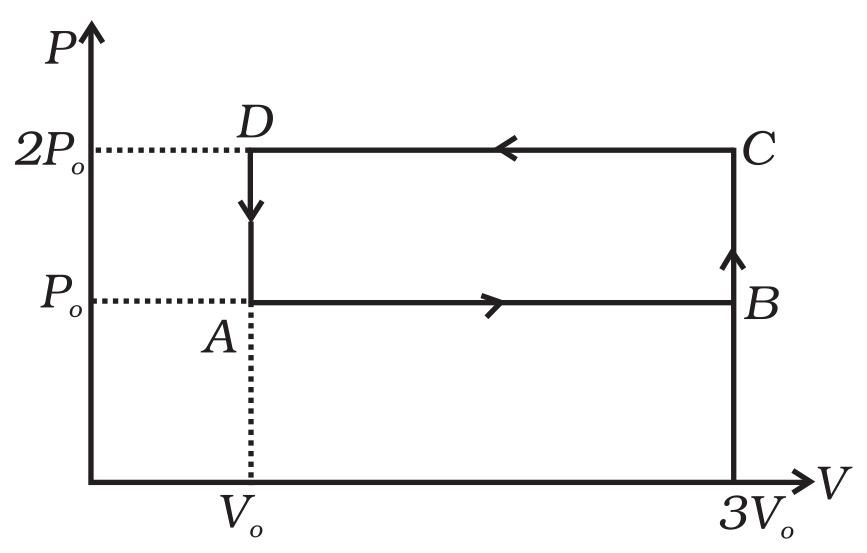
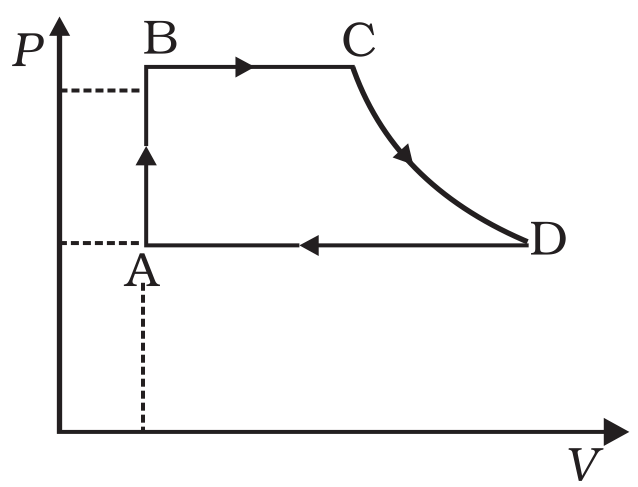
An ideal gas undergoes cyclic process ABCDA as shown in given PV diagram. The amount of work done by the gas is:

  1. $6\text{P}_0\text{V}_0$

  2. $-2\text{P}_0\text{V}_0$

  3. $+2\text{P}_0\text{V}_0$

  4. $+4\text{P}_0\text{V}_0$

View full solution
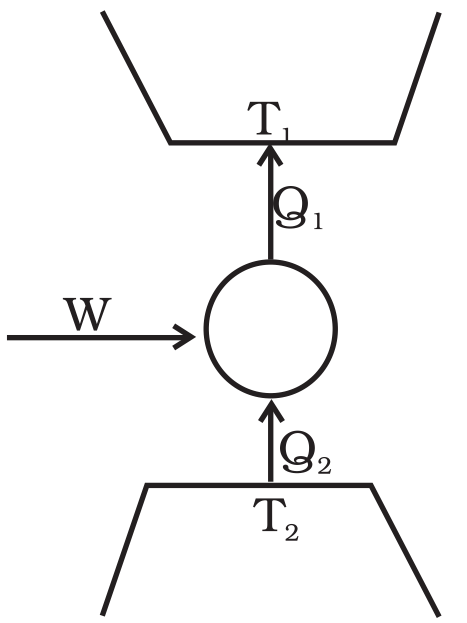
Consider a heat engine as shown in Q1 and Q2 are heat added to heat bath T1 and heat taken from T2 in one cycle of engine. W is the mechanical work done on the engine. If W > 0, then possibilities are:

  1. $\text{Q}_1>\text{Q}_2>0$
  2. $\text{Q}_2>\text{Q}_1>0$
  3. $\text{Q}_2<\text{Q}_1<0$
  4. $\text{Q}_1<0,\text{Q}_2>0$

View full solution
Consider two containers A and B containing identical gases at the same pressure, volume and temperature. The gas in container A is compressed to half of its original volume isothermally while the gas in container B is compressed to half of its original value adiabatically. The ratio of final pressure of gas in B to that of gas in A is

  1. $2^{\gamma-1}$

  2. $\Big(\frac{1}{2}\Big)^{\gamma-1}$

  3. $\Big(\frac{1}{1-\gamma}\Big)^2$

  4. $\Big(\frac{1}{\gamma-1}\Big)^2$

View full solution
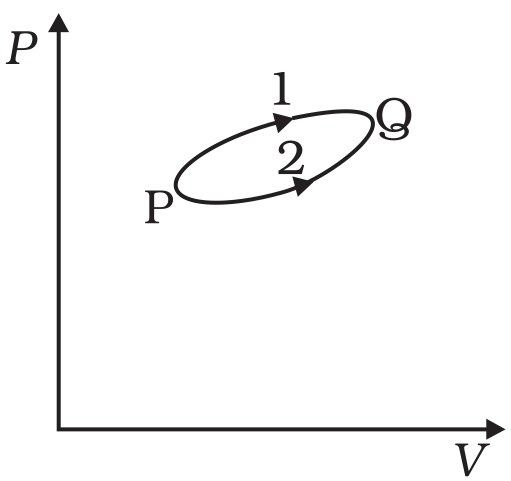
A system goes from P to Q by two different paths in the P-V diagram as shown in Fig. Heat given to the system in path 1 is 1000J. The work done by the system along path 1 is more than path 2 by 100J. What is the heat exchanged by the system in path 2?

View full solution
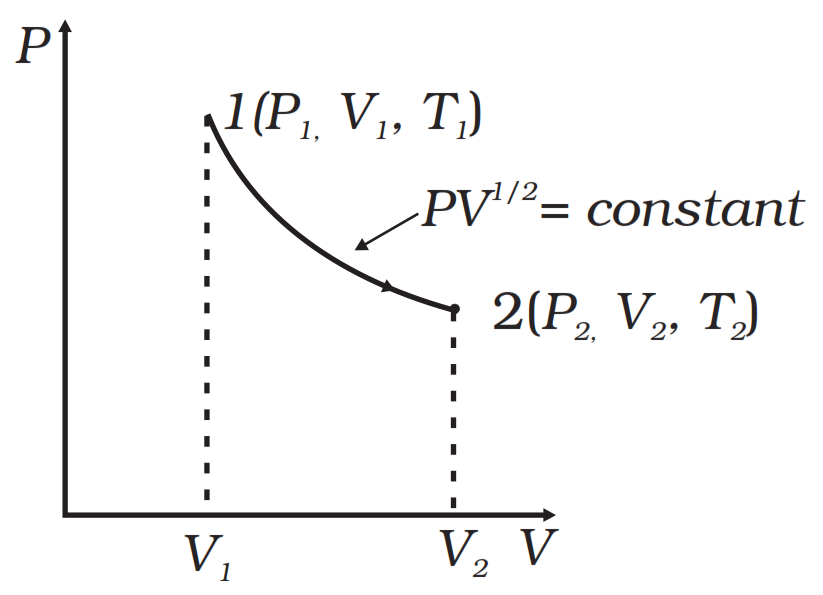
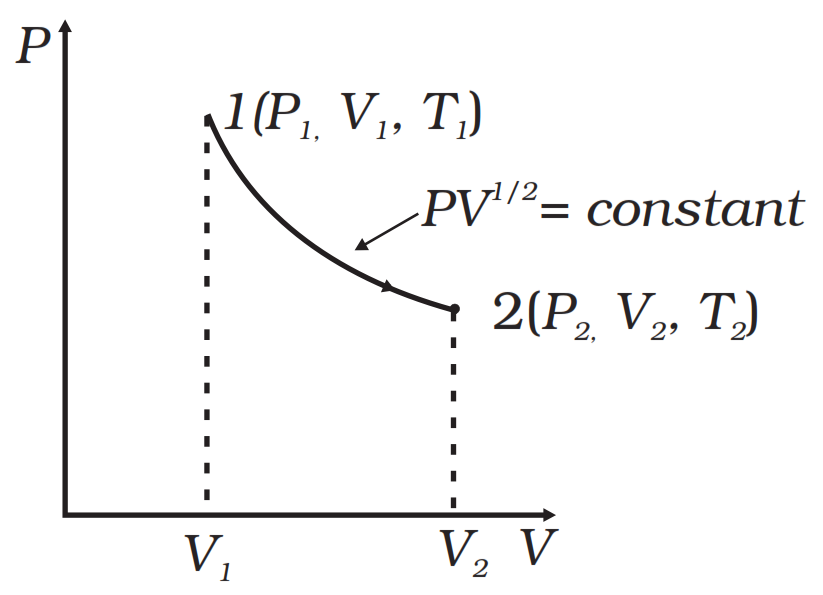
Consider a P-V diagram in which the path followed by one mole of perfect gas in a cylindrical container is shown in Fig.

Find the work done when the gas is taken from state 1 to state 2.
View full solution
If the co-efficient of performance of a refrigerator is 5 and operates at the room temperature (27°C), find the temperature inside the refrigerator.
View full solution
Q 123 Marks Question3 Marks
Consider a P-V diagram in which the path followed by one mole of perfect gas in a cylindrical container is shown in Fig.

Given the internal energy for one mole of gas at temperature T is (3/2) RT, find the heat  supplied to the gas when it is taken from state (1) to (2)  with V2 = 2V1.
View full solution
Q 133 Marks Question3 Marks
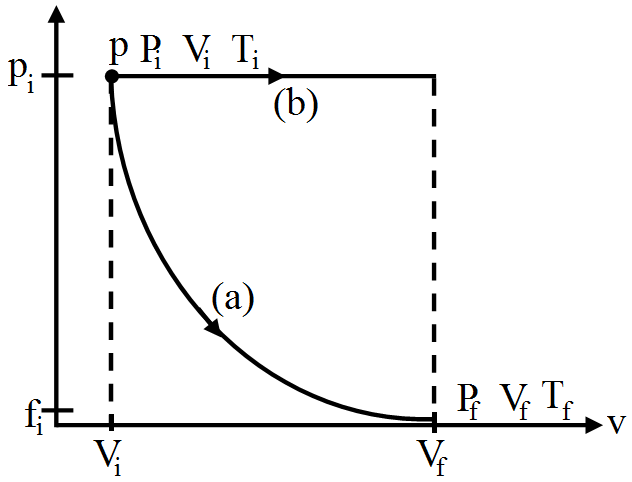
The initial state of a certain gas is (Pi , Vi , Ti ). It undergoes expansion till its volume becoms Vf . Consider the following two cases:
  1. The expansion takes place at constant temperature.
  2. The expansion takes place at constant pressure.
Plot the P-V diagram for each case. In which of the two cases, is the work done by the gas more?

View full solution
Q 153 Marks Question3 Marks
Consider a Carnot’s cycle operating between T1 = 500K and T2=300K producing 1k J of mechanical work per cycle. Find the heat transferred to the engine by the reservoirs.
View full solution
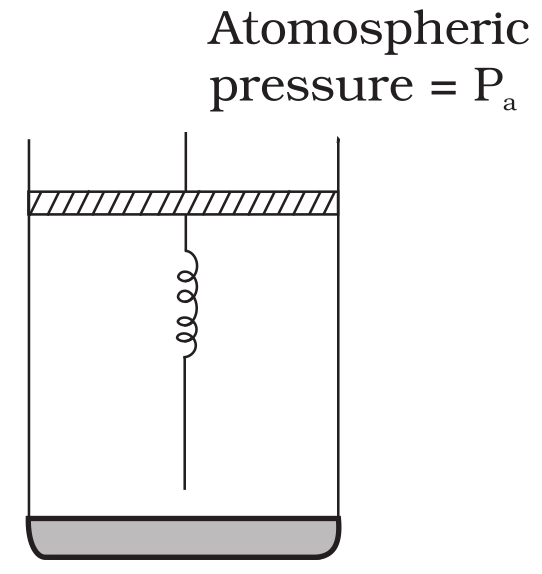
Consider one mole of perfect gas in a cylinder of unit cross section with a piston attached (Fig.) A spring (spring constant k) is attached (unstretched length L) to the piston and to the bottom of the cylinder. Initially the spring is unstretched and the gas is in equilibrium. A certain amount of heat Q is supplied to the gas causing an increase of volume from Vo to V1.

  1. What is the initial pressure of the system.
  2. What is the final pressure of the system.
  3. Uing the first law of thermodynamics, write down a relation between Q, Pa, V, Vo and k.
View full solution
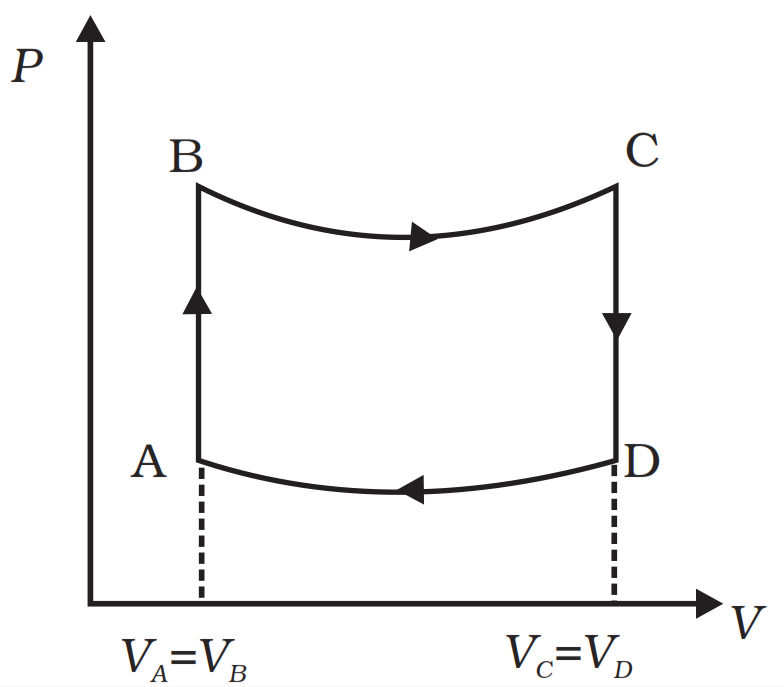
A cycle followed by an engine (made of one mole of perfect gas in a cylinder with a piston) is shown in Fig.

A to B : volume constant

B to C : adiabatic

C to D : volume constant

D to A : adiabatic

V= V= 2V= 2VB

  1. In which part of the cycle heat is supplied to the engine from outside?
  2. In which part of the cycle heat is being given to the surrounding by the engine?
  3. What is the work done by the engine in one cycle? Write your answer in term of PA, PB, VA.
  4. What is the efficiency of the engine?[$\gamma=\frac{5}{3}$ for the gas], $\big(\text{C}_\text{v}=\frac{3}{2}\text{R for one mole}\big)$
View full solution
A cycle followed by an engine (made of one mole of an ideal gas in a cylinder with a piston) is shown in Fig. Find heat exchanged by the engine, with the surroundings for each section of the cycle. (Cv = (3/2) R)

AB : constant volume

BC : constant pressur

CD : adiabati

DA : constant pressure

View full solution
In a refrigerator one removes heat from a lower temperature and deposits to the surroundings at a higher temperature. In this process, mechanical work has to be done which is provided by an electric motor. If the motor is of 1KW power, and heat is transferred from –3°C to 27°C, find the heat taken out of the refrigerator per second assuming its efficiency is 50% of a perfect engine.
View full solution
Consider a cycle tyre being filled with air by a pump. Let V be the volume of the tyre (fixed) and at each stroke of the pump $\Delta\text{V}(<<\text{V})$ of air is transferred to the tube adiabatically. What is the work done when the pressure in the tube is increased from P1 to P2?
View full solution

Generate a Thermodynamics paper free

Pick question groups from the list above, set marks and difficulty, and export a branded PDF with step-by-step answer keys. First 3 chapters free — no signup.

Download App