Questions

3 Marks Question

Take a timed test

4 questions · self-marked practice — reveal the answer and mark yourself.

Question 13 Marks
The initial state of a certain gas is $(P_i , V_i , T_i )$. It undergoes expansion till its volume becoms $V_f$ . Consider the following two cases:
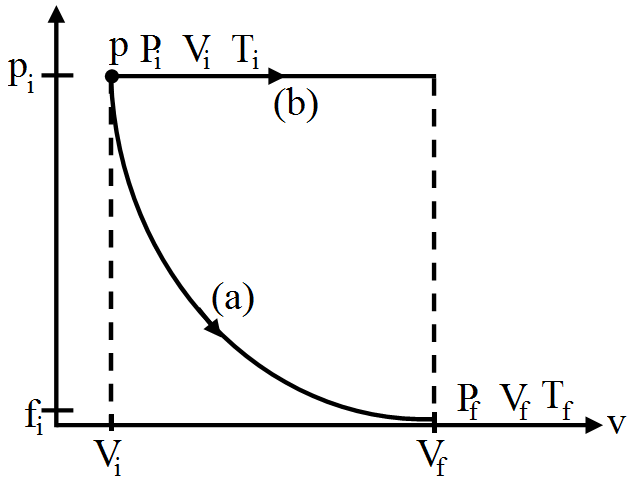
  1. The expansion takes place at constant temperature.
  2. The expansion takes place at constant pressure.
Plot the $P-V$ diagram for each case. In which of the two cases, is the work done by the gas more?
Answer
$a.$ The expension from $V _{ i }$ to Vf tempreature $T _{ i }$ remains constant so isothermal expension i.e. $P _{ i } V _{ i }= P _{ f } V _{ f }$ constant $T$ .
$b.$ The expension is at constant pressure $p_i$ so isobaric process so graph $P-V$ will be parallel to $V$ axis till its volume becomes $V _{ f }$ As the area enclosed by graph $(a)$ is less than $(b)$ with volume axis so $W.D$. by process $(b)$ is more than of $(a)$.
View full question & answer
Question 23 Marks
Is it possible to increase the temperature of a gas without adding heat to it? Explain.
Answer
Yes, it is possible to increase the temperature of a gas without adding heat to it, during adiabatic compression the temperature of a gas increases while no heat is given to it. For an adiabatic compression, no heat is given or taken out in adiabatic process. Therefore,$\Delta\text{Q}=0$ According to the first law of thermodynamics, $\Delta\text{Q}=\Delta\text{U}+\Delta\text{W}$$\Delta\text{U}=-\Delta\text{W}(\Delta\text{Q}=0)$
In compression work is done on the gas, i.e. work done is negativ. Therefore, $\Delta\text{U}=$ positive. Hence, internal energy of the gas increases due to which its temperature increases.
View full question & answer
Question 33 Marks
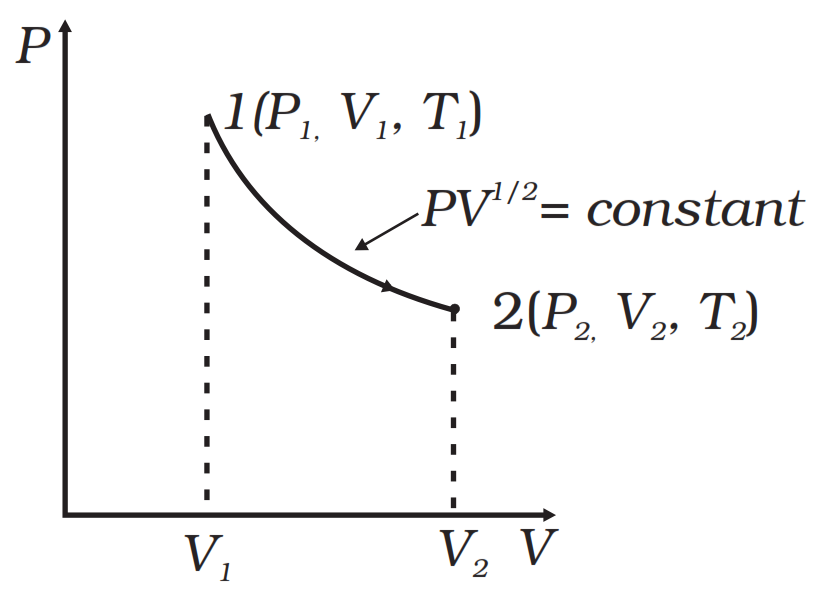
Consider a P-V diagram in which the path followed by one mole of perfect gas in a cylindrical container is shown in Fig.

Given the internal energy for one mole of gas at temperature T is (3/2) RT, find the heat supplied to the gas when it is taken from state (1) to (2) with $V_2 = 2V_{1.}$​​​​​​​
Answer
$\therefore\ \text{PV}=$ constant = K (given) or $\text{P}_1\text{V}_1^\frac{1}{2}=\text{P}_2\text{V}_2^\frac{1}{2}= \text{K}\ \text{and}\ \text{P}=\frac{\text{K}}{\text{V}^\frac{1}{2}}$ Given that internal energy U of gas is$\text{U}=\Big(\frac{3}{2}\Big)\text{RT}$
$\Delta\text{U}=\frac{3}{2}\text{RdT}=\frac{3}{2}\text{R}(\text{T}_2-\text{T}_1)$
$\therefore\ \text{T}_2=\sqrt2\text{T}_1,$ from part (b)
$\Delta\text{U}=\frac{3}{2}\text{R}\big[\sqrt2\text{T}_1-\text{T}_1\big]=\frac{3}{2}\text{R}\text{T}_1\big(\sqrt2-1\big)$
Form part (a) $\text{dW}=2\text{P}_1\text{V}^\frac{1}{2}\big(\sqrt{\text{V}_2}-\sqrt{\text{V}_1}\big)$$\because\ \text{V}_2=2\text{V}_1$ (given)
so, $\sqrt{\text{V}_2}=\sqrt2\sqrt{\text{V}_1}$$$ then $\text{dW}=2\text{P}_1\text{V}_1^\frac{1}{2}\big(\sqrt2\sqrt{\text{V}_1}-\sqrt{\text{V}_1}\big)$
$=2\text{P}_1\text{V}_1\sqrt{\text{V}_1}\big[\sqrt2-1\big]$
$\text{dW}=2\text{P}_1\text{V}_1\big(\sqrt2-1\big)$
$\text{dW}=2\text{n}\text{R}\text{T}_1\big(\sqrt2-1\big)$ $\big(\therefore\ \text{P}_1\text{V}_1=\text{n}\text{R}\text{T}_1\big)$
$\therefore\ \text{n}=1\therefore\ \text{dW}=2\text{R}\text{T}_1\big(\sqrt2-1\big)$
$\therefore\ \text{dQ}=\text{dW}+\text{dU}=2\text{R}\text{T}_1\big(\sqrt2-1\big)+\frac{3}{2}\text{R}\text{T}_1\big(\sqrt2-1\big)$
$=\big(\sqrt2-1\big)\text{R}\text{T}_1\Big[2+\frac{3}{2}\Big]$
$\text{dQ}=-\big(\sqrt2-1\big)\text{RT} .$
View full question & answer
Question 43 Marks
Consider a Carnot's cycle operating between $T_1=500 K$ and $T_2=300 K$ producing 1 kJ of mechanical work per cycle. Find the heat transferred to the engine by the reservoirs.
Answer
Efficiency of Carnot's engine $\mu=1-\frac{\text{T}_{2}}{\text{T}_{1}}$ Tempreature of source or reservior $= T_1 = 500K$ Tempreature of sink $T_2 = 300K$
$\therefore\mu=1-\frac{\text{T}_{2}}{\text{T}_{1}}$
$\frac{\text{Output work}}{\text{Input work}(E)}=1-\frac{300}{500}$
$\frac{1000\text{J}}{\text{x}}=1-0.6$
$\text{x}=\frac{1000}{\text{x}}=0.4$
$\text{x}=\frac{1000}{0.4}=2500 \text{J} .$
View full question & answer
3 Marks Question - Physics STD 11 Science Questions - Vidyadip