9 questions · self-marked practice — reveal the answer and mark yourself.

$\therefore\ $fundamental frequency, $\text{f}_0=\frac{\text{v}}{2\text{l}}=30\text{sec}^{-1}=30\text{Hz}.$
$\text{y}=\text{A}\sin (\text{kx}-\omega\text{t}+\phi)$
Here, A is the amplitude, k is the wave nunumber, $\omega$ is the angular frequency and $\phi$ is the initial phase. The argument of the sine is a phase, so the smallest positive phase constant should be.$\sin(7.5\pi)=\sin (3\times2\pi+1.5\pi)$
$=\sin (1.5\pi)$
Therefore, the smallest positive phase constant is $1.5 \pi.$$\text{y}=\text{A}\sin (\omega\text{t}-\text{kx})$
Where, A is the amplitude$\omega$ is the angular frequency
k is the wave number Velocity of wave, $\upsilon=\frac{\omega}{\text{k}}$ Velocity of particle, $\upsilon_\text{p}=-\frac{\text{dy}}{\text{dt}}=\text{A}\omega\cos(\omega\text{t}-\text{kx})$ Max velocity of particle, $\upsilon_{\text{p}_{\text{max}}}=\text{A}\omega$ As given$\text{A}<\frac{\lambda}{2\pi}$
$\upsilon_{\text{p}_{\text{max}}}=\frac{\lambda}{2\pi}$
$\upsilon_{\text{p}_{\text{max}}}<\frac{\omega}{\text{k}}$ $\Big[\therefore \frac{2\pi}{\lambda}=\text{k}\Big]$
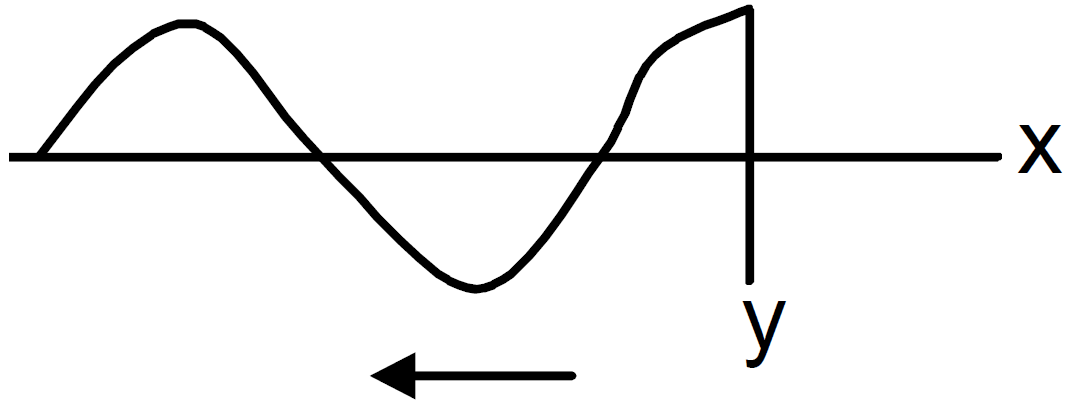
$\text{y}=\text{c}_1\sin(\text{c}_2\text{x}+\text{c}_3\text{t})$
When the variable of the equation is (c2x + c3t), then the wave must be moving in the negative x-axis with time t.$\frac{\text{y}_\text{max}}{\text{u}_\text{max}}=\frac{\text{v}_\text{max}}{\text{a}_\text{max}},$
Where the symbols have usual meanings. Can we use componendo and dividendo taught in algebra to write,$\frac{\text{y}_\text{max}+\text{v}_\text{max}}{\text{y}_\text{max}-\text{v}_\text{max}}=\frac{\text{v}_\text{max}+\text{a}_\text{max}}{\text{v}_\text{max}-\text{a}_\text{max}}?$
$\text{y}=\text{A}\sin(\omega\text{t}-\text{kx})$
$\text{v}=\frac{\text{dy}}{\text{dt}}=\text{A}\cos(\omega\text{t}-\text{kx})$
$\text{v}_{\text{max}}=\text{A}\omega$
$\text{a}=\frac{\text{dv}}{\text{dt}}=-\text{A}\omega^2\sin(\omega\text{t}-\text{kx})$
$\text{a}_{\text{max}}=\omega^2\text{A}$
To prove,
$\frac{\text{y}_\text{max}}{\text{u}_\text{max}}=\frac{\text{v}_\text{max}}{\text{a}_\text{max}}$
LHS
$\frac{\text{y}_\text{max}}{\text{u}_\text{max}}=\frac{\text{A}}{\text{A}\omega}=\frac{1}{\omega}$
RHS
$\frac{\text{v}_\text{max}}{\text{a}_\text{max}}=\frac{\text{A}\omega}{\omega^2\text{A}}=\frac{1}{\omega}$
No, componendo and dividendo is not applicable. We cannot add quantities of different dimensions.