Questions · Page 1 of 2

2 Marks Questions

Take a timed test

50 questions · self-marked practice — reveal the answer and mark yourself.

Question 12 Marks
Explain your answers.
What is the amplitude of a point 0.375m away from one end?
Answer
Amplitude at a point x = 0.375m will be obtained by putting $\cos(120\pi\text{ t})$ as + 1 in the wave equation
$\therefore\ \text{A(x)}=0.06\sin\Big(\frac{2\pi}{3}\times0.375\Big)\times1=00.06\sin\frac{\pi}{4}=0.042\text{m}$
View full question & answer
Question 22 Marks
A transverse harmonic wave on a string is described by
$\text{y}(\text{x, t})=3.0\sin\big(36\text{t}+0.018\text{x}+\frac{\pi}{4}\big)$
where x and y are in cm and t in s. The positive direction of x is from left to right.
What are its amplitude and frequency?
Answer
3cm; 5.73Hz
Explanation:
Given,
$\text{y}(\text{x, t})=3\sin\big(36\text{t}+0.018\text{x}+\frac{\pi}{4}\big)$
Amplitude of the wave, a = 3cm
Frequency of the wave $\text{v}=\frac{\omega}{2\pi}=\frac{36}{2\pi}=5.7\text{hz}$
View full question & answer
Question 32 Marks
Explain why (or how):
Bats can ascertain distances, directions, nature, and sizes of the obstacles without any “eyes”,
Answer
Bats emit ultrasonic waves of large frequencies. When these waves are reflected from the obstacles in their path, they give them the idea about the distance, direction, size and nature of the obstacle.
View full question & answer
Question 42 Marks
A transverse harmonic wave on a string is described by
$\text{y}(\text{x, t})=3.0\sin\big(36\text{t}+0.018\text{x}+\frac{\pi}{4}\big)$
where x and y are in cm and t in s. The positive direction of x is from left to right.
What is the least distance between two successive crests in the wave?
Answer
3.49m
Explanation:
Given,
$\text{y}(\text{x, t})=3\sin\big(36\text{t}+0.018\text{x}+\frac{\pi}{4}\big)$
the smallest distance between two adjacent crests in the wave, $\lambda=\frac{2\pi}{\text{k}}=\frac{2\pi}{0.018}=349\text{cm}$
View full question & answer
Question 52 Marks
The transverse displacement of a string (clamped at its both ends) is given by
$\text{y}(\text{x, t})=0.06\sin\Big(\frac{2\pi}{3}\text{x}\Big)\cos(120\pi\text{ t})$
where x and y are in m and t in s. The length of the string is 1.5m and its mass is 3.0 × 10–2kg.
Answer the following:
Does the function represent a travelling wave or a stationary wave?
Answer
The general equation representing a stationary wave is given by the displacement function:
$\text{y}(\text{x, t})=2\text{a}\sin\text{kx}\cos\omega\text{t}$
This equation is similar to the given equation:
$\text{y}(\text{x, t})=0.06\sin\Big(\frac{2}{3}\text{x}\Big)\cos(120\pi\text{ t})$
Hence, the given function represents a stationary wave.
View full question & answer
Question 62 Marks
You have learnt that a travelling wave in one dimension is represented by a function y = f(x, t) where x and t must appear in the combination x – v t or x + v t, i.e. y = f (x ± v t). Is the converse true? Examine if the following functions for y can possibly represent a travelling wave:
  1. (x – vt)2
  2. log[(x + vt)/x0]
  3. 1/(x + vt)
Answer
No, the converse is not true. The basic requirements for a wave function to represent a travelling wave is that for all values of x and t, wave function must have finite value.
Out of the given functions for y, no one satisfies this condition. Therefore, none can represent a travelling wave.
View full question & answer
Question 72 Marks
Explain why (or how):
in a sound wave, a displacement node is a pressure antinode and vice versa,
Answer
A node (N) is a point where the amplitude of vibration is the minimum and pressure is the maximum.
An antinode (A) is a point where the amplitude of vibration is the maximum and pressure is the minimum.
Therefore, a displacement node is nothing but a pressure antinode, and vice versa.
View full question & answer
Question 82 Marks
Explain why (or how):
The shape of a pulse gets distorted during propagation in a dispersive medium.
Answer
A sound pulse is a combination of waves of different wavelength. As waves of different $\lambda$ travel in a dispersive medium with different velocities, therefore, the shape of the pulse gets distorted.
View full question & answer
Question 92 Marks
Estimate the speed of sound in air at standard temperature and pressure. The mass of 1 mole of air is $29.0 \times 10^{-3} kg$.
Answer
We know that 1 mole of any gas occupies 22.4 litres at STP. Therefore, density of air at STP is:
$
\begin{aligned}
\rho_o= & \text { (mass of one mole of air)/ (volume of one } \\
& \text { mole of air at STP) } \\
& =\frac{29.0 \times 10^{-3} kg }{22.4 \times 10^{-3} m ^3} \\
& =1.29 kg m ^{-3}
\end{aligned}
$
According to Newton's formula for the speed of sound in a medium, we get for the speed of sound in air at STP,
$
v=\left[\frac{1.01 \times 10^5 N m ^{-2}}{1.29 kg m ^{-3}}\right]^{1 / 2}=280 m s ^{-1}
$
View full question & answer
Question 102 Marks
The frequencies of two tuning forks A and B are 250Hz and 255Hz respectively. Both are sounded together. How many beats will be heard in 5 seconds?
Answer
f1 = 250Hz, f2 = 255Hz
No. of beats per second or beat frequency = 255 - 250 = 5
No. of beats heard in 5 seconds = 5 × 5 = 25
View full question & answer
Question 112 Marks
Given below are some functions of x and t to represent the displacement of an elastic wave.
$\text{y}=5\cos(4\times)\sin(20\text{t})$
Answer
A travelling wave along (-x) direction must have $+\text{kx}\ \text{i}.\text{e}.,$ in $(\text{iv})\text{y}=100\cos(100\pi\text{t}+0.5)$ so (a) (iv).
View full question & answer
Question 122 Marks
How is the speed of sound waves in atmosphere affected by the humidity and temperature?
Answer
  1. Speed of sound wave in atmosphere is more in moist air (humid) than in dry air, since density of moist air is less than that of dry air.
  2. Speed of sound wave in atmosphere is directly proportional to square root of absolute temperature.
View full question & answer
Question 132 Marks
Explain graphically that number of beats formed per second is n = v1 - v2 where v1 and v2 be the frequency of two superimposing waves.
View full question & answer
Question 142 Marks
What are the uses of ultrasonic waves?
Answer
Ultrasonic waves are used for the following purposes:
  1. They are used in SONAR for finding the range and direction of submarines.
  2. They are used for detecting the presence of cracks and other inhomogeneities in solids.
  3. They are used to kill the bacteria and hence for sterilising milk.
  4. They are used for cleaning the surface of solid.
View full question & answer
Question 152 Marks
When two waves of almost equal frequencies n1 and n2 reach at a point simultaneously, what is the time interval between successive maxima?
Answer
If two waves of almost equal frequencies interfere, they are producing beats.

Let $\text{n}_1>\text{n}_2$

Beat frequency $\text{f}_\text{beat}=\text{n}_1-\text{n}_2$

$\therefore$ Time period of beats $\text{T}_\text{beats}=\frac{1}{\text{f}_\text{beat}}=\frac{1}{\text{n}_1-\text{n}_2}$

This time period will be wqual to the time interval between successive mixima.

View full question & answer
Question 162 Marks
Write basic conditions for formation of stationary waves.
Answer
The basic conditions for formation of stationary waves are listed below:
  1. The direct and reflected waves must be travelling along the same line.
  2. For stationary wave formation, the superposing waves should either be longitudinal or transverse. A longitudinal and a transverse wave cannot superposition.
  3. For formation of stationary waves, there should not be any relative motion between the medium and oppositely travelling waves.
  4. Amplitude and period of the superposing waves should be same.
View full question & answer
Question 172 Marks
If the earth is moving towards a stationary star at a speed of 30km/s, find the apparent wavelength of light emitted from the star. The real wavelength has the value $5875\mathring{\text{A}}.$
Answer
$\Delta\lambda=\lambda-\lambda'$
$=\frac{\text{u}_0\lambda}{\text{c}}=\frac{3\times10^4\times5875\mathring{\text{A}}}{3\times10^8}$
$=5875\times10^{-4}\mathring{\text{A}}$
The apparent wave length,
$\lambda'=\lambda-\Delta\lambda$
$=5875\mathring{\text{A}}-(5875\times10^{-4}\mathring{\text{A}})$
$=0.9999\times5875\mathring{\text{A}}$
$=5874.4\mathring{\text{A}}$
View full question & answer
Question 182 Marks
A spring of mass 2.50kg is under a tension of 200N. The length of the stretched string is 20.0m. If a transverse jerk is struck at one end of the string, how long does the disturbance take to reach the other end?
Answer
$\text{T}=200\text{N}, \text{ l}=20\text{m}$
$\mu=\frac{2.50}{20}\text{kg/m}$
$\text{v}=\sqrt{\frac{\text{T}}{\mu}}=\sqrt{\frac{200}{\frac{2.50}{20}}}=40\text{ms}^{-1}$
$\text{t}=\frac{20}{40}=0.5\text{s}$
View full question & answer
Question 192 Marks
A closed and an open pipe are sounded for same frequency. What is the ratio of their lengths?
Answer
$\text{v}_\text{o}=\frac{\text{nv}}{2\text{l}_\text{o}}.\text{v}_\text{c}=(2\text{n}-1)\times\frac{\text{v}}{4\text{l}_\text{c}},$
Since the velocity of medium is same and frequencies are equal,
$\frac{\text{v}}{2\text{l}_0}=\frac{\text{v}}{4\text{l}_\text{c}}$
$\therefore\frac{\text{l}_\text{c}}{\text{l}_0}=\frac{2}{4}=\frac{1}{2}=1:2.$
View full question & answer
Question 202 Marks
Explain why (or how):
The shape of a pulse gets distorted during propagation in a dispersive medium.
Answer
A sound pulse is a combination of waves of different wavelength. As waves of different $\lambda$ travel in a dispersive medium with different velocities, therefore, the shape of the pulse gets distorted.
View full question & answer
Question 212 Marks
At what temperatures (in oC) will the speed of sound in air be 3 times its value at OoC?
Answer
We know that speed of sound in air $\text{v}=\sqrt{\frac{\gamma\text{RT}}{\text{M}}}\Rightarrow\text{v}\propto\sqrt{\text{T}}$
$\therefore\frac{\text{v}_\text{T}}{\text{v}_0}=\sqrt{\frac{\text{T}_\text{T}}{\text{T}_0}}=\sqrt{\frac{\text{T}_\text{T}}{273}}$
But it is given, $\frac{\text{v}_\text{T}}{\text{v}_0}=\frac{3}{1}$
$\Rightarrow\frac{3}{1}=\sqrt{\frac{\text{T}_\text{T}}{\text{T}_0}}\Rightarrow\frac{\text{T}_\text{T}}{273}=9$
$\therefore\text{T}_\text{T}=273\times9=2457\text{k}$
$=2457-273=2184^\circ\text{C}$
View full question & answer
Question 222 Marks
Two medium particles are separated by a distances $\frac{\lambda}{2}.$ What is the relationship between phase of these particles at any instant?
Answer
The phase difference between two given particles $=\frac{2\pi}{\lambda}\times\frac{\lambda}{2}=\pi$ radian i.e., the two particles are in mutually opposite phase conditions.
View full question & answer
Question 232 Marks
The equation for the transverse wave on a string is $\text{y}=4\sin 2\pi \Big(\frac{\text{t}}{0.05}-\frac{\text{x}}{50}\Big)$ with length expressed in cm and time in second. Calculate the wave velocity and maximum particle velocity.
Answer
$\text{y}=4\sin 2\pi \Big(\frac{2\pi\text{t}}{0.05}-\frac{2\pi\text{x}}{50}\Big)\text{cm}$
wave velocity $=\frac{\omega}{\text{k}}=\frac{\frac{2\pi}{0.05}}{\frac{2\pi}{50}}$
$\frac{50}{0.05}\text{cm/sec}$
$=1000\text{cm/sec}$
$=10\text{ms}^{-1}$
Particle velocity $=\frac{\text{dy}}{\text{dt}}=4\times\frac{2\pi}{0.05}\cos\Big(\frac{2\pi\text{t}}{0.05}-\frac{2\pi\text{x}}{50}\Big)$
Maximum particle velocity $=4\times\frac{2\pi}{0.05}=502.4\text{cms}^{-1}$
View full question & answer
Question 242 Marks
The speed of sound wave depends on temperature but speed of light waves does not. Why?
Answer
Sound waves are mechanical waves whose velocity $\text{v}=\sqrt{\text{y}_0\frac{\text{RT}}{\text{m}}}.$ Light waves are non-mechanical waves or electromagnetic waves for which $\text{c}=\frac{1}{\sqrt{\mu_0\in_0}},$ where $\mu_0$ is absolute electrical permittivity of free space.
Therefore, v depends upon T, but c does not.
View full question & answer
Question 252 Marks
An open organ pipe vibrates in harmonic modes. What is the ratio of their wavelengths?
Answer
In open harmonic pipes, $\text{l}=\frac{\text{n}\lambda}{2}$ and $\text{v}=\frac{\text{nv}}{2\text{l}}.$ So, the wavelengths will be in the ratio, $\frac{1}{1}:\frac{1}{2}:\frac{1}{3}:\frac{1}{4}:$ etc...
View full question & answer
Question 262 Marks
Air gets thinner as we go up in the atmosphere. Will the velocity of sound change?
Answer
As we move up, the pressure (P) of air and density of air $(\rho),$ both decrease. As $\text{v}=\sqrt{\frac{\gamma\text{RT}}{\text{m}}},$ therefore velocity of sound will not change so long as tempreture T of air remains constant.
View full question & answer
Question 272 Marks
In an open organ pipe, third harmonic is 450Hz. What is the frequency of fifth harmonic?
Answer
Given: $\text{v}_3=450\text{Hz}$
$\because \text{v}_3=3\text{v}_1$
$\Rightarrow\text{v}_1=\frac{\text{v}_3}{3}=\frac{450}{3}=150\text{Hz}$
$\therefore$ Frequency of fifth harmonic, $\text{v}_5=5\text{v}_1$
$\Rightarrow\text{v}_5=5\times150\text{Hz}$
$=750\text{Hz}$
View full question & answer
Question 282 Marks
On what factors does the speed of transverse waves setup in a string depend?
Answer
Speed of transverse waves setup in a string depends upon the tension (T) in the string and the linear mass density (u) of the string. In fact, $v=\sqrt{\frac{\text{T}}{\mu}}.$
View full question & answer
Question 292 Marks
In the given progressive wave $​​​​\text{y}=5\sin(100\pi\text{t+0.4x})$ where y and x are in m, t is in s. What is the:
Wave length
Answer
Standard form of progressive wave travelling in $+\text{x}$ direction (kx and $\omega\text{}t$ have opposite sign is given)
Eqn. is $\text{y}=\text{a}\sin(\omega\text{t}-\text{kx}+\phi)$
$\text{y}=5\sin(100\pi\text{t}-0.4\pi\text{t}+0)$
Wavelength $\lambda,\text{k}=\frac{2\pi}{\lambda}$
$\text{k}=0.4\pi$
$\lambda=\frac{2\pi}{\text{k}}=\frac{2\times\pi}{0.4\pi}=5\text{m}$
View full question & answer
Question 302 Marks
If $\text{Y}=3\sin(36\text{t}+.018\text{x}+\frac{\pi}{4})\text{cm}$ find the amplitude and velocity of the wave.
Answer
$\text{Y}=3\sin(36\text{t}+.018\text{x}+\frac{\pi}{4})\text{cm}$
Amplitude = 3cm
Velocity of wave $=\frac{\omega}{\text{k}}=\frac{36}{0.018}=\frac{36\times10^3}{18}$
$=2\times10^3\text{cm/sec.}$
View full question & answer
Question 312 Marks
In a hot summer day, pitch of an organ pipe will be higher or lower?
Answer
The speed of sound in air is more at higher temperature, as $\text{v}\propto\sqrt{\text{T}}.$ As we know, frequency $\text{v}=\frac{\nu}{\lambda}$ as $\nu$ is more, hence, $\nu$ will be more and accordingly pitch will be more.
View full question & answer
Question 322 Marks
Why should a bat be able to sense high frequencies?
Answer
Due to less inertia, the ear drum of bats can resonate faster than human ears. So they can receive high frequencies.
View full question & answer
Question 332 Marks
The audible frequency range of a human ear is 20Hz-20kHz. Convert this into the corresponding wavelength range. Take the speed of sound in air at ordinary temperature to be 340m/s.
Answer
$\text{v}=\text{v}\lambda$
For 20Hz, $\lambda_1=\frac{\text{v}}{\text{v}}=\frac{340}{20}=17\text{m}$
For 20KHz, $\lambda_2=\frac{\text{v}}{\text{v}_1}=\frac{340}{20,000}=0.017\text{m}$
Thus, the wavelength range at the audible sound is 0.017m - 17m.
View full question & answer
Question 342 Marks
If density is made four times, what will be the effect on the velocity of sound?
Answer
If $\rho$ is made four times, the velocity will become half since $\text{v}\propto\frac{1}{\sqrt{\rho}}.$
View full question & answer
Question 352 Marks
What is the change in frequency when a source goes past a stationary observer with velocity Vs? (Given: velocity of sound is c and the frequency is v).
Answer
When a source approaches a stationary observer,
$\text{v}'=\text{v}\Big(\frac{\text{c}}{\text{c}-\text{v}_\text{s}}\Big)$
When the source goes away,
$\text{v}"=\text{v}\Big(\frac{\text{c}}{\text{c}+\text{v}_\text{s}}\Big)$
$\therefore$ Change when the source goes past stationary observer is,
$\text{v}'-\text{v}"=\text{vc}\Big[\frac{\text{c}}{\text{c}-\text{v}_\text{s}}-\frac{\text{c}}{\text{c}+\text{v}_\text{s}}\Big]$
$=\frac{2\text{vcv}_\text{s}}{(\text{c}^2-\text{v}^2_\text{s})}$
View full question & answer
Question 362 Marks
Given below are some functions of x and t to represent the displacement of an elastic wave.
$​​​​\text{y}=10\cos[(252-250)\pi\text{t}]\cos[(252+250)\pi\text{t}]$
Answer
Beats involve $(\text{v}_1+\text{v}_2)$ and $(\text{v}_1-\text{v}_2)$ so beats can be represented by$\text{y}=10\cos[(252-250)\pi\text{t}]$ represents beat so (c) (iii).
View full question & answer
Question 372 Marks
Write a formula for the frequency of vibration of a stretched string in the case of a sonometer.
Answer
Frequency of vibration, vs given by,
$\text{v}=\frac{\text{k}}{\text{l}}\sqrt{\frac{\text{T}}{\mu}}$
where l is the length of the string between wedges, T is the tension in the string, and u is mass per unit length of the string. k is a constant which depends upon the mode of vibration of the string.
View full question & answer
Question 382 Marks
Set up a relation between speed of sound in a gas and root mean square velocity of the molecules of that gas.
Answer
Speed of sound in gas is
$\text{v}=\sqrt{\gamma\frac{\text{P}}{\rho}}...(\text{i})$
According to kinetic theory of gases, root mean square velocity (C) of molecules of gas is obtained from the relation.
$\text{P}=\frac{1}{3}\rho\text{C}^2,\text{C}=\sqrt{\frac{3\text{P}}{\rho}}...(\text{ii})$
Dividing (i) by (ii), we get
$\frac{\text{v}}{\text{C}}=\sqrt{\frac{\gamma}{3}}$ Or $\text{v}=\sqrt{\frac{\gamma}{3}}\times\text{C}$
This is the required relation.
View full question & answer
Question 392 Marks
We hear two distinct sounds on placing our ear at one end of the metallic pipe, when the other end is being hammered. Why?
Answer
When the metallic pipe is hammered, there are two distinct sounds, through the solid layer, and through the air within the pipe. The sound through the solid reaches much earlier than the sound through air.
View full question & answer
Question 402 Marks
Examine whether the following functions of Y represent a travelling wave.
  1. $(\text{x}-\text{vt})^2$
  2. $\frac{1}{\text{x}+\text{vt}}$
Answer
Both the functions are not continuous and definite at all values of x and $\theta$. So, they do not represent a wave.
View full question & answer
Question 412 Marks
You have learnt that a travelling wave in one dimension is represented by a function y = f(x, t) where x and t must appear in the combination x – v t or x + v t, i.e. y = f (x ± v t). Is the converse true? Examine if the following functions for y can possibly represent a travelling wave:
  1. (x – vt)2
  2. log[(x + vt)/x0]
  3. 1/(x + vt)
Answer
No, the converse is not true. The basic requirements for a wave function to represent a travelling wave is that for all values of x and t, wave function must have finite value.
Out of the given functions for y, no one satisfies this condition. Therefore, none can represent a travelling wave.
View full question & answer
Question 422 Marks
A transverse harmonic wave on a string is described by
$\text{y}(\text{x, t})=3.0\sin\big(36\text{t}+0.018\text{x}+\frac{\pi}{4}\big)$
where x and y are in cm and t in s. The positive direction of x is from left to right.
What are its amplitude and frequency?
Answer
3cm; 5.73Hz
Explanation:
Given,
$\text{y}(\text{x, t})=3\sin\big(36\text{t}+0.018\text{x}+\frac{\pi}{4}\big)$
Amplitude of the wave, a = 3cm
Frequency of the wave $\text{v}=\frac{\omega}{2\pi}=\frac{36}{2\pi}=5.7\text{hz}$
View full question & answer
Question 432 Marks
Explain why (or how):
in a sound wave, a displacement node is a pressure antinode and vice versa,
Answer
A node (N) is a point where the amplitude of vibration is the minimum and pressure is the maximum.
An antinode (A) is a point where the amplitude of vibration is the maximum and pressure is the minimum.
Therefore, a displacement node is nothing but a pressure antinode, and vice versa.
View full question & answer
Question 442 Marks
Two sitars A and B, playing the note 'Dha' are slightly out of tune and produce beats of frequency 5Hz. Then tension of the string B is slightly increased and the beat frequency is found to decrease to 3Hz. What is the original frequency of B if the frequency of A is 427Hz?
Answer
Beat frequency is 5Hz.
Original frequency of A = 427Hz
Then tension of the string B is slightly increased and beat frequency is found to decrease to 3Hz.
i.e., VA - VB = 5
or VB - VA = 5
According to question, when tension of B increases, VB should be increased.
$\Rightarrow\text{v}_\text{A}-\text{v}_\text{B}=5$ is valid relation
$\Rightarrow427-\text{v}_\text{B}=5$
$\Rightarrow\text{v}_\text{B}=422\text{Hz}$
View full question & answer
Question 452 Marks
Obtain an expression for apparent frequency of sound when the source is moving with a velocity vs towards the stationary listener.
Answer
Let v be the velocity of sound and vs be the velocity of source towards observer.
As the source approaches, the space between source and observer gets reduced but should accomodate the same number of waves (as frequency). So, wavelength reduces. The new wavelength is,
$\lambda'= \frac{\text{velocity of sound w.r.t. source}}{\text{frequency}}$
$=\frac{\text{v}-\text{v}_\text{s}}{\text{v}}$
Also, $\lambda' =\frac{\text{v}}{\text{v}'}$
$\therefore \text{v}'=\text{v}\Big(\frac{\text{v}}{\text{v}-\text{v}_\text{s}}\Big)$
View full question & answer
Question 462 Marks
Define longitudinal wave motion. What are the essential conditions required for the formation of longitudinal wave motion?
Answer
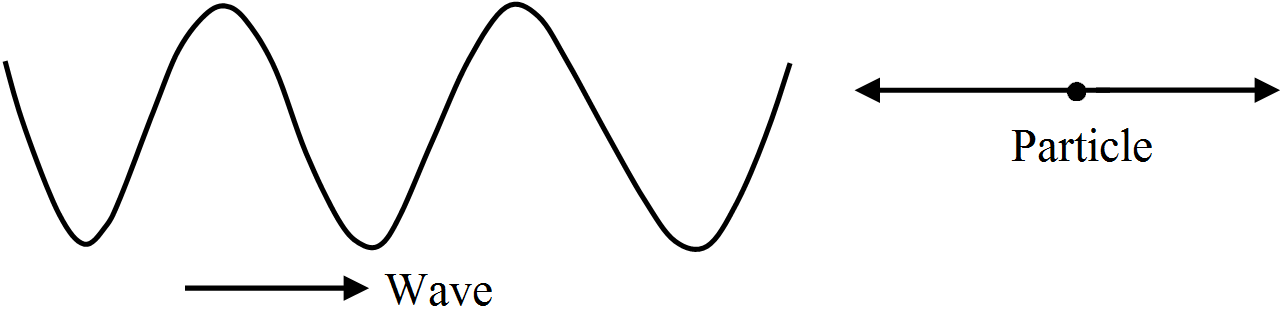
It is that wave motion in which the particles of the medium through which the wave is travelling vibrate in a direction parallel to the direction of the motion of the wave. In the figure given below, the wave is travelling from left to right and the particles of the medium vibrate in the horizontal direction simple harmonically. It represents the longitudinal wave motion.

For their propagation, the medium must possess:

  1. Elasticity.
  2. Inertia.
  3. Absence of frictional resistance.
View full question & answer
Question 472 Marks
Explain why (or how):
Bats can ascertain distances, directions, nature, and sizes of the obstacles without any “eyes”,
Answer
Bats emit ultrasonic waves of large frequencies. When these waves are reflected from the obstacles in their path, they give them the idea about the distance, direction, size and nature of the obstacle.
View full question & answer
Question 482 Marks
A transverse harmonic wave on a string is described by
$\text{y}(\text{x, t})=3.0\sin\big(36\text{t}+0.018\text{x}+\frac{\pi}{4}\big)$
where x and y are in cm and t in s. The positive direction of x is from left to right.
What is the least distance between two successive crests in the wave?
Answer
3.49m
Explanation:
Given,
$\text{y}(\text{x, t})=3\sin\big(36\text{t}+0.018\text{x}+\frac{\pi}{4}\big)$
the smallest distance between two adjacent crests in the wave, $\lambda=\frac{2\pi}{\text{k}}=\frac{2\pi}{0.018}=349\text{cm}$
View full question & answer
Question 492 Marks
Why bells are made of metal and not of wood?
Answer
Metals have less damping than wood. So, bells are made of metals.
View full question & answer
Question 502 Marks
The apparent frequency of the whistle of an engine changes in the ratio 3 : 2 as the engine passes a stationary observer. If the velocity of sound is 330m/s, calculate the velocity of the engine.
Answer
$\frac{\text{v}_1}{\text{v}_2}=\frac{\text{c}+\text{u}_0}{\text{c}-\text{u}_0}=\frac{3}{2}$
Solving we get, $\text{u}_0=\frac{\text{c}}{5}=\frac{330}{5}=66\text{ms}^{-1}.$
View full question & answer
2 Marks Questions - Physics STD 11 Science Questions - Vidyadip