Questions · Page 2 of 2

2 Marks Questions

Question 512 Marks
Explain your answers.
What is the amplitude of a point 0.375m away from one end?
Answer
Amplitude at a point x = 0.375m will be obtained by putting $\cos(120\pi\text{ t})$ as + 1 in the wave equation
$\therefore\ \text{A(x)}=0.06\sin\Big(\frac{2\pi}{3}\times0.375\Big)\times1=00.06\sin\frac{\pi}{4}=0.042\text{m}$
View full question & answer
Question 522 Marks
A steel wire has a length of 12.0m and a mass of 2.10kg. What should be the tension in the wire so that the speed of transverse wave on the wire equals the speed of sound in dry air at 20°C? Take the speed of sound at 20°C = 343m/s.
Answer
$\text{l}=12\text{m}$ and $\text{M}=2.10\text{kg}$
$\therefore\mu=\frac{2.10}{12}=0.175\text{kg/m}$
and $\text{v}=343\text{m/s}$
Using, $\text{v}=\sqrt{\frac{\text{T}}{\mu}}$
$\text{T}=\text{v}^2\mu=(343)^2\times0.175$
$=20.5\times10^4\text{N}$
View full question & answer
Question 532 Marks
The intensity maxima due to two interfering waves of equal amplitude a1 = a2 = a is 4a2. Does this violate the law of conservation of energy? Justify. 
Answer
No, The average intensity of maxima and minima will be, $\text{I}_{\text{av}}=\frac{4\text{a}^2+0}{2}=2\text{a}^2,$ which is the sum of their intensities.
So, energy conservation is obeyed, but redistribution of energy has taken place.
View full question & answer
Question 542 Marks
Define temperature coefficient of the velocity of sound.
Answer
The temperature coefficient of the velocity of sound is defined as the change in the velocity of sound, when the temperature changes by 1°C (or 1K). It is denoted by $\alpha.$
View full question & answer
Question 552 Marks
In an experiment, it was found that a tuning fork and a sonometer wire gave 5 beats per second, both when the length of the wire was 1m, and 1.05m. Calculate the frequency of the fork.
Answer
We know $\text{v}=\frac{1}{2\text{l}}\sqrt{\frac{\text{T}}{\mu}}$
I case: $\text{v}_1=\frac{1}{2\times1}\sqrt{\frac{\text{T}}{\mu}}\ ... (\text{i})$
II case: $\text{v}_2=\frac{1}{2\times1.05}\sqrt{\frac{\text{T}}{\mu}}\ ...\text{(ii)}$
Let v be the frequecy of the tuning fork, therefore,
$\text{v}_1-\text{v}=5$ and $\text{v}-\text{v}_2=5$
$\text{v}_1=\text{v}+5$
and $\text{v}_2=\text{v}-5$
$\frac{\text{v}_1}{\text{v}_2}=\frac{5+\text{v}}{\text{v}-5}$
From (i) and (ii), we have
$\frac{\text{v}+5}{\text{v}-5}=\frac{1}{2}\times2\times1.05=1.05$
$\frac{\text{v}+5}{\text{v}-5}=\frac{105}{100}=\frac{21}{20}$
$\Rightarrow\text{v}=205\text{Hz}$
View full question & answer
Question 562 Marks
What travels faster-a rifle bullet or the sound of a shot?
Answer
Rifle bullet travels faster than the sound of shot. The ratio of vb and vs is nearly 3 : 1.
View full question & answer
Question 572 Marks
The transverse displacement of a string (clamped at its both ends) is given by
$\text{y}(\text{x, t})=0.06\sin\Big(\frac{2\pi}{3}\text{x}\Big)\cos(120\pi\text{ t})$
where x and y are in m and t in s. The length of the string is 1.5m and its mass is 3.0 × 10–2kg.
Answer the following:
Does the function represent a travelling wave or a stationary wave?
Answer
The general equation representing a stationary wave is given by the displacement function:
$\text{y}(\text{x, t})=2\text{a}\sin\text{kx}\cos\omega\text{t}$
This equation is similar to the given equation:
$\text{y}(\text{x, t})=0.06\sin\Big(\frac{2}{3}\text{x}\Big)\cos(120\pi\text{ t})$
Hence, the given function represents a stationary wave.
View full question & answer
Question 582 Marks
If the frequency of a tuning fork is 400Hz and the velocity of sound in air is 320m/s, find how far does the sound travel when the fork executes 30 vibrations.
Answer
$\text{v}=320\text{m/s};$
$\text{v}=400\text{Hz};$
$\lambda=\frac{\text{v}}{\text{v}}=\frac{320}{400}=0.8\text{m}$
$\therefore$ The required distance travelled during the time the fork makes 30 vibrations = 30 × 0.8 = 24m.
View full question & answer
Question 592 Marks
For the harmonic travelling wave $\text{y}=2\cos2\pi(10\text{t}-0.0080\text{x}+3.5)$ where x and y are in cm and t is second. What is the phase difference between the oscillatory motion at two points separated by a distance of:
4m
Answer
$\text{y}=2\cos2\pi(10\text{t}-0.0080\text{x+3.5})$
$\text{y}=2\cos(20\pi\text{t}-0.0016\pi\text{x}+7.0\pi)$
Wave is propagated in $+\text{x}$ direction because $\omega\text{t}$ and kx are in with opposite sign standard equation $\text{y}=\text{a}\cos(\omega\text{t}-\text{kx}+\phi)$
a = 2, $\omega=20\pi,\ \text{k}=0.016\pi$ and $\phi=7\pi$
Path difference p =4 m (given) = 400cm
Phase difference $\Delta\phi=\frac{2\pi}{\lambda}\times\text{p}=\frac{2\pi}{\lambda}\times400$
$\Delta\phi=\text{k}\times400=0.016\pi\times400$
Phase difference $\Delta\phi=6.4\pi$ rad.
View full question & answer
Question 602 Marks
A child blows air at one end of a straw and slowly cuts pieces of the straw from the other end. What will be the outcome that will be observed?
Answer
As the pipe gets cut, the length of the resonating column varies, and so at a particular length, there will be an audible frequency that will be heard.
View full question & answer
Question 612 Marks
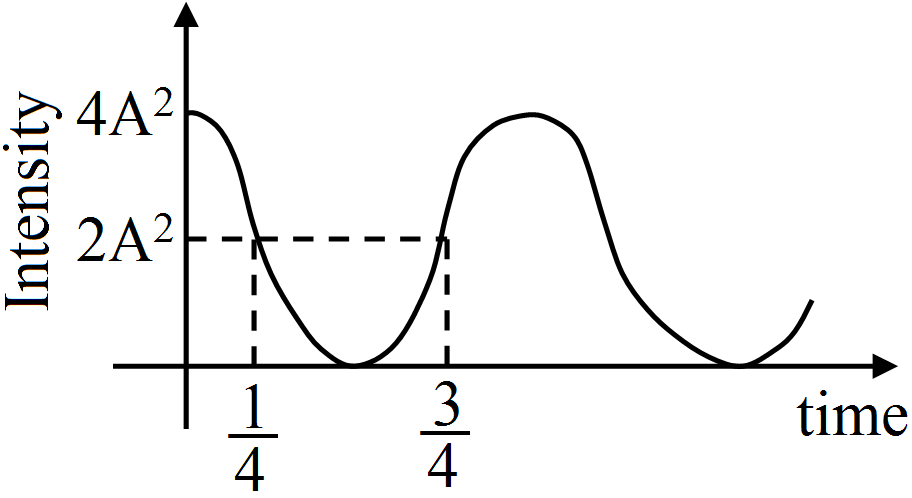
Show graphically, the intensity variation of beats formation?
Answer
When beats are formed by two sources having same amplitude but slightly different frequencies, the amplitude is given by $2\text{A}\cos2\pi\text{v}_\text{m}\text{t}$ where $\text{v}_\text{m}=\frac{\text{v}_1-\text{v}_2}{2}.$ Intensity $=4\text{A}^2\cos^2(2\pi\text{v}_\text{m}\text{t})$ and is shown graphically here.

View full question & answer
Question 622 Marks
If oil of density higher than that of water is used in place of water in a resonance tube, how does the frequency change?
Answer
The frequency is governed by the air column and does not depend upon the nature of the liquid. So frequency would not change.
View full question & answer
Question 632 Marks
What is the condition to be obeyed for receiving an echo?
Answer
The separation between the reflecting surface and source of sound ‘d’ should be greater than $\Big(\frac{1}{20}\Big)^{\text{th}}$ of the velocity of sound, since persistence of sound in human ears is $\frac{1}{10}\text{sec}.$
View full question & answer
Question 642 Marks
An observer at a sea-coast observes waves reaching the coast. What type of waves does he observe? Why?
Answer
Elliptical waves while the waves on the surface of water are transverse, the waves just below the surface of water are longitudinal. So the resultant waves are elliptical.
View full question & answer
Question 652 Marks
The frequencies of the two tuning forks A and B are 250Hz and 255Hz respectively. Both are sounded together. How many beats will be heared in 5s?
Answer
Given: vA = 250Hz, vB = 255Hz, t = 5s
vB - vA = 255Hz - 250Hz = 5Hz = Beat frequency
$\therefore$ No. of beats heard in 5s = 5 × 5 = 25
View full question & answer
Question 662 Marks
Does a vibrating source always produce sound?
Answer
A vibrating source produces sound when it vibrates in a medium and frequency of vibration lies within the audible range (20Hz to 20kHz).
View full question & answer
Question 672 Marks
Why do we not hear beats if the frequency of two sounds are widely different?
Answer
The beats cannot be heard due to persistence of hearing if the difference in frequencies is more than 10.
View full question & answer
Question 682 Marks
What is the physical reason to take both +1 and -1 as the cosine maxima in beats formation?
Answer
Since Intensity $\propto$ (Amplitude)2, both +1 and -1 are to be considered in beats.
View full question & answer
Question 692 Marks
Two sound sources produce 20 beats in 5s. By how much do their frequencies differ?
Answer
Number of beats per second $=\frac{20}{5}=4$
$\therefore \text{V}_1-\text{V}_2=4.$
View full question & answer
Question 702 Marks
What is the ratio of frequencies of fundamental tone and various overtones formed in a vibrating string?
Answer
The frequencies of various harmonics (or fundamental tone and overtones) in vibrating string are in the ratio:
V1 : V2 : V3..... = 1 : 2 : 3 : 4......
View full question & answer
Question 712 Marks
Define the terms 'node' and 'antinode'?
Answer
Node: It is a point on stationary wave at which amplitude of vibration of the particle is zero.
Antinode: It is a point on stationary wave at which amplitude of vibration of the particle is maximum.
View full question & answer
Question 722 Marks
An open pipe resonates with a frequency v. When half of it is immersed in a dense liquid, what is the fundamental frequency?
Answer
$\text{V}=\frac{\nu}{2\text{l}}$ with fundamental frequency. When half immersed in a denser liquid, it will act as a closed pipe of length $\frac{\text{l}}{2}.$
$\therefore \text{V}'=\frac{\nu}{4\text{l}'}=\frac{\nu}{\frac{4\text{l}}{2}}=\frac{\nu}{2\text{l}}$
So, V = V'
View full question & answer
Question 732 Marks
If a balloon is filled will CO2 gas, then how can it behave as a lens for sound waves? If it was filled with hydrogen gas, then what will happen?
Answer
Velocity of sound in CO2 is less than that in air. Therefore, balloon will behave as a convex lens for sound waves. In hydrogen, velocity of sound is greater than that in air. Therefore, balloon filled with hydrogen will behave as a concave lens.
View full question & answer
Question 742 Marks
Why do we see the flash of lightning first and hear the thunder later?
Answer
Since light travels much faster than sound, the flash of lightning is seen first, and the thunder is heard later.
View full question & answer
2 Marks Questions - Page 2 - Physics STD 11 Science Questions - Vidyadip