Question types

Work and Energy question types

101 questions across 6 question groups — pick any mix to generate a Physics paper with step-by-step answer keys.

101
Questions
6
Question groups
5
Question types
Sample Questions

Work and Energy questions

One sample from each question group in this chapter. Select any group above to see the full set with answer keys.

Two springs A and B(kA = 2kB) are stretched by applying forces of equal magnitudes at the four ends. If the energy stored in A is E, that in B is:

  1. $\frac{\text{E}}{2}$

  2. $2\text{E}$

  3. $\text{E}$

  4. $\frac{\text{E}}{4}$

View full solution
A small block of mass m is kept on a rough inclined surface of inclination $\theta$ fixed in an elevator. The elevator goes up with a uniform velocity v and the block does not slide on the wedge. The work done by the force of friction on the block in time t will be:

  1. zero

  2. $\text{mgvt}\cos^2\theta$

  3. $\text{mgvt}\sin^2\theta$

  4. $\text{mgvt}\sin2\theta$

View full solution
Two equal masses are attached to the two ends of a spring of spring constant k. The masses are pulled out symmetrically to stretch the spring by a length x over its natural length. The work done by the spring on each mass is:

  1. $\frac{1}{2}\text{kx}^2$

  2. $-\frac{1}{2}\text{kx}^2$

  3. $\frac{1}{4}\text{kx}^2$

  4. $-\frac{1}{4}\text{kx}^2$

View full solution
______ of a two particle system depends only on the separation between the two particles. The most appropriate choice for the blank space in the above sentence is:
  1. Kinetic energy.
  2. Total mechanical energy.
  3. Potential energy.
  4. Total energy.
View full solution
One end of a light spring of spring constant k is fixed to a wall and the other end is tied to a block placed on a smooth horizontal surface. In a displacement, the work done by the spring is $\frac{1}{2}\text{kx}^2.$ The possible cases are:
  1. At spring was initially compressed by a distance x and was finally in its natural length.
  2. It was initially stretched by a distance x and and finally was in its natural length.
  3. It was initially in its natural length and finally in a compressed position.
  4. It was initially in its natural length and finally in a stretched position.
View full solution
A particle moves from a point $\vec{\text{r}}_1=(2\text{m})\vec{\text{i}}+(3\text{m})\vec{\text{j}}$ to another point $\vec{\text{r}}_2=(3\text{m})\vec{\text{i}}+(2\text{m})\vec{\text{j}}$ during which a certain force $\vec{\text{F}}=(5\text{N})\vec{\text{i}}+(5\text{N})\vec{\text{j}}$ acts on it. Find the work done by the force on the particle during the displacement.
View full solution
One person says that the potential energy of a particular book kept in an almirah is 20J and the other says it is 30J. Is one of them necessarily wrong?
View full solution
The magnetic force on a charged particle is always perpendicular to its velocity. Can the magnetic force change the velocity of the particle? Speed of the particle?
View full solution
Q 123 Marks Question3 Marks
Consider the situation of the previous question from a frame moving with a speed v0 parallel to the initial velocity of the block.
  1. What are the initial and final kinetic energies?
  2. What is the work done by the kinetic friction?
View full solution
Q 133 Marks Question3 Marks
A particle of mass m moves on a straight line with its velocity varying with the distance travelled according to the equation $\text{v}=\text{a}\sqrt{\text{x}},$ where a is a constant. Find the total work done by all the forces during a displacement from x = 0 to x = d.
View full solution
Q 143 Marks Question3 Marks
A block of mass 250g is kept on a vertical spring of spring constant 100N/m fixed from below. The spring is now compressed to have a length 10cm shorter than its natural length and the system is released from this position. How high does the block rise? Take g =10m/s2.
View full solution
Q 153 Marks Question3 Marks
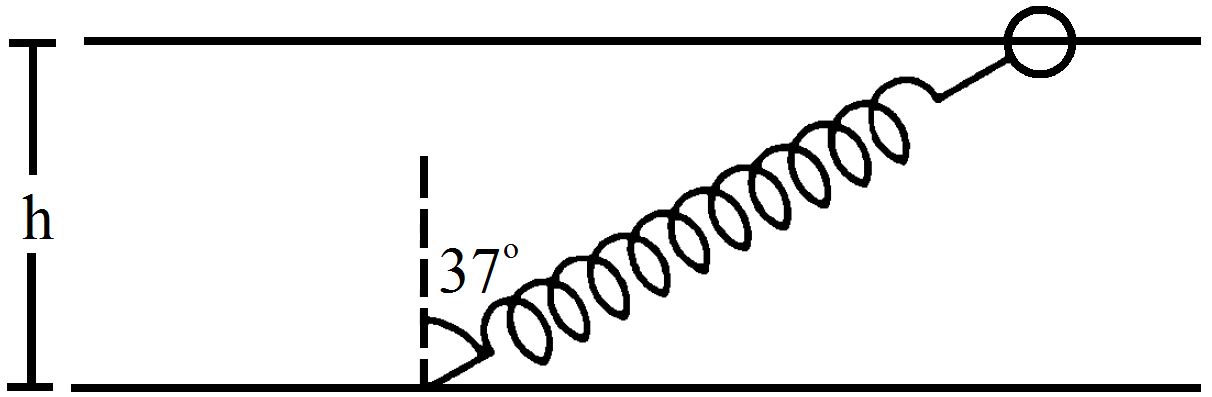
One end of a spring of natural length h and spring constant k is fixed at the ground and the other is fitted with a smooth ring of mass m which is allowed to slide on a horizontal rod fixed at a height h (figure). Initially, the spring makes an angle of 37° with the vertical when the system is released from rest. Find the speed of the ring when the spring becomes vertical.

View full solution
Q 163 Marks Question3 Marks
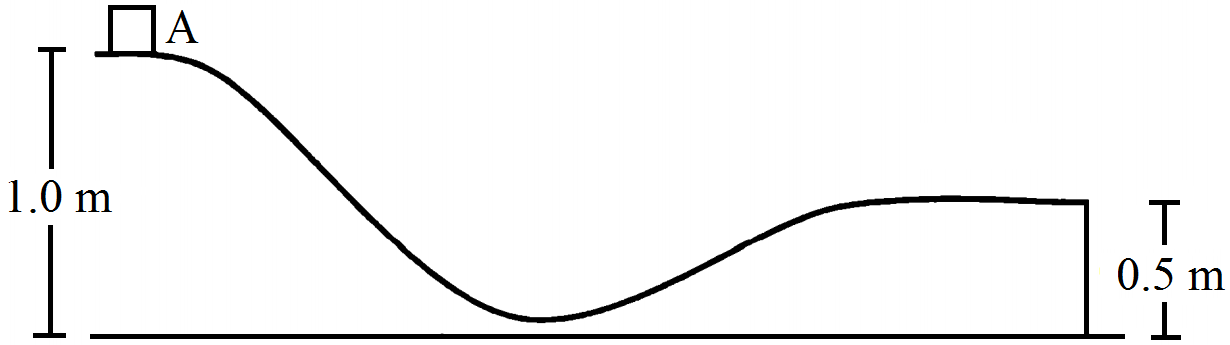
Figure shows a particle sliding on a frictionless track which terminates in a straight horizontal section. If the particle starts slipping from the point A, how far away from the track will the particle hit the ground?

View full solution
Q 174 Marks Question4 Marks
The US athlete Florence Griffith-Joyner won the 100m sprint gold medal at Seol Olympic 1988 setting a new Olympic record of 10.54s. Assume that she achieved her maximum speed in a very short-time and then ran the race with that speed till she crossed the line. Take her mass to be 50kg.
  1. Calculate the kinetic energy of Griffith-Joyner at her full speed.
  2. Assuming that the track, the wind etc. offered an average resistance of one tenth of her weight, calculate the work done by the resistance during the run.
  3. What power GriffithJoyner had to exert to maintain uniform speed?
View full solution
Q 194 Marks Question4 Marks
In one of the exercises to strengthen the wrist and fingers, a person squeezes and releases a soft rubber ball. Is the work done on the ball positive, negative or zero during compression? During expansion?
View full solution
Q 204 Marks Question4 Marks
In tug of war, the team that exerts a larger tangential force on the ground wins. Consider the period in which a team is dragging the opposite team by applying a larger tangential force on the ground. List which of the following works are positive, which are negative and which are zero?
  1. Work by the winning team on the losing team.
  2. Work by the losing team on the winning team.
  3. Work by the ground on the winning team.
  4. Work by the ground on the losing team.
  5. Total external work on the two teams.
View full solution
A box weighing 2000N is to be slowly slid through 20m on a straight track having friction coefficient 0.2 with the box.
  1. Find the work done by the person pulling the box with a chain at an angle $\theta $ with the horizontal.
  2. Find the work when the person has chosen a value of $\theta $ which ensures him the minimum magnitude of the force.
View full solution
A block of weight 100N is slowly slid up on a smooth incline of inclination 37° by a person. Calculate the work done by the person in moving the block through a distance of 2.0m, if the driving force is:
  1. Parallel to the incline.
  2. In the horizontal direction.
View full solution
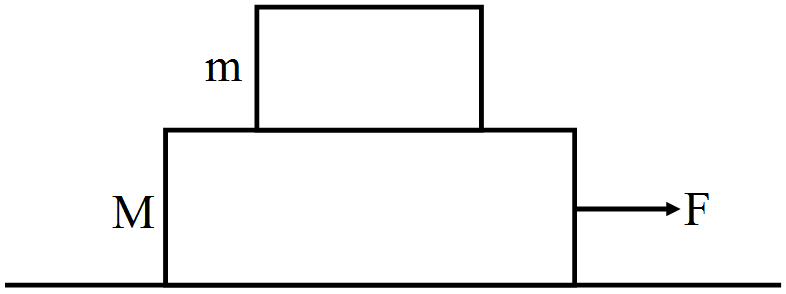
A block of mass m is kept over another block of mass M and the system rests on a horizontal surface figure. A constant horizontal force F acting on the lower block produces an acceleration $\frac{\text{F}}{2(\text{m+M})}$ in the system, the two blocks always move together.
  1. Find the coefficient of kinetic friction between the bigger block and the horizontal surface.
  2. Find the frictional force acting on the smaller block.
  3. Find the work done by the force of friction on the smaller block by the bigger block during a displacement d of the system.

View full solution
The bob of a pendulum at rest is given a sharp hit to impart a horizontal velocity $\sqrt{10\text{gl}},$ where l is the length of the pendulum. Find the tension in the string when,
  1. The string is horizontal.
  2. The bob is at its highest point.
  3. The string makes an angle of 60° with the upward vertical.
View full solution
A particle of mass m is kept on the top of a smooth sphere of radius R. It is given a sharp impulse which imparts it a horizontal speed v.
  1. Find the normal force between the sphere and the particle just after the impulse.
  2. What should be the minimum value of v for which the particle does not slip on the sphere?
  3. Assuming the velocity v to be half the minimum calculated in part.
  4. Find the angle made by the radius through the particle with the vertical when it leaves the sphere.

View full solution

Generate a Work and Energy paper free

Pick question groups from the list above, set marks and difficulty, and export a branded PDF with step-by-step answer keys. First 3 chapters free — no signup.

Download App