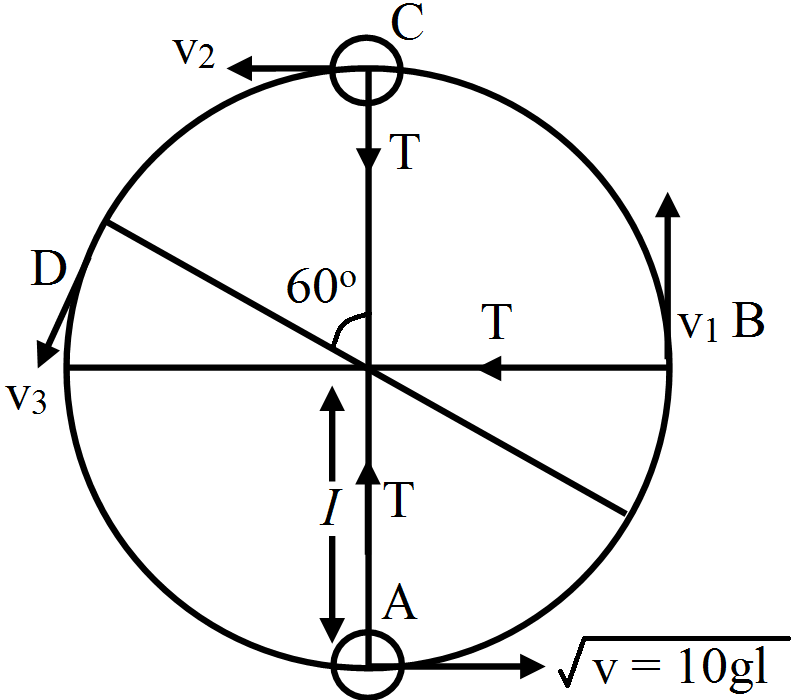
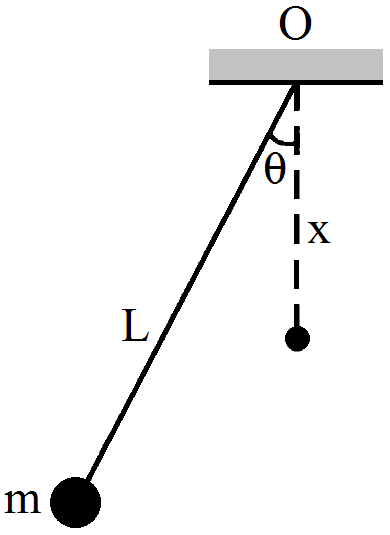
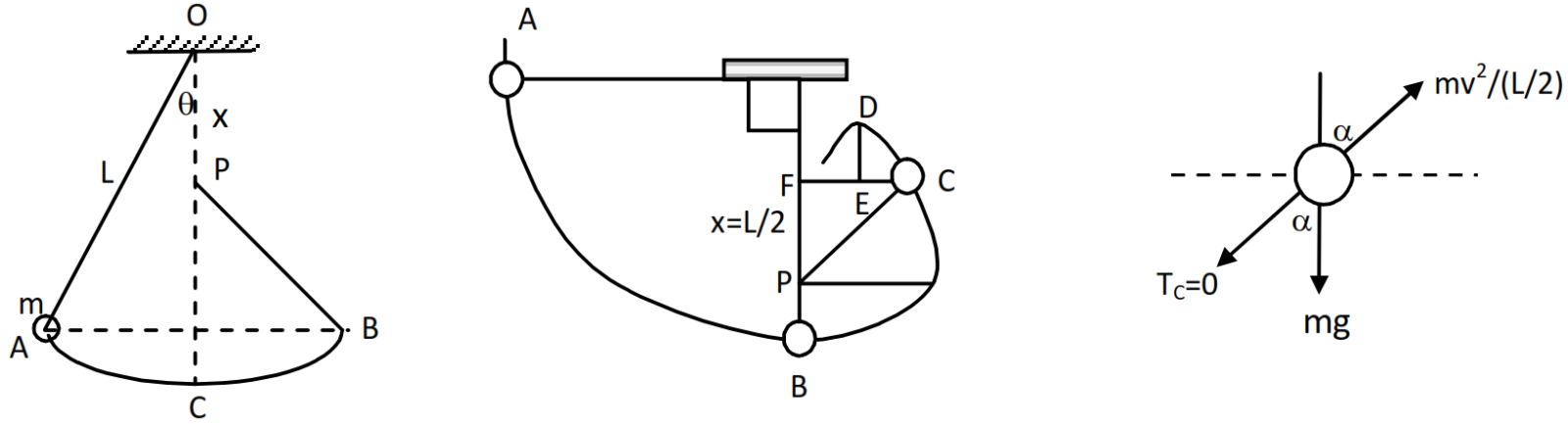
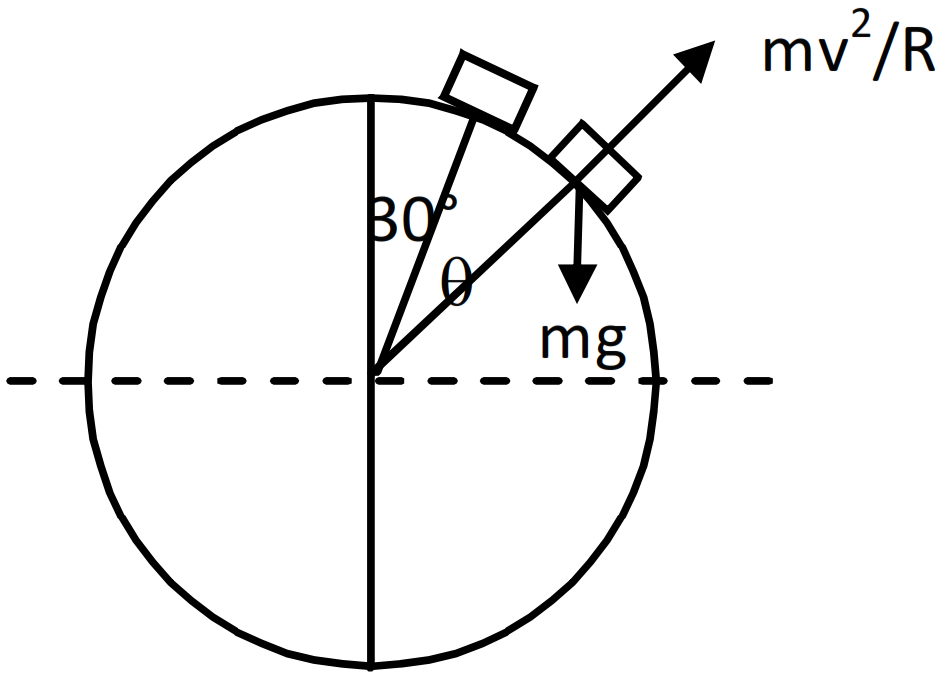
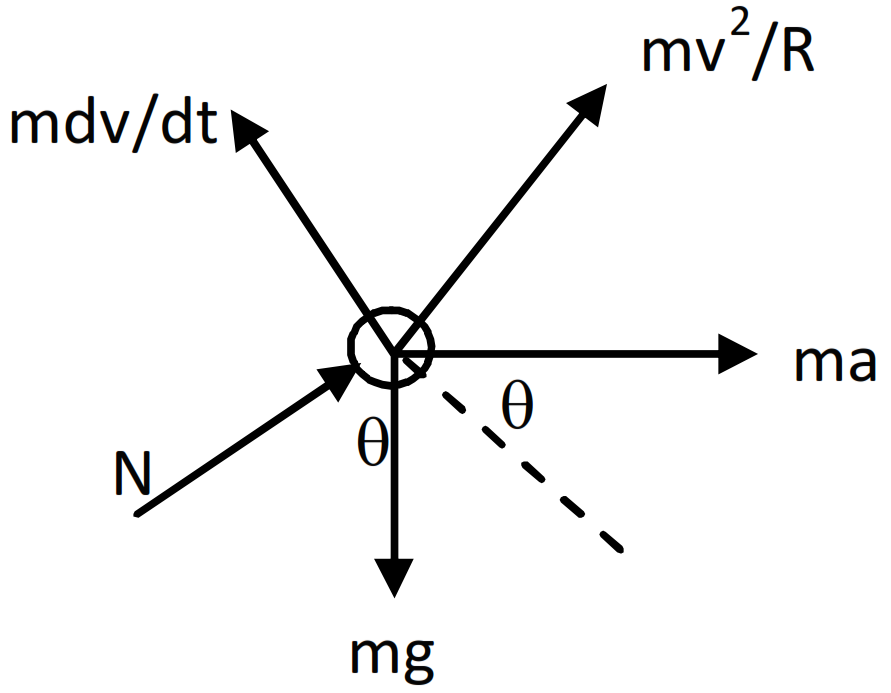
- When the bob has an initial height less than the peg and then released from rest (figure), let body travels from A to B.
Since, Total energy at A = Total energy at B
$\therefore$ (K.E)A = (PE)A = (KE)B + (PE)B
⇒ (PE)A = (PE)B [because, (KE)A = (KE)B = 0]
So, the maximum height reached by the bob is equal to initial height.
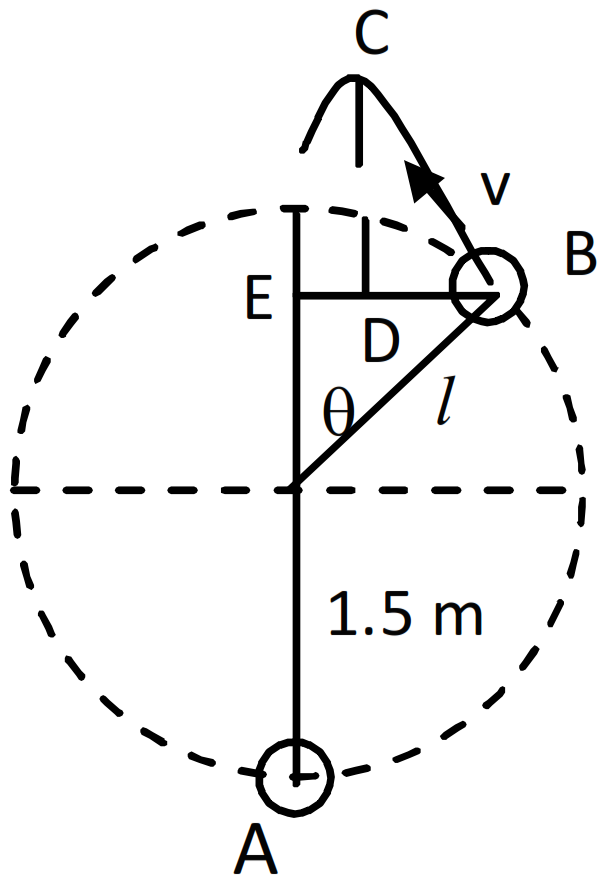
- When the pendulum is released with $\theta=90^\circ$ and $\text{x}=\frac{\text{L}}{2},$ (figure) the path of the particle is shown in the figure.
At point C, the string will become slack and so the particle will start making projectile motion.
$\Rightarrow\Big(\frac{1}{2}\Big)\text{mv}_\text{c}^2-0=\text{mg}\Big(\frac{\text{L}}{2}\Big)(1-\cos\alpha)$
Because, distance between A nd C in the vertical direction is $\frac{\text{L}}{2}(1-\cos\alpha)$
$\Rightarrow\text{v}_\text{c}^2=\text{gl}(1-\cos\alpha)\ \dots(1)$
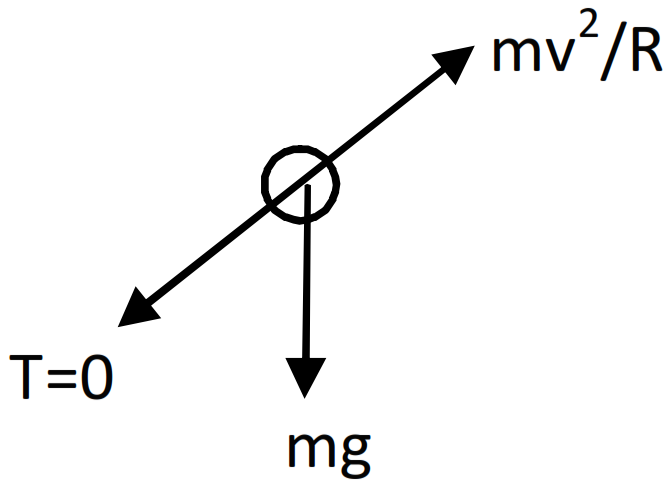
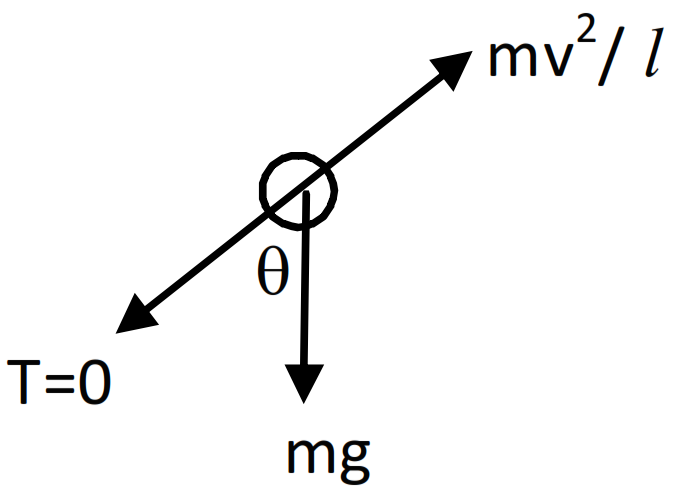
Again, form the freebody diagram,
$\frac{\text{mv}_\text{c}^2}{\frac{\text{L}}{2}}=\text{mg}\cos\alpha$ [because Tc = 0]
So, $\Rightarrow\text{v}_\text{c}^2=\frac{\text{gl}}{2}\cos\alpha\ \dots(2)$
From Eqn.(1) and equn (2),
$\text{gl}(1-\cos\alpha)=\frac{9\text{L}}{2}\cos\alpha$
$\Rightarrow(1-\cos\alpha)=\frac{1}{2}\cos\alpha$
$\Rightarrow\frac{3}{2}\cos\alpha=1$
$\Rightarrow\cos\alpha=\frac{2}{3}\ \dots(3)$
To find highest position C, before the string becomes slack.
$\text{BF}=\frac{\text{L}}{2}+\frac{\text{L}}{2}\cos\theta$
$\text{BF}=\frac{\text{L}}{2}+\frac{\text{L}}{2}\times\frac{2}{3}=\text{L}\Big(\frac{1}{2}+\frac{1}{3}\Big)$
So, $\text{BF}=\frac{5\text{L}}{6}$
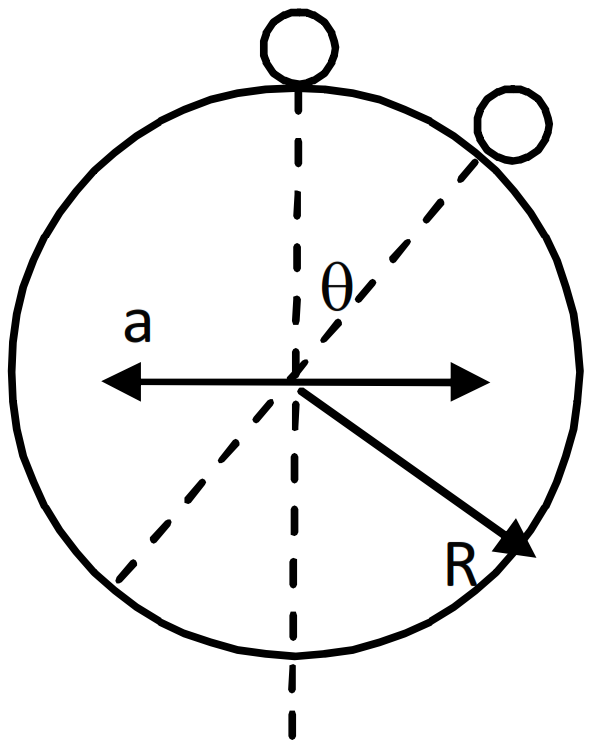
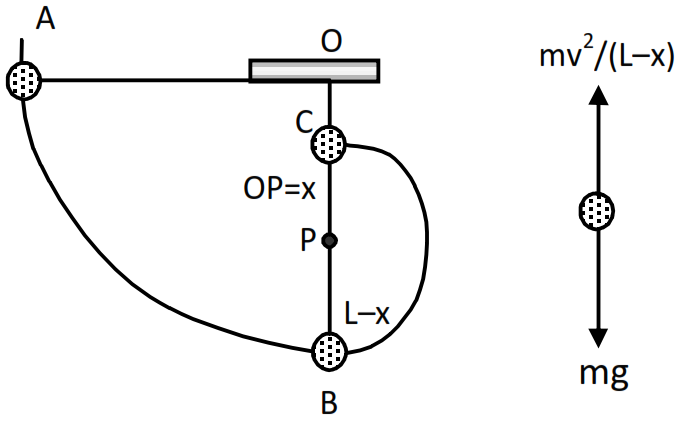
- If the particle has to complete a vertical circle, at the point C.

$\frac{\text{mv}_\text{c}^2}{(\text{L}-\text{x})}=\text{mg}$
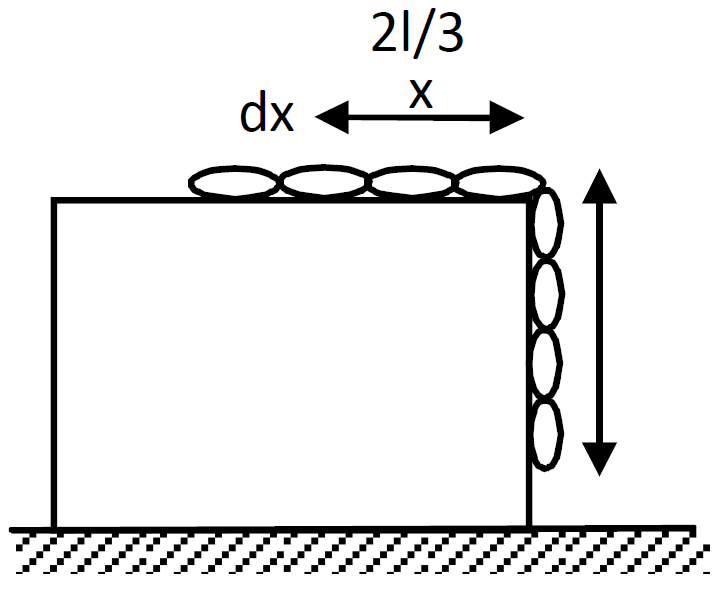
$\Rightarrow\text{v}_\text{c}^2=\text{g}(\text{L}-\text{x})\ \dots(4)$
Again, applying energy principle between A and C,
$\frac{1}{2}\text{mv}_\text{c}^2-0=\text{mg}(\text{OC})$
$\Rightarrow\frac{1}{2}\text{v}_\text{c}^2-0=\text{mg}[\text{L}-2(\text{L}-\text{x})]$
$\Rightarrow\text{mg}(2\text{x}-\text{L})$
$\Rightarrow\text{v}_\text{c}^2=2\text{g}(2\text{x}-\text{L})\ \dots(5)$
From equn. (4) and equn (5),
$\text{g}(\text{L}-\text{x})=2\text{g}(2\text{x}-\text{L})$
$\Rightarrow\text{L}-\text{x}=4\text{x}-2\text{L}$
$\Rightarrow5\text{x}=3\text{L}$
$\therefore\ \frac{\text{x}}{\text{L}}=\frac{3}{5}=0.6$
So, the rates $\Big(\frac{\text{x}}{\text{L}}\Big)$ should be 0.6