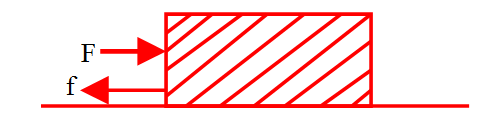
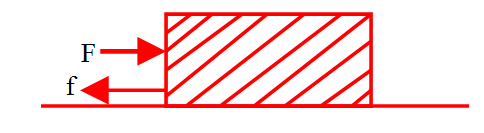
Work done by friction in 10 s.
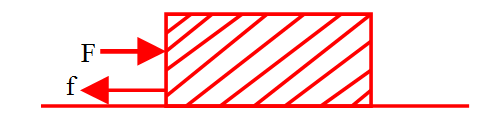
Total force = F - f = 7 - 1.96 = 5.04N
110 questions · self-marked practice — reveal the answer and mark yourself.
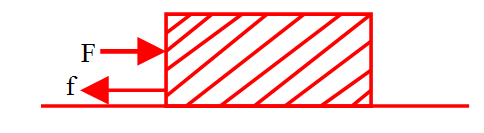
Total force = F - f = 7 - 1.96 = 5.04N
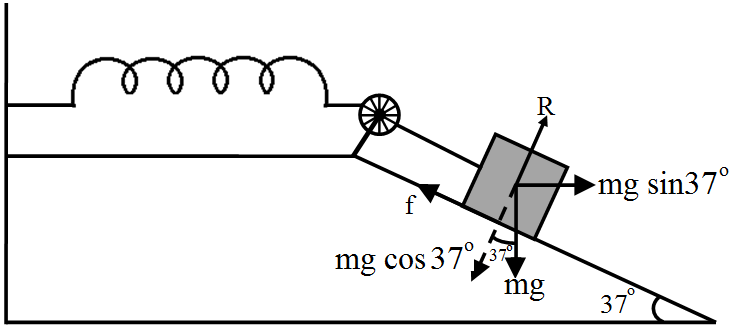
At equilibrium:
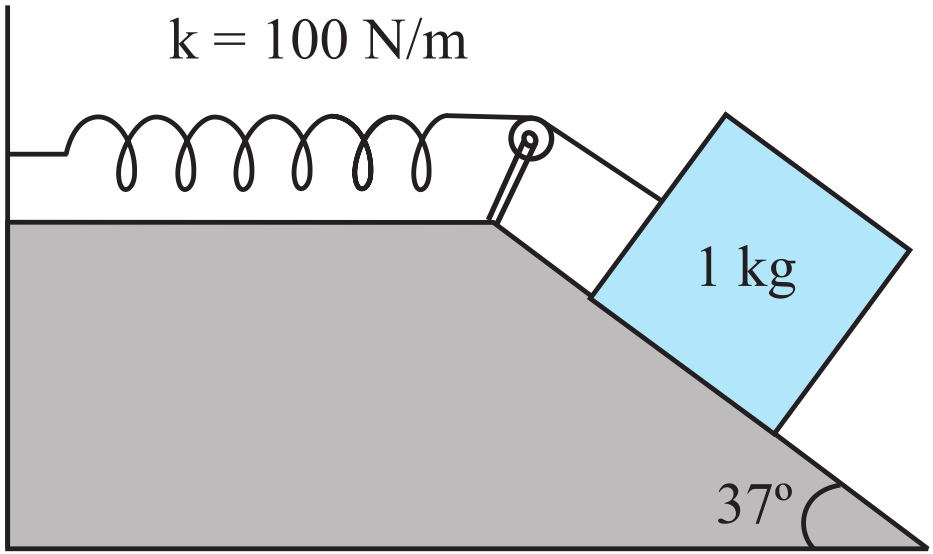
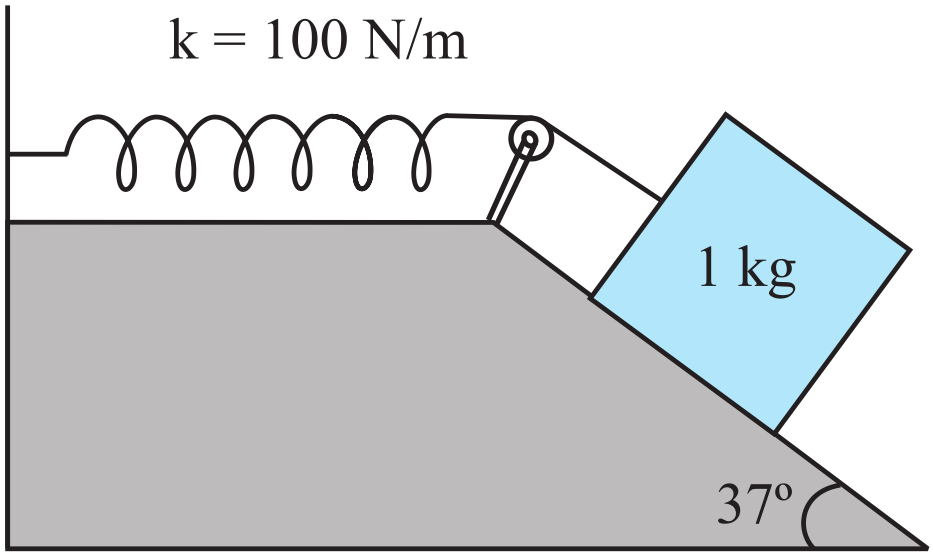
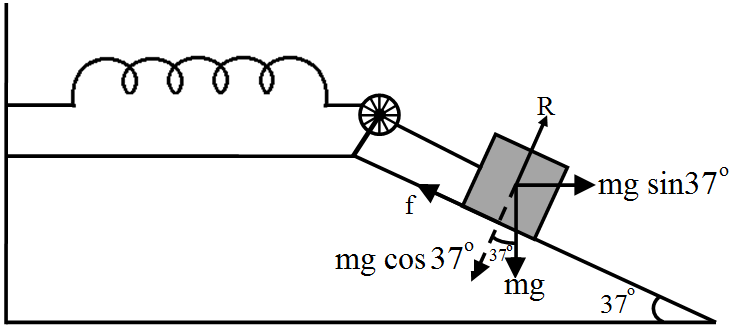
Normal reaction, $\text{R}=\text{mg}\cos37^{\circ}$ Frictional force, $\text{f}=\mu\text{R}=\text{mg}\sin37^{\circ}$ Where, $\mu$ is the coefficient of friction Net force acting on the block $ =\text{mg}\sin 37^{\circ}-\text{f}$ $=\text{mg}\sin37^{\circ}-\mu\text{m}\cos37^{\circ}$ $=\text{mg}(\sin37^{\circ}-\mu\cos37^{\circ})$ At equilibrium, the work done by the block is equal to the potential energy of the spring, i.e., $=\text{mg}(\sin37^{\circ}-\mu\cos37^{\circ})\text{x}=\Big(\frac{1}{2}\Big)\text{kx}^2$ $1\times9.8(\sin37^{\circ}-\mu\cos37^{\circ})=\Big(\frac{1}{2}\Big)\times100\times(0.1)$ $0.602-\mu\times0.799=0.510$ $\therefore\mu=\frac{0.092}{0.799}=0.115$
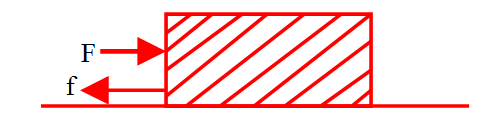
Total force = F - f = 7 - 1.96 = 5.04N
Solution:
From,
V = u + at
V = 0 + at = at
As power, P = F × V
$\therefore$ P = (ma) × at = ma2t
As m and a are constants, therefore, $\text{P}\propto\text{t}$
Hence, right choice is (ii) t.
Solution:
As power, P = force × veclocity
$\text{P}=\big[\text{MLT}^{-2}\big]\big[\text{LT}^{-1}\big]=\big[\text{ML}^2\text{T}^{-3}\big]$
As, $\text{P}=\big[\text{ML}^2\text{T}^{-3}\big]$
= Constant
$\therefore\text{ L}^2\text{T}^3=\text{Constant}$
Or, $\frac{\text{L}^2}{\text{T}^3}=\text{Constant}$
$\therefore\text{ L}^2\propto\text{T}^3$
Or, $\text{L}\propto \text{T}^{\frac{3}{2}}$
Hence, right choice is (iii) $\text{t}^{\frac{3}{2}}$

At equilibrium:
Normal reaction, $\text{R}=\text{mg}\cos37^{\circ}$ Frictional force, $\text{f}=\mu\text{R}=\text{mg}\sin37^{\circ}$ Where, $\mu$ is the coefficient of friction Net force acting on the block $ =\text{mg}\sin 37^{\circ}-\text{f}$ $=\text{mg}\sin37^{\circ}-\mu\text{m}\cos37^{\circ}$ $=\text{mg}(\sin37^{\circ}-\mu\cos37^{\circ})$ At equilibrium, the work done by the block is equal to the potential energy of the spring, i.e., $=\text{mg}(\sin37^{\circ}-\mu\cos37^{\circ})\text{x}=\Big(\frac{1}{2}\Big)\text{kx}^2$ $1\times9.8(\sin37^{\circ}-\mu\cos37^{\circ})=\Big(\frac{1}{2}\Big)\times100\times(0.1)$ $0.602-\mu\times0.799=0.510$ $\therefore\mu=\frac{0.092}{0.799}=0.115$
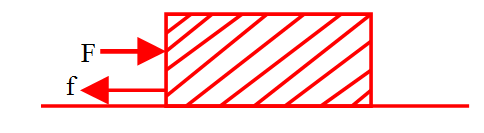
Total force = F - f = 7 - 1.96 = 5.04N
Explanation:
E is negative if U is negative and is numerically greater than K.
Total force = F - f = 7 - 1.96 = 5.04N
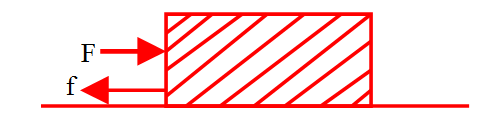
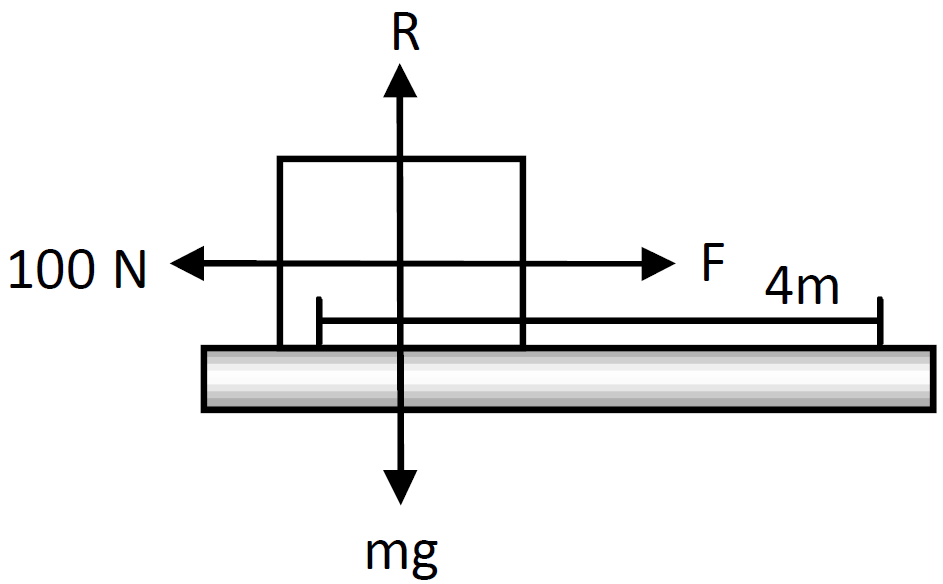
$\text{F}=100\text{N}$
$\text{S}=4\text{m},\theta=0^\circ$
$\omega=\vec{\text{F}}.\vec{\text{S}}$
$=100\times4=400\text{J}$
Explanation:
Work done is zero because force is acting at 90° to the direction of motion $\text{w}=\text{Fs}\cos90^\circ=0$

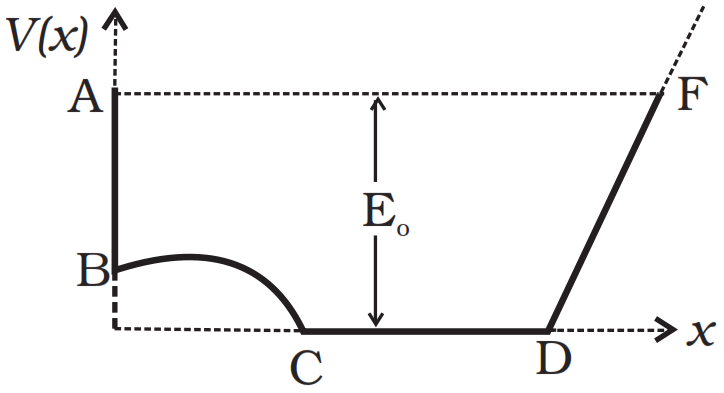
E = KE + PE
E0 = KE + V(x)
K.E. = E0 - V(x)
At point A
PE is maximum,
PE = E0 ; background:rgba(220,220,220,0.5))
KE = E0 - E0 = 0
At B, x = 0, PE = VB(let)
KE = E0 - V0
At C, x = x1, PE = 0
KE = E0 - V(x)
= E0 - 0 = E0
At D, x = x2, KE = E0
At E, x = x3, PE = E0
; background:rgba(220,220,220,0.5))
KE = 0
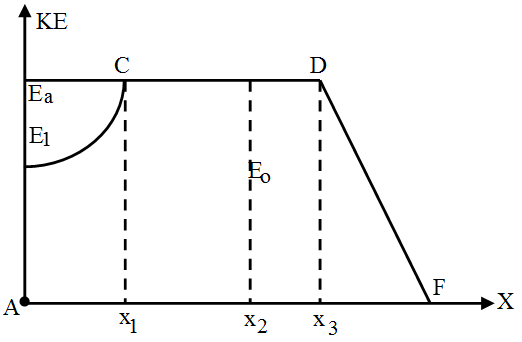
Figure shows graph KE versus x.
| X | KE | Point |
| 0 | 0 | A |
| 0 | E1 | B |
| x1 | E0 | C |
| x2 | E0 | D |
| x3 | 0 | F |

; background:rgba(220,220,220,0.5))
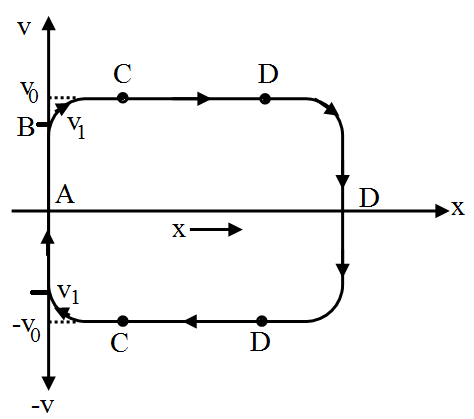
| Point | v | x |
| A | 0 | 0 |
| B | | 0 |
| C | ![]() | x1 |
| D | ![]() | x2 |
| E | 0 | x3 |

At point A and F.
and ; background:rgba(220,220,220,0.5))
At C and D, ; background:rgba(220,220,220,0.5))
; background:rgba(220,220,220,0.5))
(v - x) graph is shown in given figure here.