Question
Is it possible to exert a force which does work on a body without changing its kinetic energy. If, so give example.
Answer

Yes, When spring is compressed or when a body is pulled with a constant velocity on a rough horizontal surface.

Need a full question paper?

Generate a complete, print-ready paper with questions like this in minutes — across 16+ boards, with answer keys.

Start Generating Free

Similar questions

Answer with reason:
In an elastic collision of two billiard balls, is the total kinetic energy conserved during the short time of collision of the balls (i.e., when they are in contact)?
Show that for a particle executing S.H.M, velocity and displacement have a phase difference of $\frac{\pi}{2}.$
It is easier to catch a table tennis ball than a cricket ball even when both are moving with same velocity. Why?
Why a body weighs more at poles and less at equator?
According to kinetic theory of gases, explain absolute zero.
In the given progressive wave $​​​​\text{y}=5\sin(100\pi\text{t+0.4x})$ where y and x are in m, t is in s. What is the:
Amplitude
Why is it that the smaller bubbles have a greater excess pressure?
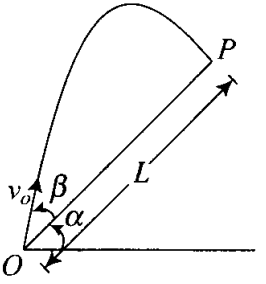
A particle is projected in air at an angle $\beta$ to a surface which itself is inclined at an angle $\alpha$ to the horizontal (Fig.).

  1. Find an expression of range on the plane surface (distance on the plane from the point of projection at which particle will hit the surface).
(Hint: This problem can be solved in two different ways:

  1. Point P at which particle hits the plane can be seen as intersection of its trajectory (parobola) and straight line. Remember particle is projected at an angle $(\alpha+\beta)$ w.r.t. horizontal.
  2. We can take x-direction along the plane and y-direction perpendicular to the plane. In that case resolve g (acceleration due to gravity) in two differrent components, gx along the plane and gy perpendicular to the plane. Now the problem can be solved as two independent motions in x and y directions respectively with time as a common parameter.)
Does specific heat of water remain constant throughout?
Two proton beams going in the same direction repel each other whereas two wires carrying currents in the same direction attract each other. Explain.