Questions · Page 1 of 2

2 Marks Questions

🎯

Test yourself on this topic

50 questions · timed · auto-graded

Question 12 Marks
A body constrained to move along the z-axis of a coordinate system is subject to a constant force F given by $\text{F}=-\hat{\text{i}}+2\hat{\text{j}}+3\hat{\text{k}}\text{N}$ where $\hat{\text{i}},\hat{\text{j}},\hat{\text{k}}$ are unit vectors along the x, y and z-axis of the system respectively. What is the work done by this force in moving the body a distance of 4m along the z-axis?
Answer
We know that the work done is given as,
W = F.s
Here
F = -i + 2j + 3k
s = 0i + 0j + 4k
So, we have
W = (-i + 2j + 3k).(0i + 0j + 4k)
Thus, we get
W = 3k.4k = 12J
View full question & answer
Question 22 Marks
A block of mass $m=1 kg$, moving on a horizontal surface with speed $V_l=2 m s ^{-1}$ enters a rough patch ranging from $x=0.10 m$ to $x=2.01 m$. The retarding force $F_r$ on the block in this range is inversely proportional to $x$ over this range,
$ F_r=\frac{-k}{x} \text { for } 0.1<x<2.01 m $ $=0$ for $x<0.1 m$ and $x>2.01 m$
where $k=0.5 J$. What is the final kinetic energy and speed $v_f$ of the block as it crosses this patch?
Answer
From Eq. (5.8a)
$
\begin{array}{l}
K_f=K_i+\int_{0.1}^{2.01} \frac{(-k)}{x} d x \\
=\frac{1}{2} m v_i^2-\left.k \ln (x)\right|_{0.1} ^{2.01} \\
=\frac{1}{2} m v_i^2-k \ln (2.01 / 0.1) \\
=2-0.5 \ln (20.1) \\
=2-1.5=0.5 J \\
v_f=\sqrt{2 K_f / m}=1 m s ^{-1}
\end{array}
$
Here, note that $\ln$ is a symbol for the natural logarithm to the base $e$ and not the logarithm to the base $10\left[\ln X =\log _e X =2.303 \log _{10} X \right]$.
View full question & answer
Question 32 Marks
Example 5.4 In a ballistics demonstration a police officer fires a bullet of mass $50.0 g$ with speed $200 m s ^{-1}$ (see Table 5.2) on soft plywood of thickness $2.00 cm$. The bullet emerges with only $10 \%$ of its initial kinetic energy. What is the emergent speed of the bullet?
Answer
The initial kinetic energy of the bullet is $m v^2 / 2=1000 J$. It has a final kinetic energy of $0.1 \times 1000=100 J$. If $v_f$ is the emergent speed of the bullet,
$
\begin{aligned}
\frac{1}{2} m v_f^2 & =100 J \\
v_f & =\sqrt{\frac{2 \times 100 J }{0.05 kg }} \\
& =63.2 m s ^{-1}
\end{aligned}
$
The speed is reduced by approximately $68 \%$ (not 90\%).
View full question & answer
Question 42 Marks
A cyclist comes to a skidding stop in 10 m. During this process, the force on the cycle due to the road is 200 N and is directly opposed to the motion. (a) How much work does the road do on the cycle ? (b) How much work does the cycle do on the road ?
Answer
Work done on the cycle by the road is the work done by the stopping (frictional) force on the cycle due to the road.
(a) The stopping force and the displacement make an angle of $180^{\circ} (\pi\ rad )$ with each other. Thus, work done by the road,
$
\begin{aligned}
W_r & =F d \cos \theta \\
& =200 \times 10 \times \cos \pi \\
& =-2000 J
\end{aligned}
$
It is this negative work that brings the cycle to a halt in accordance with WE theorem.
(b) From Newton's Third Law an equal and opposite force acts on the road due to the cycle. Its magnitude is 200 N. However, the road undergoes no displacement. Thus, work done by cycle on the road is zero.
View full question & answer
Question 52 Marks
Find the angle between force $F =(3 \hat{ i }+4 \hat{ j }-5 \hat{ k })$ unit and displacement $d =(5 \hat{ i }+4 \hat{ j }+3 \hat{ k })$ unit. Also find the projection of $F$ on $d$.
Answer
$\begin{aligned} \text { Answer } F \cdot d & =F_x d_x+F_y d_y+F_z d_z \\ & =3(5)+4(4)+(-5)(3) \\ & =16 \text { unit } \\ \text { Hence } F \cdot d & =F d \cos \theta=16 \text { unit } \\ \text { Now } F \cdot F \quad & F^2=F_x^2+F_y^2+F_z^2 \\ & =9+16+25 \\ & =50 \text { unit } \\ \text{and} \ d \cdot d & =d^2=d_x^2+d_y^2+d_z^2 \\ & =25+16+9 \\ & =50 \text { unit } \\ \therefore \cos \theta & =\frac{16}{\sqrt{50} \sqrt{50}}=\frac{16}{50}=0.32, \\ & \theta=\cos ^{-1} 0.32\end{aligned}$
View full question & answer
Question 62 Marks
Is work-energy theorem valid in non-inertial frames?
Answer
In an non-inertial frame, pseudo force also comes into account. As we know that pseudo force does not exist, work-energy theorem is not valid in non-inertial frames.
View full question & answer
Question 72 Marks
What is the difference between head-on collision and glancing collision? Define coefficient of restitution.
Answer
Head-on collision: If the bodies move along the same straight line before and after collision it is called headon collision.
Glancing collision: If the bodies do not move along the same straight line after the collision it is called glancing collision.
Coefficient of restitution: It is the measure of degree of elasticity of a collision and is defined as.
$\text{e}=\frac{\text{relative speed of separation after collision}}{\text{relative speed of approach before collision}}$
View full question & answer
Question 82 Marks
An electric heater supplies heat to system at a rate 100W. If system performs work at a rate of 75 joules/ sec, at what rate is the internal energy increased?
Answer
Heat supplied to the system at rate of 100W.
$\therefore$ Heat supplied Q = 100J/ s
The system performs at a rate of 75J/ s.
$\therefore$ Work done W = 75J/ s.
From first law of thermodynamics we have,
Q = U + W
⇒ U = Q - W
U = 100 - 75
= 25J/ s = 25W
$\therefore$ Internal energy of given electric heater increases at the rate of 25W.
View full question & answer
Question 92 Marks
What happens when a light sphere collides head-on with a more massive sphere initially at rest?
Answer
Let the sphere A be of mass m1 moving with velocity v1 collide head-on with another sphere B of mass m at rest. If v1 and v2 are the velocities of spheres after head-on collision,$\text{v}_1=\Big(\frac{\text{m}_1-\text{m}_2}{\text{m}_1+\text{m}_2}\Big)\mu_1\dots(\text{i})$
and $\text{v}_2=\Big(\frac{2\text{m}_1}{\text{m}_1+\text{m}_2}\Big)\dots(\text{ii})$
Since m1 << m2 from (i) we have
V1 = -u1 and from (ii) v2 is very small almost zero. In other words light sphere rebounds with nearly the same velocity whereas massive sphere remains stationary.
View full question & answer
Question 102 Marks
A body constrained to move along the z-axis of a coordinate system is subject to a constant force F given by $\text{F}=-\hat{\text{i}}+2\hat{\text{j}}+3\hat{\text{k}}\text{N}$ where $\hat{\text{i}},\hat{\text{j}},\hat{\text{k}}$ are unit vectors along the x, y and z-axis of the system respectively. What is the work done by this force in moving the body a distance of 4m along the z-axis?
Answer
We know that the work done is given as,
W = F.s
Here
F = -i + 2j + 3k
s = 0i + 0j + 4k
So, we have
W = (-i + 2j + 3k).(0i + 0j + 4k)
Thus, we get
W = 3k.4k = 12J
View full question & answer
Question 112 Marks
Calculate the work done by a car against gravity in moving along a straight horizontal road. The mass of the car is 400kg and the distance moved is 2m.
Answer
$\because\ \text{WD}=\text{Fs}\cos\theta$
As rhe angle between horicontal distance 2m and gravity vertically downward is 90º So WD.
$\text{WD}=\text{Fs}\cos90^\circ=0$
So work done by car aginst the gravity is zero.
View full question & answer
Question 122 Marks
Two protons are brought towards each other. Will the potential energy of the system decrease or increase? Explain.
Answer
Potential energy with a pair of protons (e) separated by a distance r is given by $\text{P.E.}=-\frac{\text{Kee}}{\text{r}}=\frac{\text{Ke}^2}{\text{r}}$ As r decreases, the P.E. by magnitude increases and the charges (protons) repel less.
View full question & answer
Question 132 Marks
A person slowly lifts a block of mass m through a vertical height h, and then walks horizontally a distance d while holding the block. Determine work done by the person.
Answer
The man slowly lifts the block, therefore he must be applying a force equal to the weight of the block, mg, the work done during the vertical displacement is mgh, since the force is in the direction of displacement. The work done by the person during the horizontal displacement of the block is zero. Since the applied force during this process is perpendicular to displacement. Therefore total work done by the man is mgh.
View full question & answer
Question 142 Marks
A projectile is fired from the top of a 40m high cliff with an initial speed of 50m/s at an unknown angle. Find its speed when it hits the ground.
Answer
h = 40m, u = 50m/sec
Let the speed be ‘v’ when it strikes the ground.
Applying law of conservation of energy,
$\text{mgh}+\frac{1}{2}\text{mu}^2+\frac{1}{2}\text{mv}^2$
$\Rightarrow10\times40+\frac{1}{2}\times2500=\frac{1}{2}\text{v}^2$
$\Rightarrow\text{v}^2=3300$
$\Rightarrow\text{v}=57.4\text{m}/\text{sec}\approx58\text{m}/\text{sec}$
View full question & answer
Question 152 Marks
The heart rate (number of heart beats per minute) scales as $\frac{1}{\text{L}}$ where L is the characteristic length of the mammal. Can you explain this?
If the scale factor of a human relative to a rhesus monkey is about 2.5, what is the monkey's heart rate?
Answer
In case of mammals, greater the length or heights, lower is the heart rate. So ratio of the rate of heart beat is the inverse ratio of their characteristic lengths.
For a human, there are 70 beats per minute. Since scale factor is 2.5, number of beats for a monkey will be 70 × 2.5 = 175 beats per minute.
View full question & answer
Question 162 Marks
A block moves with uniform circular motion because a cord tied to the block is anchored at the centre of a circle. Is the power of the force exerted on the block by the cord positive, negative or zero?
Answer
$\vec{\text{F}}\text{ and }\vec{\text{v}}$ are perpendicular.
So, Power $=\vec{\text{F}}.\vec{\text{v}}=\text{Fv}\cos90^\circ$
$=\text{zero}(\therefore\cos90^\circ=0)$
View full question & answer
Question 172 Marks
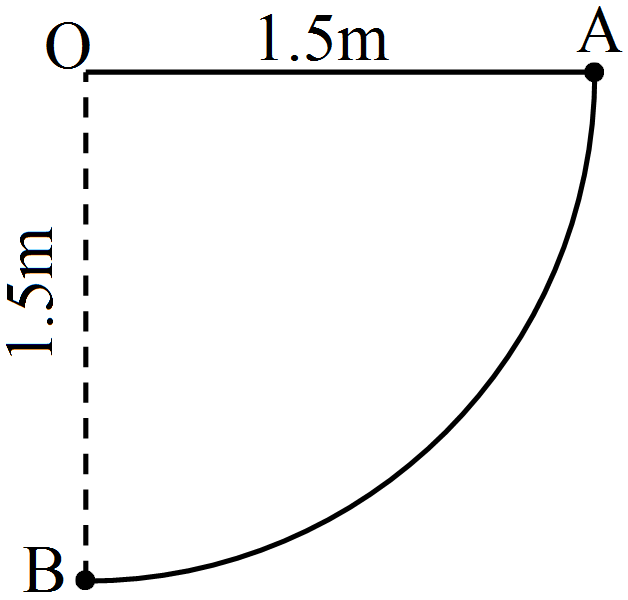
The bob of a pendulum is released from a horizontal A as shown. If the length of the pendulum is 1.5m, what is the speed with which the bob arrives at the lowermost point B, given that it dissipates 5% of its initial energy against air resistance?

Answer
Gravitational Potential energy at A = mg × 1.5J
Kinetic energy at B = $\Big[\text{mg}\times1.5-\frac{5}{100}\times\text{mg}\times1.5\Big]\text{J}$
$\text{mg}\times1.5\times\frac{95}{100}\text{J}$
$\because$ (P.E.)A = (K.E.)B and 5% of initial energy is dissipated against air resistance.
$\therefore\text{mv}^2=\text{mg}\times1.5\times\frac{95}{100}$ 
$\text{v}^2=\frac{2\times9.8\times1.5\times95}{100}$
$\text{v}=5.285\text{ms}^{-1}$
View full question & answer
Question 182 Marks
A truck and a car moving with the same kinetic energies (KE) on a straight road. Their engines are simultaneously switched off. Which one will stop at a lesser distance?
Answer
By Work = Energy theorem,
Loss in K.E. = Work done against the force of friction × Distance
$\text{K}.\text{E}.=\text{f}\times\text{S}=\mu\text{R}\times\text{S}=\mu\text{mg}\times\text{S}$
$\Rightarrow\text{S}=\frac{\text{K}.\text{E}.}{\mu\text{mg}}$
Distance is inversely proportional to the mass of an object or body i.e. $\text{S}\propto\frac{1}{\text{m}}$
So, truck will stop in lesser distance than the car.
View full question & answer
Question 192 Marks
Define the terms elastic collision and inelastic collision. What is the difference between inelastic collision and a completely inelastic collision?
Answer
Elastic collisions are those collisions in which the momentum and kinetic energy will be conserved. In inelastic collision only momentum will remain conserved.
In inelastic collision, loss in K.E. of moving body may not be 100% but in complete or perfect inelastic collision, the K.E. of moving body is lost so that the bodies move together after collision.
View full question & answer
Question 202 Marks
Can a body have energy without momentum? If yes, then explain how they are related with each other?
Answer
Yes, When P = 0,
Then, $\text{K}=\frac{\text{P}^2}{2\text{m}}=0$
 But E = K + U = U
(Potential energy), which may or may not be zero.
View full question & answer
Question 212 Marks
Two bodies of unequal mass are moving in the same direction with equal kinetic energy. The two bodies are brought to rest by applying retarding force of same magnitude. How would the distance moved by them before coming to rest compare?
Answer
By work energy theorem change in KE is equal to work is equal done by body. Hence KE = WD


Hence, both bodies will travel equal displacement or distance (it does not depend on mass of bodies.)
View full question & answer
Question 222 Marks
A shell explodes while at rest. Discuss the momentum and energy conservation in the explosion.
Answer
As the shell explodes, while being at rest, the momentum after explosion should also be zero. The internal energy with the shell will provide kinetic energy to the pieces into which it is broken. Therefore, there is increase in kinetic energy at the loss of internal energy.
View full question & answer
Question 232 Marks
The 200m free style women's swimming gold medal at Seol Olympic 1988 went to Heike Friendrich of East Germany when she set a new Olympic record of 1 minute and 57.56 seconds. Assume that she covered most of the distance with a uniform speed and had to exert 460W to maintain her speed. Calculate the average force of resistance offered by the water during the swim.
Answer
t = 1min. 57.56sec = 11.56sec, p= 400W, s =200m
$\text{p}=\frac{\text{w}}{\text{t}},$ Work W = pt = 460 × 117.56J
Again, $\text{W}=\text{FS}=\frac{460\times117.56}{200}$
$=270.3\text{N}\approx270\text{N}$
View full question & answer
Question 242 Marks
A water pump lifts water from a level 10m below the ground. Water is pumped at a rate of 30kg/ minute with negligible velocity. Calculate the minimum horsepower the engine should have to do this.
Answer
h = 10m
Flow rate $=\frac{\text{m}}{\text{t}}$
$=30\text{kg}/\text{min}=0.5\text{kg}/\text{sec}$
power $\text{P}=\frac{\text{mgh}}{\text{t}}$
$=(0.5)\times9.8\times10=49\text{W}$
So, horse power (h.p) $=\frac{\text{p}}{746}=\frac{49}{746}=6.6\times10^{-2}\text{hp}$
View full question & answer
Question 252 Marks
A bullet of mass 0.012kg and horizontal speed 70ms-1 strikes a block of wood of mass 0.4kg and instantly comes to rest with respect to block. The block is suspended from the ceiling by means of thin wires. Calculate the height to which the block rises.
Answer
Mass of the bullet (m0) = 0.012kg

Mass of a block of the wood (M) = 0.4kg

Horizontal speed of the bullet (u) = 70ms-1

Let V is the velocity of combination, then by conservation of linear momentum.

$\text{V}=\frac{\text{m}_0\text{u}}{\text{m}_0+\text{M}}=\frac{0.012\times70}{0.012+0.4}$

$=\frac{0.84\text{ms}^{-1}}{0.412}=2.04\text{ms}^{-1}$

Let h be the height through which the block rises. Then from the conservation of energy

P.E. of the combination = K.E. of the combination.

$\Rightarrow(\text{M}+\text{m}_0)\text{gh}=\frac{1}{2}(\text{M}+\text{m}_0)\text{V}^2$

$\Rightarrow\text{h}=\frac{\text{V}^2}{2\text{g}}$

$\Rightarrow\text{h}=\frac{(2.04)^2}{2\times9.8}=\frac{4.1616}{19.6}$

$=0.212\text{m}$

View full question & answer
Question 262 Marks
Ravi came to stay in a multistoried building. He noticed that motor supplying water to the second floor is power rating X k W while of that supplying water to 8th floor is Y k W. He asked his father the reason behind the difference of the power ratings. His father explained him the reason.
  1. What values does Ravi posses?
  2. Which power rating is more X or Y?
  3. A motor pumps up 1000kg of water through a height of 10min 5 s. If the efficiency of the motor is 60%, calculate the power of the motor in kilowatt. 
Answer
Motor supplying water to the II floor is power rating X k W.
Motor supplying water to the VIII floor is power rating Y k W.
  1. Curious and logical.
  2. YkW is more power rating.
  3. (c)m = 1000kg, h = 10m, 1 = 55
Efficiency of the motor = 60%
$\therefore$ Required Power =$\frac{\text{Work}}{\text{Time}}=\frac{\text{mgh}}{\text{t}}$
$=\frac{1000\times9.8\times10}{5}$
$=196000\text{W}$
Power of motor = P'
$\Rightarrow60\%\text{ of}\text{ p}'=196000\text{W}$
$\Rightarrow\frac{60}{100}\times\text{p}'=196000$
$\Rightarrow\text{p}'=\frac{19600000}{60}=32.7\text{kW} $
View full question & answer
Question 272 Marks
A person is painting his house walls. He stands on a ladder with a bucket containing paint in one hand and a brush in other. Suddenly the bucket slips from his hand and falls down on the floor. If the bucket with the paint had a mass of 6.0kg and was at a height of 2.0m at the time it slipped, how much gravitational potential energy is lost together with the paint?
Answer
m = 6kg, h = 2m
P.E. at a height ‘2m’ = mgh = 6 × (9.8) × 2 = 117.6J
P.E. at floor = 0
Loss in P.E. = 117.6 - 0
$=177.6\ \text{J}\approx118\text{J}$
View full question & answer
Question 282 Marks
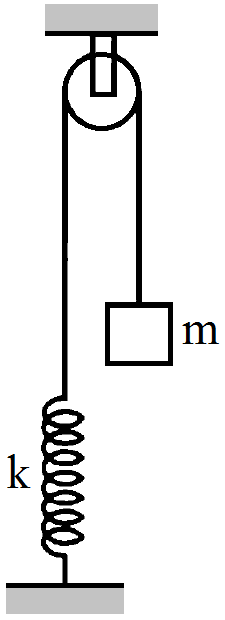
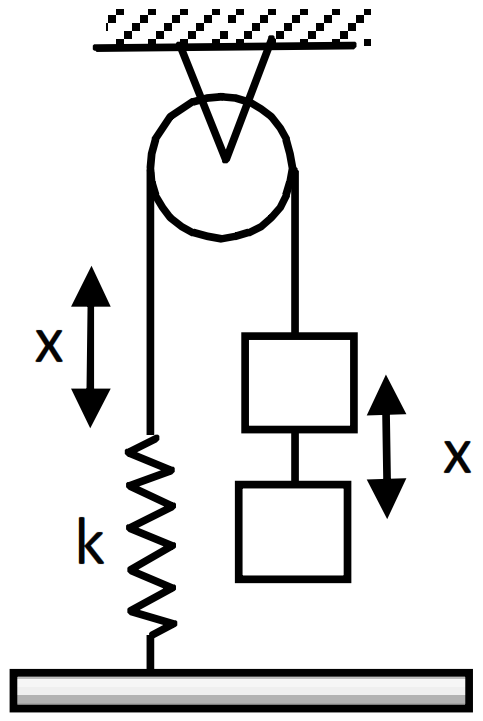
Consider the situation shown in figure. Initially the spring is unstretched when the system is released from rest. Assuming no friction in the pulley, find the maximum elongation of the spring.

Answer
Mass of the body = m
Let the elongation be x
So, $\frac{1}{2}\text{kx}^2=\text{mgx}$
$\Rightarrow\text{x}=2\text{mg}/\text{k}$

View full question & answer
Question 292 Marks
A planet moving around the sun is a good illustration of the law of conservation of energy. Explain.
Answer
At all stages during motion of the planet around sun, the sum of kinetic and potential energies is constant. When the planet is farthest from the sun, it is slowest. In other words, it has minimum kinetic energy and hence maximum potential energy.
View full question & answer
Question 302 Marks
An unruly demonstrator lifts a stone of mass 200g from the ground and throws it at his opponent. At the time of projection, the stone is 150cm above the ground and has a speed of 3.00m/s. Calculate the work done by the demonstrator during the process. If it takes one second for the demonstrator to lift the stone and throw, what horsepower does he use?
Answer
m = 200g = 0.2kg, h = 150cm = 1.5m, v = 3m/sec, t = 1sec
Total work done $=\frac{1}{2}\text{mv}^2+\text{mgh}$
$=\Big(\frac{1}{2}\Big)\times(0.2)\times9+(0.2)\times(9.8)\times(1.5)=3.84\text{J}$
h.p. used $=\frac{3.84}{746}=5.14\times10^{-3}$
View full question & answer
Question 312 Marks
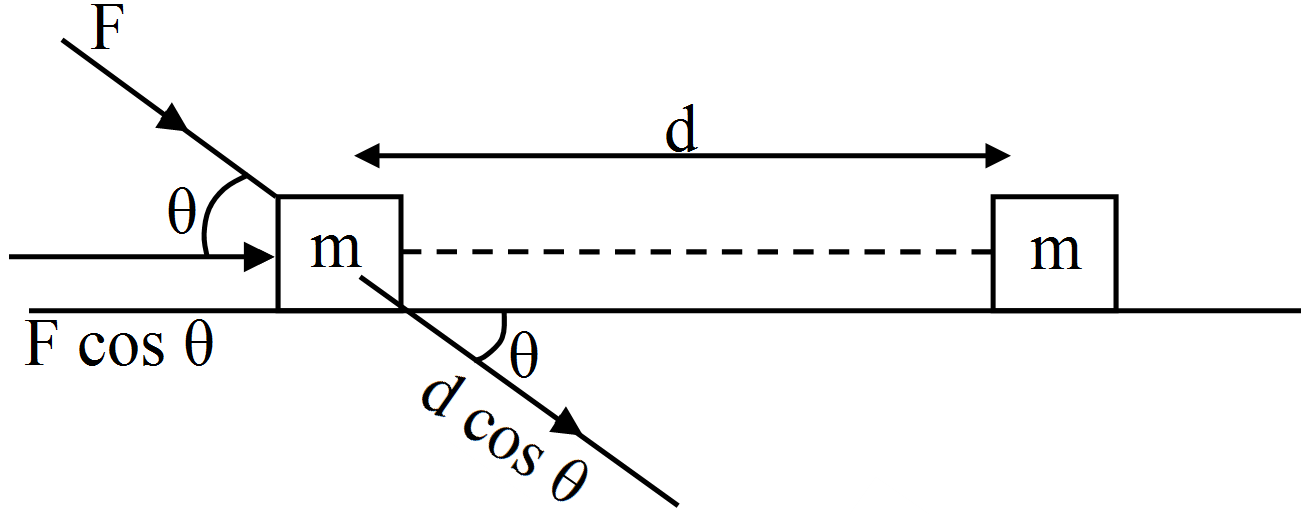
Establish that work done is the product of the displacement and the force in the direction of displacement.
Answer
Work done =$\vec{\text{F}}\cdot\vec{\text{d}}=\text{F}(\text{d}\cos\theta) \text{ or}\text{ F}\cos\theta\text{d}\cdot\text{d}\cos\theta$ is the component of displacement in the direction of force and $\text{F}\cos$ is the component of force in the direction of displacement. Therefore work done is the product of the component of force and displacement with the displacement and force in the same direction.

View full question & answer
Question 322 Marks
Two springs A and B with constants kA and kB (kA > kB) are given. In which of the springs more work is to be done if,
  1. They are stretched by the same amount.
  2. They are stretched by same force. 
Answer
We know, $\text{F}=\text{-kx}$ and W = Energy =$\frac{1}{2}\text{kx}^2$.

  1. For same stretch, $\frac{\text{w}_\text{A}}{\text{w}_\text{B}}=\frac{\text{k}_\text{A}}{\text{k}_\text{B}}$

$\therefore\text{k}_\text{A}>\text{k}_\text{B},\text{w}_\text{A}>\text{w}_\text{B}$

  1. For same force,

$\frac{\text{w}_\text{A}}{\text{w}_\text{B}}=\frac{\text{F}^2}{2\text{k}_\text{A}}\cdot\frac{2\text{k}_\text{B}}{\text{F}^2},\frac{\text{w}_\text{A}}{\text{w}_\text{B}}$

$\therefore\text{w}_\text{A}<\text{w}_\text{B}$

View full question & answer
Question 332 Marks
A force F = a + bx acts on a particle in the x-direction, where a and b are constants. Find the work done by this force during a displacement from x = 0 to x = d.
Answer
Given that F= a + bx
Where a and b are constants.
So, work done by this force during this force during the displacement x = 0 and x = d is given by,
$\text{W}=\int\limits_0^\text{d}\text{Fdx}$
$\text{W}=\int\limits_0^\text{d}\text{(a+bx)dx}$
$=\Big[\text{ax}+\Big(\frac{\text{bx}^2}{2}\Big)\Big]_0^\text{d}$
$=\Big[\text{a}+\frac{1}{2}\text{bd}\Big]\text{d}$
View full question & answer
Question 342 Marks
Show that in elastic one dimensional collision, velocity of approach before collision is equal to velocity of separation after collision.
Answer
In elastic collision, we know, both K.E. and momentum will be conserved. Therefore,
$\frac{1}{2}\text{m}_1\text{u}_1^2=\frac{1}{2}\text{m}_2\text{u}_2^2=\frac{1}{2}\text{m}_1\text{v}_1^2+\frac{1}{2}\text{m}_2\text{v}_2^2$
$\text{and}\text{ m}_1\text{u}_1+\text{m}_2\text{u}_2=\text{m}_1\text{v}_1+\text{m}_2\text{v}_2$
They can be Writtem as,
$\text{m}_1(\text{u}_1^2-\text{v}_1^2)=\text{m}_2(\text{v}_2^2-\text{u}_2^2)\cdots\text{ (i)}$
$\text{m}_1(\text{u}_1-\text{v}_1)=\text{m}_2(\text{v}_2^2-\text{u}_2)\cdots\text{(ii)}$
Dividing (i) and (ii), we have 
$\text{u}_1+\text{v}_1=\text{v}_2+\text{u}_2$
$\text{v}_2-\text{v}_1=-\text{u}_2-\text{u}_1).$
Hence Proved.
View full question & answer
Question 352 Marks
A spring balance reads forces in Newtons. The scale is 20cm long and read from 0 to 60N. Find potential energy of spring when the scale reads 20N.
Answer
We can calculate the spring constant of spring, as it is extended by 20cm under 60N force.
F = kx
⇒ 60 = k × 20 × 10-2
K = 300N/ m
At a force of 20N, the extension in spring is 
F = kx 
⇒ 20 = 300x
$\text{x}=\frac{1}{2}=\frac{1}{15}\text{m}$
View full question & answer
Question 362 Marks
The magnetic force on a charged particle is always perpendicular to its velocity. Can the magnetic force change the velocity of the particle? Speed of the particle?
Answer
The magnetic force on a charged particle is always perpendicular to its velocity. Therefore, the work done by the magnetic force on the charged particle is zero. Here, the kinetic energy and speed of the particle remain unaffected, while the velocity changes due to the change in direction of its motion.
View full question & answer
Question 372 Marks
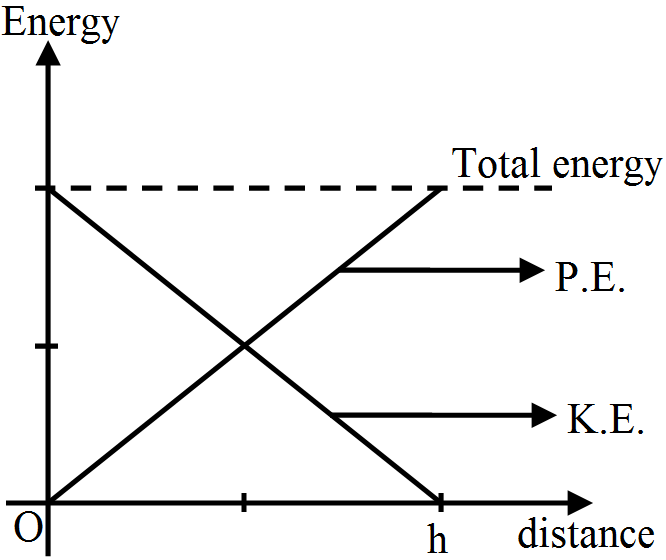
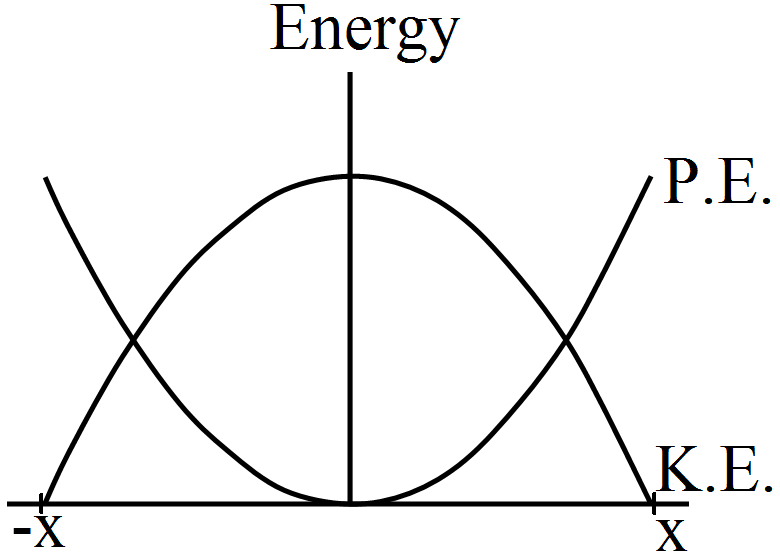
Draw a graph showing the variation of potential energy and kinetic energy with respect to height of a free fall under gravitational force.
Answer
The total energy associated with a mass 'm' at any height 'h' is mgh. The variation of potential and kinetic energy from ground to height 'h' is given as.

View full question & answer
Question 382 Marks
Can a body have energy without having momentum and have momentum without having energy? Explain.
Answer
Yes, A body at rest has no momentum. i.e., mv = 0 also $\text{K.E}=\frac{1}{2}\text{mv}^2=0$.
But it has potential energy. Therefore it possesses energy (K.E. + P.E.), without having momentum.
Yes, if K.E = -P.E. then total energy is zero but momentum is still there, e.g., an electron in an atom has momentum but negative total energy.
View full question & answer
Question 392 Marks
Prove that the work done in a frictional surface is non zero in a closed path.
Answer
Let Ff be the force of friction in a surface. The work done to carry a mass m from a point A to another point B is, -Ff AB. In the return path B to A also, the work done is -Ff AB, since the Ff acts against the motion. The net work done is therefore, -2Ff (AB). Since friction is dependent on the nature of the surface it is dependent on path.
View full question & answer
Question 402 Marks
The displacement (in metre) of a particle moving along X-axis is given by x(m) = 18t + 5t2.

Calculate:

  1. The instantaneous velocity.
  2. Instantaneous acceleration.

At = 2 second.

Answer
x(m)= 18t + 5t2

  1. Instantaneous velocity (v) $=\frac{\text{dx}}{\text{dt}}$

$=(18+10\text{t})\text{ms}^{-1}$

$\text{at}\text{ t}=2\text{ sec,}\text{v}=18+20=38\text{m/ s}$

  1. Instanraneous acceleration $\text{a}=\frac{\text{dx}}{\text{dt}}=10\text{m/ s}^2$
View full question & answer
Question 412 Marks
Discuss the variation of mass with velocity.
Answer
By Einstein's theory of relativity
$\text{m}=\frac{\text{m}_0}{\sqrt{1\frac{\text{v}_2}{\text{c}^2}}}$
= mass of moving body increases with velocity, because if v is increased $\Rightarrow\frac{\text{v}^2}{\text{c}^2}$ is increased.
$\Rightarrow1-\frac{\text{v}^2}{\text{c}^2}\text{ is decreased }$
$\Rightarrow\frac{\text{m}_0}{\sqrt{1\frac{\text{v}^2}{\text{c}^2}}}\text{is increased}.$
If v is zero then m = m0
View full question & answer
Question 422 Marks
A particle moves from a point $\vec{\text{r}}_1=(2\text{m})\vec{\text{i}}+(3\text{m})\vec{\text{j}}$ to another point $\vec{\text{r}}_2=(3\text{m})\vec{\text{i}}+(2\text{m})\vec{\text{j}}$ during which a certain force $\vec{\text{F}}=(5\text{N})\vec{\text{i}}+(5\text{N})\vec{\text{j}}$ acts on it. Find the work done by the force on the particle during the displacement.
Answer
Given,
$\vec{\text{r}}_1=2\hat{\text{i}}+3\hat{\text{j}}$
$\vec{\text{r}}_2=3\hat{\text{i}}+2\hat{\text{j}}$
So, displacement vector is given by,
$\vec{\text{r}}=\vec{\text{r}}_1-\vec{\text{r}}_2$
$\Rightarrow\vec{\text{r}}=\Big(3\hat{\text{i}}+2\hat{\text{j}}\Big)-\Big(2\hat{\text{i}}+3\hat{\text{j}}\Big)$
$=\hat{\text{i}}-\hat{\text{j}}$
So, work done $=\vec{\text{F}}\times\vec{\text{S}}$
$=5\times1+5(-1)=0$
View full question & answer
Question 432 Marks
Calculate the power of a crane in watts, which lifts a mass of 100kg to a height of 10 m in 20s.
Answer
According to the problem, mass = m = 100kg height = h - 10m, time interval, t = 20s Power is the rate of doing work with respect to time.
$\text{Power}=\frac{\text{Work done}}{\text{time}}=\frac{\text{mgh}}{\text{t}}$
$=\frac{100\times9.8\times10}{20}$
$=5\times98=490\text{W}$
View full question & answer
Question 442 Marks
Draw the graph showing the variation of potential energy and kinetic energy of a block attached to a spring, which obeys Hooke's law.
Answer
Within elastic limit.

View full question & answer
Question 452 Marks
Define the term watt, and kilo-watt hour.
Answer
Watt Power is said to be one watt if it can work at the rate of 1 joule per second 1 watt = 1 joule/ sec.
Kilowatt hour = 1 kWh is work done in 1 hour at a constant rate of 1 kilowatt. (kWh) 1 kWh = 3.6 × 106 J.
View full question & answer
Question 462 Marks
In a nerve impulse about 105 neurons are fired. Estimate the energy used. (Energy associated with discharge of a single neuron = 10-10J)
Answer
Energy used for 1 neuron = 10-10J
Energy used when 105 neurons are fired
= 105 × 10-10 = 10-5J.
View full question & answer
Question 472 Marks
A book is lifted from the floor and is kept in an almirah. One person says that the potential energy of the book is increased by 20J and the other says it is increased by 30J. Is one of them necessarily wrong?
Answer
Yes, one of them is necessarily wrong. We measure potential energy from a reference level chosen by the observer. However, the change in potential energy of a body does not depend on the level of reference.
View full question & answer
Question 482 Marks
How does the mass vary when the velocity is varied? What is mass-energy equivalence? Give an example.
Answer
Mass varies according to the relation, As velocity v increases, mass increases. According to Einstein, Energy = mc2, where c is the velocity of light. For example, 1kg of mass is embedded with an energy of $\text{E}=1\times(3\times10^8)^2=9\times10 ^{16}\text { joule}$.
View full question & answer
Question 492 Marks
In a nuclear reactor, fast neutrons collide with the atoms of the moderator and lose energy. Explain this collision.
Answer
The mass of neutrons and protons are comparable. So when a fast neutron collides on a proton at rest, it transfers its energy to the proton and comes to rest. Heavy water (D2O) has large availability of protons.
View full question & answer
Question 502 Marks
In a head-on collision between two particles, is it necessary that the particles will acquire a common velocity at least for one instant?
Answer
It is not necessary that in a head on collision the particles would acquire same initial velocity it is possible in elastic collision but it is not necessary.
View full question & answer
2 Marks Questions - Physics STD 11 Science Questions - Vidyadip