Question
What is the difference between head-on collision and glancing collision? Define coefficient of restitution.

Answer

Head-on collision: If the bodies move along the same straight line before and after collision it is called headon collision.
Glancing collision: If the bodies do not move along the same straight line after the collision it is called glancing collision.
Coefficient of restitution: It is the measure of degree of elasticity of a collision and is defined as.
$\text{e}=\frac{\text{relative speed of separation after collision}}{\text{relative speed of approach before collision}}$

Need a full question paper?

Generate a complete, print-ready paper with questions like this in minutes — across 16+ boards, with answer keys.
Start Generating Free

Similar questions

The 200m free style women's swimming gold medal at Seol Olympic 1988 went to Heike Friendrich of East Germany when she set a new Olympic record of 1 minute and 57.56 seconds. Assume that she covered most of the distance with a uniform speed and had to exert 460W to maintain her speed. Calculate the average force of resistance offered by the water during the swim.
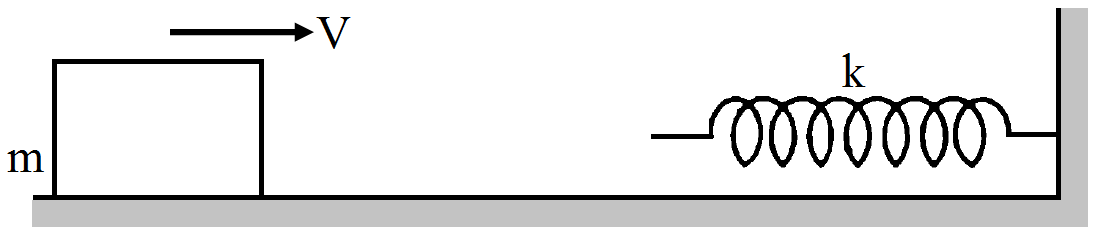
A block of massip, sliding on a smooth horizontal surface with a velocity $\vec{\text{v}}$ meets a long horizontal spring fixed at one end and having spring constant k as shown in figure. Find the maximum compression of tin spring. Will the velocity of the block be the same $\vec{\text{v}}$ when it comes back to the original position shown?

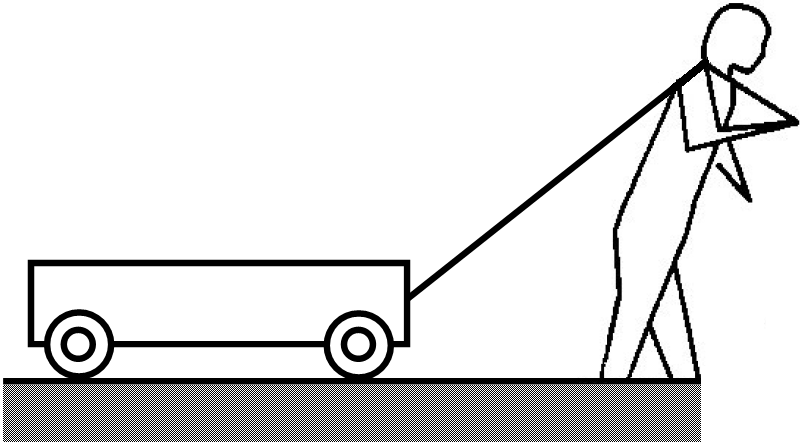
Figure shows a boy pulling a wagon on a road. List as many forces as you can which are relevant with this figure. Find the pairs of forces connected by Newton's third law of motion.

If water be used to construct a barometer, what would be the height of water column at standard atmospheric pressure (76cm of mercury)?
Is a 'single isolated force' possible in nature?
Two exactly identical pendulums are oscillating with amplitudes 2cm and 6cm. Calculate the ratio of their energies of oscillation.
A cyclist speeding at 18 km/h on a level road takes a sharp circular turn of radius 3 m without reducing the speed. The co-efficient of static friction
between the tyres and the road is 0.1. Will the cyclist slip while taking the turn?
Distinguish the radiation and convection methods of heat transfer.
A car moving at 40km/h is to be stopped by applying brakes in the next 4.0m. If the car weighs 2000kg, what average force must be applied on it?
A block of mass 5.0kg slides down an incline of inclination 30° and length 10m. Find the work done by the force of gravity.