Question 11 Mark
Answer
View full question & answer→- Both the stones reach the bottom with the same speed and stone II reaches the bottom earlier than stone I.
Explanation:
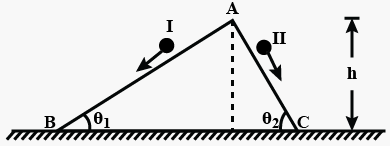
As shown in diagram AB and AC are two smooth planes inclined to the angle $\theta_1$ and $\theta_2$ respectively. As friction is absent here, hence, mechanical energy will be conserved. As both the tracks having common height h, From conservation of mechanical energy,

$\frac{1}{2}\text{mv}^2=\text{mgh}$ (for both tracks I and II)
$\text{v}=\sqrt{2\text{gh}}$
Hence, speed is same for both stones. For stone I, a1 = acceleration along inclines plane $=\text{g}\sin\theta_1$
Similarly, for stone II, $\text{a}_2=\text{g}\sin\theta_2$ as $\theta_2>\theta_1$ hence, $\text{a}_2>\text{a}_1$
And both length for track II is also less, hence stone II reaches earkier than stone I.