Questions

3 Marks Question

Take a timed test

11 questions · self-marked practice — reveal the answer and mark yourself.

Question 13 Marks
Clarify any two reasons of loss of biodiversity.
Answer
(1) Habitat loss and fragmentation : This is the most important cause of extinction of biodiversity. Once the earth was covered more than 14% by Tropical rainforest but now these rainforest cover no more than 6%. At present they are being rapidly destroyed. The Amazon rain forest (which is also called the lungs of the planet because it is so huge) harbouring millions of species, is being cut and clear for cultivating soya beans or for the conversion to grassland for grazing cattles. Besides of destroying the jungle many habitats are being destroyed and it threatens the survival of many species when large habitats are broken up into small fragments due to various and human activities. Mammals and bird requiring large territories and certain animals with migratory habits are badly affected leading to population decline.
(2) Alien Species Invasion : When alien species are brought into a habitat unknowingly or intentionally for any purpose, some become aggressive after getting more favourable conditions. In such a situation, these species dominate the indigenous species and cause decline or extinction of that indigenous species. Many such examples are present in different ecosystem. For example :
When Nile perch introduced into lake Victoria in East Africa led eventually to the extinction of an ecologically unique assemblage of more than 200 species of cichlid fishes in the lake.
Recently the African catfish (Clarias gariepinus) introduced for aquaculture is posing a threat to the indigenous catfish (Calarias bacterachus) in our rivers.
Carrot grass is an exotic weed that grows rapidly and has an adverse effect on the growth of endemic species. It causes skin diseases and asthma in humans.
View full question & answer
Question 23 Marks
The species diversity of plants (22 per cent) is much less than that of animals (72 per cent). What could be the explanations to how animals achieved greater diversification?
Answer
If we look at earth biodiversity based on the currently available species inventories. We find more than 70% of all the species recorded are animals while plants including algae, fungi, bryophytes, gymnosperms and angiosperms comprise no more than 22% of the total. Among animals, insect are the most species rich taxonomic group. making up more than 70% of the total. That means out of every 10 animals, 7 are insect. The number of fungal species. in the world is more than the combined total of the species of fishes, amphibian, reptiles and mammal.
The reason for this is that there are more groups of taxa in animals and also the number of insects is highest in them. There are less taxa groups in plants and thereby plants have less means of protection and are more susceptible to be extinct in fluctuating environment than animals. Tropical areas are more suitable for plant growth and biodiversity. These types of areas on Earth are less affected than the entire Earth. In animals nervous system and endocrine system are found, due to which animals receive the sensations from the environment and respond to them and adapt themselves to the environment. Due to this, there is more biodiversity in animals in any ecosystem environment than plants.
View full question & answer
Question 33 Marks
Among the ecosystem services are control of floods and soil erosion. How is this achieved by the biotic components of the ecosystem?
Answer
Biodiversity maintains the structure of the earth due to which it does not suffer from deficiency of soil and nutrients. Lack of storage capacity of the ecosystem leads to soil erosion. As a result soil develops salinity. When the amount of nutrients in the soil decrease, the upper layer of the soil gets weathered and the fertility of the soil is affected adversely. Different types of are responsible to announce fertility of the soil where as the vegetation cover acts as mulch, keeps the upper layer to be covered so that soil maintains its fertility. Soil organisms also produce humus in the soil increases.
Plants absorb water from the soil and carry out transpiration. Vegetation also controls the flood. Vegetation also controls the water cycle. Due to vegetation, water balance is maintained in the soil. Not only this, the balance of the environment is also maintained. Due to the destruction of forests, natural disasters like floods etc. start occurring Scientists say that forests have a significant role in maintaining the constant environment. If the vegetation keeps decreasing then it will start disturbing the weather of that area. Due to the deep root system of the trees, they stop the upper fertile soil from flowing and check soil erosion and flood.
View full question & answer
Question 43 Marks
What are sacred groves? What is their role in conservation?
Answer
India has a history of religious and cultural traditions like worshiping trees, wildlife and rivers that protects biodiversity. In many cultures, sacred groves are developed by leaving aside land for forests. This type of sacred groves are still present in some places like Meghalaya's Khansi and Jayanti Hills, Aravalli mountain ranges of Rajasthan, Western Ghats Karnataka and Maharashtra and Sarguja, Chanda and Bastar region of Madhya Pradesh, etc. Many rare species are safe in the sacred groves of Meghalaya. Rajasthan Vishnoi caste worships Khejri tree and deer and considers their conservation as their religion. Many communities worship cow, Peepal, Amla, Banyan, Tulsi. Such religious sentiments also help in bio-conservation of ecology.
It's strategy for the protection of biodiversity has been in practice in India and some other Asian countries. These are forest patches of varying dimension protected by tribal community. Due to religious sanctity the sacred forest are free from all disturbances, though these are frequently surrounded by highly degraded landscapes. They serve as refugia for a number of rare endangered and endemic taxa Water bodies like khecheopatri lake have been declared sacred by the people for protection of aquatic fauna and flora.
View full question & answer
Question 53 Marks
What is the significance of the slope of regression in a species-area relationship?
Answer
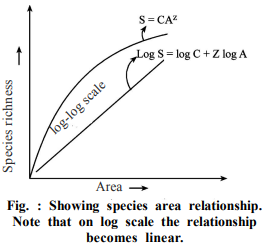
The slope of regression (Z) has a great significance in order to find a species-area relationship. Ecologist have reported that the value of Z (slope of regression) lies in the range of 0.1 to 0.2 regardless of the taxonomic group of the region (whether is the plant in Britain, birds in California, all mollusc in New York State, slopes the regression line amazingly similar). But, if we analyze the species-area relationship among very large areas like the entire continent, we will find that the slope of the line to be much steeper (as the Z-value in the range of 0.6 to 1.2). For example, for firugivorous (fruit eating) birds and mammals in the tropical forest of the different continents, the slope comes to be 1.15 which represents the dense species richness over the wide area.
View full question & answer
Question 63 Marks
Biodiversity plays a key role in many ecosystem services provided by nature.
(a) Present any two widely useful arguments to prove the validity of the statement.
(b) Write any one moral reason for protecting biodiversity.
Answer
Biodiversity plays a key role in many ecosystem services provided by nature. It can be understood by following examples :
1. Amazon forest alone provides about 20% oxygen to the atmosphere of the earth through photosynthesis, that is why it was said to be the lungs of the earth. Although we do not estimate its price but it is vital air.
2. Similarly pollination process in plants is made by air, water, insects, birds and bats. This process is done by various pollinating agents (Honeybees, bumblebees, birds and bats,). Without pollination process, seeds and fruits are not formed in plants.
It is our moral duty to conserve biodiversity. We know very well that humans cannot live alone on this earth. If humans have to maintain their existence, it is necessary to conserve all the plants, animals and microbe species available in the environment. Every species found on earth has its own intrinsic value. Therefore, it is our moral responsibility to take good care of the property and save this biological heritage for the future generations.
View full question & answer
Question 73 Marks
(a) Write the conclusions drawn by Alexander von Humbolt based on his extensive exploration of South America.
(b) Study the graph given below :
Image
According to Alexander von Humbolt, what do the symbols S, A, C, and Z used in graphs indicate in the context of a species and region relationship?
Answer
(a) Conclusion : To some extent, the species richness of an area increases with increasing extent of exploration area.
(b) S = Species Richness, A= Area. Z = Slope of line (regression coefficient) and C = Y-intercept.
View full question & answer
Question 83 Marks
What are the fundamental difference between In-situ and Ex-situ conservation.
Answer
Differences between In-site and Ex-situ conservation.
S.No.In-situ ConservationEx-situ Comervation
1It means onsite conservation.It means offsite conservation.
2It is the conservation of wild species in their natural habitates in order to maintain and recover endangered species.It is conservation of species in the man-made habitat hut imitate the natural habitats of species.
3It is more dynamic as it involves natural habitats of organisms.It is less dynamic as it involves man-made hubitats.
4It provides protection to endangered species against predators.It provides protection against all hostile factors.
5It is suitable for animals that are found in abundanceIt is suitable for animals that are not found in abundance.
6It is not suitable in the event of a rapid decline in the number of a species due to environmental genetic or any other factor.It is an ideal option in case of rapid decline in the number of a species due to environmental or any other reason.
7Wildlife and livestock conservation involve in in-situ conservation.It can be used to conserve crops and their wild relatives.
8Examples include national parks, wildlife sanctuaries, biospheres reserve etc.Examples include zoo, aquarium and botanical garden.
9It involves designation, management and monitoring of the target species in their natural habitat.It involves sampling, storage and transfer of target species from their natural habitats to man-made habitats.
10It helps maintain the ongoing process of evolution and adaptation within the natural environment of the species.It separates the animals from the ongoing process of evolution and adaptation within their natural environment.
View full question & answer
Question 93 Marks
Explain into how many categories the endangered species have been classified on the basis of threatened species.
Answer
On the basis of threatening, endangered species have been classified into five groups : 
Threatened Species Categories (According to IUCN)
Extinct (E)A taxon is Extinct when there is no reasonable doubt that that the last individual has died
Critically Endangered (CR)A taxon is Critically Endangered when it is facing an extremely high risk of extinction in the wild in the immediate future.
Endangered (EN)A taxon is Endangered when it is not Critically Endangered but facing a very high risk of extinction in the wild in the near future.
Vulnerable (VU)A taxon is Vulnerable when it is not Critically Endangered but facing a high risk of extinction in the wild in the medium-term future.
Lower Risk (LR)A taxon is Lower Risk when it has been evaluated, does not satisfy the criteria for any of the categories CR, E, or VU.
Endemic species : Species restricted to a particular region or ecosystem due to various environmental factors or due to the barriers of dispersal.
Rare species : Some species are naturally rare due to presence in small numbers.
View full question & answer
Question 103 Marks
Write a short note on extinct species?
Answer
Under this category, biological species are included which were alive in the recent past but are now no longer present in their habitat and their existence has ended in other habitats also, that is, it has become extinct from the biosphere. Once extinct, specific organisms of any species can never be obtained. Man has been hunting various terrestrial, aquatic and terrestrial animals on a large scale, as a result of which many animal species have become extinct forever from the biosphere due to human activities. The IUCN Red List (2004) documents the extinction of 784 species (including 338 vertebrates, 359 invertebrates and 87 plants) in the last 500 years. The recently extinct species include Dodo of Mauritius, Quega of Africa, Thai Laysan of Australia, Steller sea cow of Russia and three sub-species of tiger in Bali; Java and Caspian. The last 20 years alone have witnessed disappearance of 27 species. Careful analysis of records that extinction across Texas are not random some groups like amphibians appear to be more vulnerable to extinction, adding to the grim scenario of extinction is the fact that more than 15500 species worldwide are facing the threat of extinction. Presently 12% of all birds species, 23% of all mammal species, 32% of all amphibian species and 31% of all gymnosperm is species in the world face the threat of extinction. The species included in this category in India are Indian crocodile, Godavan, Indian sarus, Hornbill, Marigold, Bear and Son bird etc. which have become extinct. 
View full question & answer
Question 113 Marks
Give a brief description of the different types of biodiversity in concise words.
Answer
Biological diversity was at first used by Norse (1980). W.G. Rosen used the term biodiversity in place of biological diversity. According to Wilson—biodiversity can be observed at 3 major levels :
1. Genetic diversity : It involves diversity existing within a species in fact it is the diversit of gene variation within a species. The immense amount of genetic information exist in the genes of organism. Genetic diversity refers to the variation of genes within species. Genetic diversity enables a population to adapt its environment and to respond to natural selection. The genetic variation shown by the medicinal plant Rauwolfia vomitoria growing in different Himalayan ranges might be in terms of the potency and concentration of the active chemical (reserpine) that the plant produces. Our country has more than 50,000 genetically different strains of rice and 1,000 varieties of mango.
2. Species diversity : It refers to the variety of species within a region. This diversity is at the species level which depends on the number of species and richness of species. Species richness refers to the number of species per unit area for example the Western Ghat have a greater amphibian species diversity then the Eastern Ghat.
3. Ecological diversity : It refers to the diversity at the level of ecosystem and habitat. It requires the study of ecology niches found in an ecosystem. It is associated with different types of ecosystem or habitat like terrestrial such as forest, grassland, desert etc and aquatic freshwater and saline water. Freshwater ecosystem includes lentic ecosystem i.e. lake and pond ecosystem or lotic ecosystem i.e river ecosystem, spring ecosystem and wetland ecosystem. Marine ecosystem includes ocean ecosystem. 
View full question & answer