Questions

5 Marks Questions

Take a timed test

19 questions · self-marked practice — reveal the answer and mark yourself.

Question 15 Marks
  1. Why should we conserve biodiversity? How can we do it?
  2. Explain the importance of biodiversity hot-spots and sacred groves.
Answer
  1.  
  1.  
  • Narrowly utilitarian - related examples like derive economic benefits from nature food (cereals, pulses, fruits)/firewood/fibre/construction materials/industrial products (tannins, lubricants, dice, resins, perfumes)/product of medicinal importance/drugs.
  • Broadly utilitarian - 20% of total O2 from Amazon forests/pollination/aesthetic pleasures.
  • Ethical - millions of species (plants, animals, microbes) share this planet/we need to realise that every species has an intrinsic value (even if it may not current or any economic value to us)/we have a moral duty to care for their wellbeing and pass on our biological legacy to future generations.
  1.  
  • In situ conservation/biosphere reserves/national parks/sanctuaries/sacred groves.
  • Ex-situ conservation/zoological parks/botanical gardens/wild life safari.
  • parks/cryopreservation/seed banks/tissue culture (eggs in vitro).
  1. Hot spots - regions with high level of species richness, high degree of endemism.
Sacred groves - tracts of forest containing tree/wildlife were venerated, and given total protection// to protect last refuses for a large number of rare, and threatened plants.
View full question & answer
Question 25 Marks
Of the four major causes for the loss of biodiversity (Alien species invasion, habitat loss and fragmentation, over-exploitation and co-extinctions which according to you is the major cause for the loss of biodiversity? Give reasons in support.
Answer
Habitat loss and fragmentation is the most important cause driving animals and plants to extinction. The most dramatic examples of habitat loss come from tropical rain forests. Once covering more than 14 per cent of the earth’s land surface, these rain forests now cover no more than 6 per cent. They are being destroyed fast. By the time you finish reading this chapter, 1000 more hectares of rain forest would have been lost. The Amazon rain forest (it is so huge that it is called the ‘lungs of the planet’) harbouring probably millions of species is being cut and cleared for cultivating soyabeans or for conversion to grasslands for raising beef cattle.
View full question & answer
Question 35 Marks
How can you, as an individual, prevent the loss of biodiversity?
Answer
The loss of biodiversity can be prevented by:
  1. Practise of recycling waste paper etc.
  2. Judicious exploitation of medicinal and commercial plants and animals.
  3. Generating awareness among the public on the importance of biodiversity, conversation through skits, screening of films, lectures etc.
Teaching people how to reduce green house gases emissions, through alternate eco friendly green technologies like use of solar energy, wind energy, biogas, vermicompost, organic farming etc.
View full question & answer
Question 45 Marks
A species-area curve is drawn by plotting the number of species against the area. How is it that when a very large area is considered the slope is steeper than that for smaller areas?
Answer
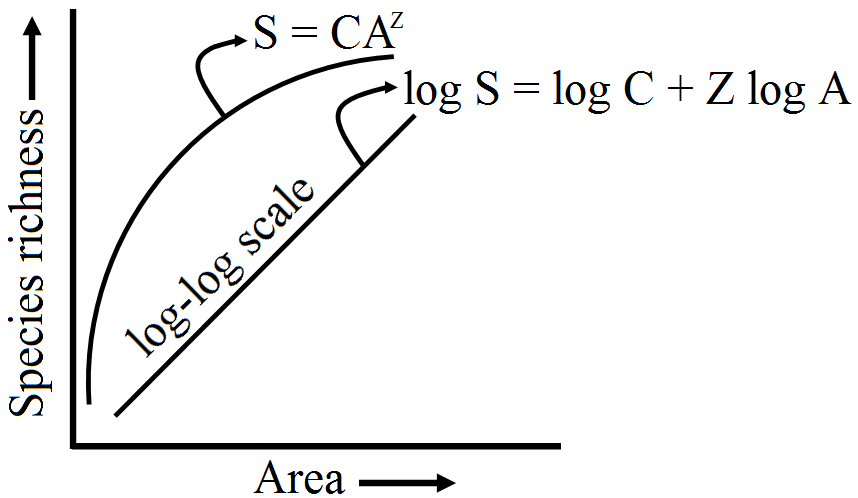
Ecologists have discovered that the value of Z (slope of the line) lies in the range of 0.1 to 0.2, regardless of the taxonomic group or the region (whether it is the plants in Britain, birds in California or molluscs in New York state, the slopes of the regression line are amazingly similar). But, if you analyse the species-area relationships among very large areas like the entire continents, you will find that the slope of the line to be much steeper (Z values in the range of 0.6 to 1.2). For example, for frugivorous (fruit-eating) birds and mammals in the tropical forests of different continents, the slope is found to be 1.15.
View full question & answer
Question 55 Marks
Species diversity decreases as we move away from the equator towards the poles. What could be the possible reasons?
Answer
Following are the reasons for greater species diversity near equator than at the poles. Equator receives direct illumination and hence has experienced more or less uniform climatic conditions throughout the history of evolution. Stable conditions near equator has given rise to large number of species. When we consider about the temperate regions; the climatic conditions have changed dramatically in these regions. Many species which lived in these regions become extinct during dramatic climatic changes. Hence, we find a lower number of species in these regions. In polar regions due to extreme cold climatic condition and less availability of sunlight species diversity is very less.
View full question & answer
Question 65 Marks
Explain briefly the ‘rivet popper hypothesis’ of Paul Ehrlich.
Answer
Paul Ehrlich proposed Rivet popper hypothesis to show the effect of biodiversity loss on the ecosystem. An airplane (ecosystem) has thousands of rivets. Popping of rivets (causing a species to become extinct) by passenger may not affect flight safety (Proper functioning of the ecosytem) in the beginning but the plane will become dangerously weak over a period of time. Removal of a rivet of a critical part like wing (key species that derive major ecosystem functions) is obviously a more serious threat to flight safety than loss of a few rivets on the seats or window inside the plane.
View full question & answer
Question 75 Marks
Describe the consumptive use value of biodiversity as food, drugs and medicines, fuel and fiber with suitable examples.
Answer
The direct use values where the biodiversity products can be harvested and consumed directly are called consumptive use value of biodiversity, humans derive countless direct economic benefits from nature food (cereals, pulses, fruits), firewood, fibre, construction material, industrial products (tannins, lubricants, dyes, resins, perfumes) and products of medicinal importance. More than 25 percent of the drugs currently sold in the market worldwide are derived from plants and 25,000 species of plants contribute to the traditional medicines used by native peoples around the world.
View full question & answer
Question 85 Marks
List any two major causes other than anthropogenic causes of the loss of biodiversity.
Answer
Two major causes (other than anthropogenic causes) for the loss of biodiversity are as follows:
  1. Glaciations and Global warming: The earth had been through many phase of glaciations and global warming. Mammoths are believed to have existed during the Ice Age. Global warming led to end of the Ice Age which resulted in mass extinction.
  2. Meteor hit: Dinosaurs are believed to become extinct because of meteor hit.
View full question & answer
Question 95 Marks
Explain the efforts for the conservation of biodiversity at international level.
Answer
The Earth Summit was held at Rio de Janeiro (Brazil) in which representatives of more than 170 countries were present. The summit promoted Convention on Biological Diversity (CBD). India became signatory to this convention in May 1994.The major objectives were:
  1. Finding and supporting various methods to conserve biological diversity.
  2. Use of biodiversity only up to sustainable limit.
  3. The benefits derived from use of genetic resources should be fairly and equitably shared.
A second world summit on biological diversity was held in 2002 in Johannesburg, South Africa. In the Summit, 190 countries pledged to reduce the current rate of biodiversity loss at global, regional and local levels by 2010.
View full question & answer
Question 105 Marks
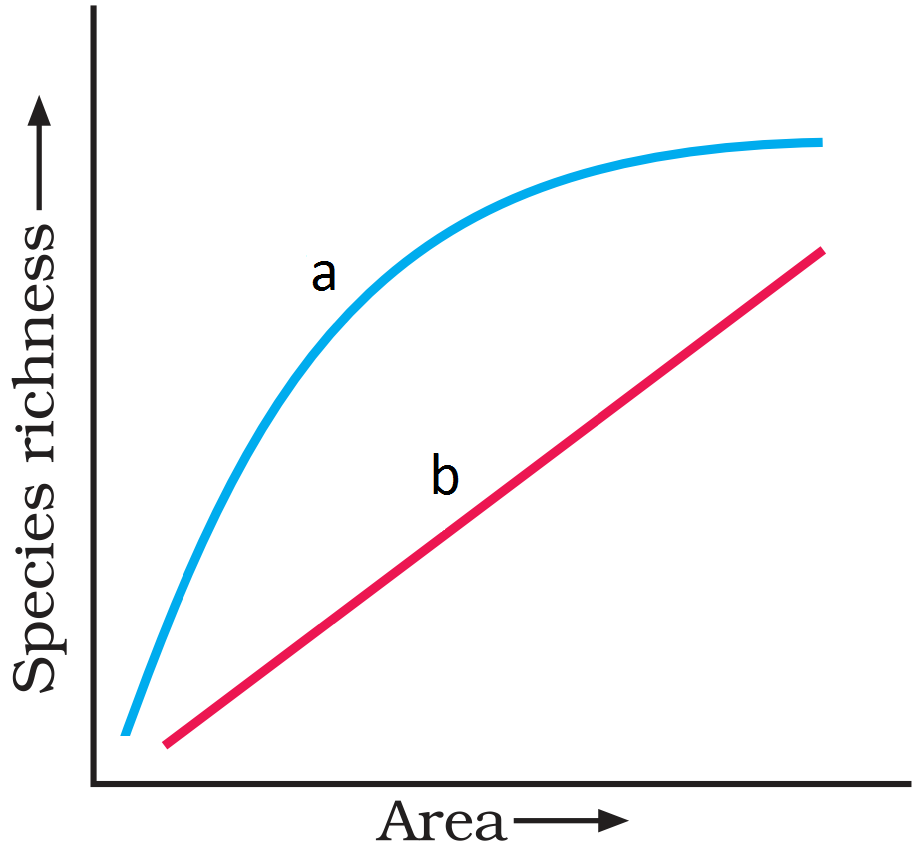
The graph shows species-area relationship:
  1. If b denotes the relationship on log scale-
  1. Describe a and b.
  2. How is slope represented? Give the normal range of slope.
  3. What kind of slope will be observed for frugivorous birds and mammals in a tropical forest?
  1. Species diversity of plants (22%) is much less than that of animals (72%). Analyze the reasons for greater diversity of animals as compared to plants.
Answer
  1.  
  1. a is $S = CA^2$ b is log S = log C + Z log A
  2. Slope is Z (regression coefficient). Its normal value ranges from 0.6 to 1.2.
  3. In frugivorous birds and mammals, value of Z = 1.15
  1. Reasons for greater diversity of animals are:
  1. Animal are mobile and can avoid predator or unfavourable event.
  2. Well developed nervous system to receive stimuli against external factors and respond to them.
View full question & answer
Question 115 Marks
Write notes on ex-situ conservation of biodiversity
Answer
Ex-situ conservation (Off-site conservation):
  • This approach involves placing threatened animals and plants in special care units for their protection.
  • India has 35 botanical gardens and 275 zoological parks where animals which have become extinct in wild are maintained.
  • By using cryopreservation (preservation at -196°C) technique, sperms, eggs, animal cells, tissues and embryos can be stored for long period in genes banks, seed banks, etc.
  • Plants are propagated in vitro using tissue culture methods (micropropagation).
  • It is the desirable approach when urgent measures to save extinction are required.
View full question & answer
Question 125 Marks
During her tour to a renowned forest, Sakshi saw a highway being constructed, which passes through the middle of the forest. She was unhappy seeing that and on return, she contacted the local eco-club and approached the concerned department to stop the work.
  1. What would be the effect on biodiversity, if the highway is constructed?
  2. How forests are useful to mankind?
  3. What values of Sakshi reflect here?
Answer
  1. Continuity of the habitat (i.e. forest) would be disrupted. Animals get confined to smaller area. Fragmentation characteristically reduces species richness and taxon diversity and may reduce the efficacy of ecosystem functioning. Fragmentation not only reduces the amount of functional habitat, but also it may isolate a species population into sub-populations. It may be sufficiently near the minimum viable population size, to risk the local extinction from successive demographic processes or catastrophic events.
  2. Forests are important for mankind due to following reasons:
  1. They are source of firewood, fibre, construction material industrial products and products of medicinal importance.
  2. They provide us with fresh air (oxygen) and also help in bringing down rain.
  3. Acts as a habitat of a wide variety of flora and fauna.
  4. They also help in keeping environment healthy and beautiful.
  1. Love for nature and environmental consciousness. She was brave, focussed, and foresighted (had vision to see the disaster in the future).
View full question & answer
Question 135 Marks
What are the reasons for biodiversity conservation?
Answer
Reasons for Biodiversity Conservation:There are three main reasons for conserving the biodiversity which have been classified into the following categories:
  1. Narrowly utilitarian arguments:
  • Human beings derive direct economic benefits from nature, like food, firewood, fibre, construction material, industrial products (resins, gums, dyes, tannins, etc.) and medicinally important products.
  • • More than 25 percent of the drugs are derived from plants and about 25,000 species of plants are used by native people as traditional medicines.
  1. Broadly utilitarian arguments:
  • Biodiversity plays a major role in maintaining and sustaining supply of goods and services from various species as well as ecological systems.
  • The different ecological services provided are:
  1. Amazon forest is estimated to contribute 20 percent of the total oxygen in the atmosphere on earth.
  2. Ecosystem provides pollinators like bees, bumble bees, birds and bats which pollinate plants to form fruits and seeds.
  1. Ethical reasons:
  • There are thousands of plants, animals and microbes on this earth which are not useless. Every one has some intrinsic value even if it is not of any economic value to us.
  • It is, therefore, our moral duty to ensure well-being of all the living creatures for the utilisation of future generations.
View full question & answer
Question 145 Marks
What is an ecosystem service? List any four important ecosystem services provided by the natural ecosystems. Are you in favour or against levying a charge on the service provided by the ecosystem?
Answer
The product of ecosystem processes is called ecosystem service.
Following is the list of four important ecosystem services:
  1. Purification of air and water
  2. Rainfall
  3. Pollination of crops
  4. Assimilation of excess carbon
There should be no charge for ecosystem services because nature provides everything for free. However, there should be proper attempts to estimate the cost of these services. Data about costs of these services should be made available to the general public. Every person should be educated about the real value of ecosystem services. This will help us in appreciating the real value of services which we get from the ecosystem.
View full question & answer
Question 155 Marks
Though the conflict between humans and wildlife started with the evolution of man, the intensity of conflict has increased due to the activities of modern man. Justify your answer with suitable examples.
Answer
From a study of the history of life on earth through fossil records, we learn that large-scale loss of species like the one we are currently witnessing have also happened earlier, even before humans appeared on the scene. During the long period (3 billion years) since the origin and diversification of life on earth there were five episodes of mass extinction of species. How is the ‘ Sixth Extinction’ presently in progress different from the previous episodes? The difference is in the rates; the current species extinction rates are estimated to be 100 to 1,000 times faster than in the pre-human times and our activities are responsible for the faster rates. Ecologists warn that if the present trends continue, nearly half of all the species on earth might be wiped out within the next 100 years. The colonisation of tropical Pacific Islands by humans is said to have led to the extinction of more than 2,000 species of native birds. The IUCN Red List (2004) documents the extinction of 784 species. The last twenty years alone have witnessed the disappearance of 27 species.
View full question & answer
Question 165 Marks
There is greater biodiversity in tropical /subtropical regions than in temperate region. Explain.
Answer
  1. Speciation is generally a function of time, unlike temperate regions subjected to frequent glaciations in the past, tropical latitudes have remained relatively undisturbed for millions of years and thus, had a long evolutionary time for species diversification.
  2. Tropical environments, unlike temperate ones, are less seasonal, relatively more constant and predictable. Such constant environments promote niche specialisation and lead to a greater species diversity.
  3. There is more solar energy available in the tropics, which contributes to higher productivity; this in turn might contribute indirectly to greater diversity.
View full question & answer
Question 175 Marks
Can you think of a scientific explanation, besides analogy used by Paul Ehrlich, for the direct relationship between diversity and stability of an ecosystem?
Answer
An ecosystem works on continuous interaction and interdependencies among various components. All the living beings depend on various abiotic factors to obtain raw material and energy. Producers depend on soil, air and sunlight to produce food. Primary consumers depend on producers for food. Secondary consumers depend on primary consumers for food. Now let us consider following scenario.
Imagine two herbivores A and B. Animal A can feed on a variety of plants, while animal B can feed on only one plant. If the sole plant which is eaten by animal B is somehow wiped out from the area, then animal B will also face extinction. But loss of a few plant species will not pose any danger to the existence of animal A. This shows the advantage of diversity in terms of available plants for animal A.
The above logic applies to other organisms as well. This means that if there is rich biodiversity in the ecosystem, then primary and secondary productivity is at optimum level. This helps in maintaining stability in the ecosystem.
View full question & answer
Question 185 Marks
Elaborate how invasion by an alien species reduces the species diversity of an area.
Answer
When an alien species is deliberately or accidentally introduced into an area, it may become invasive and threaten other species. Invasive species can be a serious competitor; competing for the same resources. It can also turn out to be predator for some species. There are many examples of invasive species which played havoc with the local biodiversity. Some
examples are as follows:
  1. Water Hyacinth: Water Hyacinth is originally from amazon basin. It has proved to be invasive species in many countries. This plant grows at rapid rate and covers the whole pond and lake. By covering the surface of the pond, this plant reduces the supply of sunlight and oxygen to the bottom of the pond. Thus, it proves detrimental for other organisms in the pond.
  2. Parthenium or Carrot Grass: This plant came as contaminant along with imported wheat from America. This plant proved to be highly invasive in India. This is a notorious breed which becomes a big problem for the farmers in India.
View full question & answer
Question 195 Marks
The relation between species richness and area for a wide variety of taxa turns out to be a rectangular hyperbola. Give a brief explanation.
Answer
Species richness in any area depends on various factors. Some of them are as follows:
  1. Balance between immigration and extinction.
  2. Rate and magnitude of disturbance in small area Vs large area.
  3. Predator prey dynamics.
  4. Clustering of individuals of the same species because of dispersal limitations.
When the area increases up to a certain extent, number of species increases; as shown by the graph. This can happen because of reduced rate of disturbance and because of favourable predator prey dynamics. Once the area increase beyond the threshold level, there is no growth in number of species. This can happen because of dispersal limitations.
View full question & answer