- AFlippers of penguins and dolphins.
- BEyes of octopus and mammals.
- CVertebrate brains.
- Eyes of octopus and mammals.
50 questions · 1 auto-graded MCQ + 49 self-marked written.
Explanation:
Triassic period, in geologic time, the first period of the Mesozoic era. It began 252 million years ago.
Reptiles increased in diversity and number, and the first dinosaurs appeared during this period along with the appearance of first mammals.
Explanation:
A small population is not in Hardy Weinberg Equilibrium and may lose alleles due to Genetic Drift.
Explanation:
Eobionts are hypothetical primordial life-form or chemical precursor to a living organism. The coacervates got transformed into the primitive living systems, which have been called as, protobionts or eobionts.
These are the first formed cells. So, called as, pre cells or protocells or protobionts.
Explanation:
At the end of Pleistocene or around late Pleistocene, evolved Homo sapiens. Homo sapiens are the parent species to which modern man belongs. Homo sapiens developed three subspecies viz.
Homo sapiens neanderthalensis or Neanderthal man, Homo sapiens fossilis or Cro-Magnon man and Homo sapiens sapiens or modern man.
Explanation:
In evolutionary biology, adaptive radiation is a process in which organisms diversify rapidly from an ancestral species into a multitude of new forms, particularly when a change in the environment makes new resources available, creates new challenges, or opens new environmental niches.
Hence, Adaptation is a type of Adaptive radiation.
In 1953 S.L. Miller created primitive earth conditions in the laboratory and gave experimental evidence for origin of first form of life from preexisting non-living organic molecules. The primitive earth conditions created include high temperature, volcanic storms, reducing atmosphere containing CH4, NH3 etc.
Explanation:
Peking man and Java man discovered in Asia are examples of Homo erectus. Homo erectus is the scientific name. Pithecanthropus erectus was the name given by the original discoverer, Eugene Dubois, in 1891. He later revised this to Homo erectus.
Along with Pithecantropus erectus, other names given to early specimens of the species are Sinanthropus pekinensis (Peking man), Javanthropus soloensis and Meganthropus paleojavanicus. All of these were provisional allocations made before all of the specimens could be compared with each other, and are now obsolete.
Explanation:
Various lines of evidence indicate that our closest relatives are chimpanzees, followed by gorillas and then orangutans, and then gibbons. The closest relative of modern man is considered to be chimpanze on the basis of:
Explanation:
Convergent evolution is the evolution of similar traits in unrelated lineages (usually geographically distant). Hummingbird, hawk and the humming moth belongs to different lineage but forelimbs are modified to wings to adapt for flight.
Animal husbandry and plant breeding programmes need human intervention and desirable characters are introduced in plants and animals through manipulation. Hence, these are examples of artificial selection.
Explanation:
During human evolution, several species and subspecies roamed on earth and lived together and also possibly exchanged genes, thus, obscuring the exact lineage which ultimately evolved into modern humans, but Homo erectus that lived around middle Pleistocene, are thought of as the direct line that evolved into modern man. The most important subspecies of Homo erectus are Java man, Peking man and Heidelberg man.
Explanation:
Any factor, which can disturb the frequency of alleles in a population is likely to affect the Hardy-Weinberg equilibrium.
The alleles in a population can be altered by mutation, migration, genetic drift, recombination, and natural selection.
Explanation:
J.B.S. Haldane was born in England but migrated to India in July 1957 and settled in Bhubaneswar, Orissa. He was a biologist, biochemist, and geneticist. He along with Oparin, a Russian scientist gave similar views regarding the origin of life.
The Oparin-Haldane theory is also called chemical theory. According to this theory, life originated upon our earth spontaneously from non-living matter.
Explanation:
The Pliocene epoch extends from 5.332 million to 2.588 million years before present. Man evolved in this era.

Explanation:
Hardy Weinberg law is applicable to genetic equilibrium. The Hardy-Weinberg equilibrium is a principle stating that the genetic variation in a population will remain constant from one generation to the next in the absence of disturbing factors.
When mating is random in a large population with no disruptive circumstances, the law predicts that both genotype and allele frequencies will remain constant because they are in equilibrium.
Similarity in structural design indicates towards a common ancestry.
Explanation:
Homo erectus is an extinct species of hominin that lived throughout most of the Pleistocene. The brain capacity of Homo erectus was 800 to 1300cc.
Explanation:
Macro evolution is a major evolutionary change, especially with regard to the evolution of whole taxonomic groups over long periods of time.
Eg: beetle genus Blepharida and beetle genus Bursera
Explanation:
The animals or plants that evolve same structure along different directions due to adaptations to different needs is known as divergent or homologous evolution and it shows common ancestry. The thorn and tendrils of Bougainvillea and Cucurbita represent homology.
Explanation:
How life actually originated we do not know but we do know that it started with accumulation of biomolecules produced in reducing atmosphere. The biomolecules later on gave rise to aggregates of biomolecules.
First nucleoproteins were most probably produced on clay surfaces. That was the important first sign of life because it meant a transition from an aggregate of biomolecule to a self replicating entity, an important characteristic of living organisms.
Explanation:
According to special creation theory, all the different forms of life that occur today on planet earth, have been created by God, the almighty. This idea is found in the ancient scriptures of almost every religion. According to Hindu mythology, Lord Brahma, the God of Creation, created the living world in accordance to his wish.
According to the Christian belief, God created this universe, plants, animals and human beings in about six natural days. The Sikh mythology says that all forms of life including human beings came into being with a single word of God. Special creation theory believes that the things have not undergone any significant change since their creation.
Explanation:
Geological Time scale is the vast expanse of geological time has been separated into eras, periods, and epochs.
All geologic time before the beginning of the Paleozoic era is known as Precambrian era. This includes about 90% of all geologic time and spans the time from the beginning of the earth, about 4.5 billion years ago, to 544 million years ago. It is the largest span of time in Earth's history.
Explanation:
In evolutionary biology, adaptive radiation is a process in which organisms diversify rapidly into a multitude of new forms, particularly when a change in the environment makes new resources available, creates new challenges and opens environmental niches. Thus, option D is correct.
Adaptive convergence is a form of evolution in which two unrelated (or distantly related) species evolve very similar forms due to similar selective pressures. Thus, option C is wrong.
Genetic drift or allelic drift is the change in the frequency of a gene variant (allele) in a population due to random sampling. Thus, option B is wrong.
Speciation is the evolutionary process by which new biological species arise. Thus, option A is wrong.
Explanation:
Convergent evolution is the process whereby organisms not closely related (not monophyletic), independently evolve similar traits as a result of having to adapt to similar environments or ecological niches.
Wings of mosquito, bats, birds are examples of convergent evolution as these organisms not closely related (not monophyletic), independently evolve similar traits as a result of having to adapt to similar environments. Thus, option A is correct.
Divergent evolution is the accumulation of differences between groups, which can lead to the formation of new species, usually a result of diffusion of the same species to different and isolated environments which blocks the gene flow among the distinct populations allowing differentiated fixation of characteristics through genetic drift and natural selection.
Parallel evolution is the evolution of geographically separated groups in such a way that they show morphological resemblances. Adaptation is the evolutionary process whereby a population becomes better suited to its habitat.
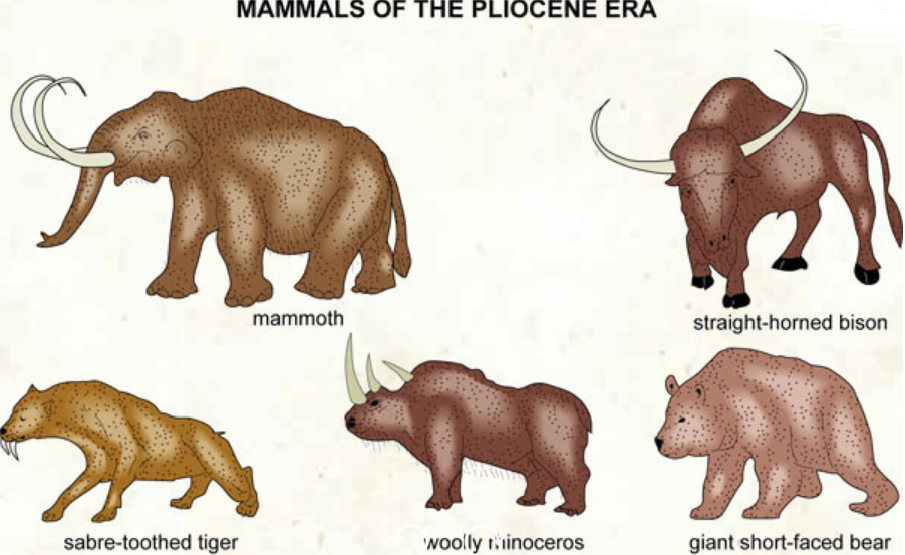
Paleontological evidences for evolution refer to the fossils. Fossils provide direct and solid evidence in favour of organic evolution thrugh ages. Fossils are studied for knowing about extinct organisms. Birbal Sahni Institute of Palaeobotany is situated at Lucknow. Birbal Sahni is called ‘Father of Indian Palaeobotany’. Age of fossils is determined by Uranium-Lead method (U238) or Potassium-Argon method or Radioactive Carbon dating (C14). ESR (electronspin - resonance method) is the most accurate method of dating of fossils.